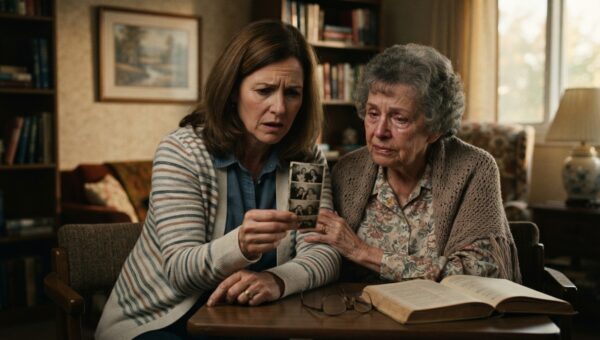
Three weeks. That was all the time it took for my own flesh and blood to decide I was no longer a person with rights, but a piece of property to be managed and disposed of. My right leg was still locked inside a heavy fiberglass cylinder from the ankle to the upper thigh, pinned together with three titanium plates and twelve steel screws after a drunk driver ran a red light on Broad Street.
I could not stand without help. I could not carry a cup of coffee across the kitchen without spilling half of it on my sweatpants. I was dependent, vulnerable, and sitting right in the middle of my mother’s dining room when she decided to cash out my life.
The house smelled like pot roast and old lemon polish, the exact same scent it had carried every Sunday since I was a little girl. My mother, Clara, always insisted on the Sunday roast, even after my father passed away and left her rattling around the brick rancher by herself. She liked the rhythm of it. She liked the feeling of being the anchor holding everybody together, though the only person she ever truly held onto was my younger brother, Wesley. Wesley was thirty-four years old, lived in a converted garage behind a bowling alley, and had spent the last decade drifting from one half-baked business scheme to another.
He had charm enough to borrow money from friends and just enough laziness to never pay it back.
I had spent those first three weeks post-op living on her pull-out sofa because my own apartment had a flight of wooden stairs I could not navigate on crutches. I thought she was being a mother. I thought the endless soup bowls and the folded washcloths meant she still remembered what it was like to care about her children equally. I was wrong about that. I was wrong about almost everything.
The mail had come around eleven that morning. A thick, official-looking manila envelope from the insurance adjusters, bearing a window that showed my full name and the exact figure we had fought six months to secure. Forty-eight thousand dollars. It was the payout for the wages I lost while recovering, the physical therapy bills that insurance balked at, and the permanent metal hardware fused to my tibia.
I laid the envelope on the kitchen island, figuring I would call my bank on Monday morning to set up a direct deposit into my own separate account.
Mama took it before I could reach for it. She did not ask. She just slid her thumb under the paper flap, tore it open, and unfolded the check with the easy familiarity of someone sorting junk mail.
“You won’t be needing to worry about all this banking business right now, Bethany,” she said, her voice dropping into that sweet, sugary register she only used when she was about to take something from me. “Your head is still foggy from the pain pills. Wesley and I were just talking about how to invest this so it actually does some good.”
She did not wait for an answer. She picked up the cream-colored slip of paper, the one with my name typed neatly across the payee line, and slid it straight across the polished maple table toward my brother.
Wesley reached out and caught it with two fingers, his eyes lighting up like a kid at a carnival. He did not look at me. He looked down at the numbers, grinning like he had just hit a jackpot on a scratch-off ticket.
“Wesley still has a future,” Mama said. She said it very clearly, looking right down at the aluminum tips of my crutches resting against the table leg.
The room went dead quiet. You could hear the old Seth Thomas clock ticking on the wall behind the pantry door, counting off the seconds while my brain tried to process what I was hearing. She was not talking about medical bills. She was not talking about my physical therapy or my rent. She was telling me, to my face, that my pain was just capital for Wesley to spend on his next foolish venture.
My first instinct was to scream. I wanted to grab the ceramic gravy boat and throw it across the room. I wanted to stand up, let the bone in my leg snap if it had to, and tear that check out of Wesley’s greasy fingers. But something stopped me. A cold, heavy wave of clarity washed over me, numbing the panic and replacing it with something much sharper.
I kept my mouth shut. I reached down slowly, pretending to adjust the Velcro strap on my brace, and tapped the screen of my smartphone resting flat against my thigh. The little red recording light was already blinking in my voice memos app. I had turned it on the second Mama started going through my mail on the kitchen island. I had a hunch, a bad, itchy feeling that had been keeping me awake on that lumpy sofa, and my phone was quietly capturing every single word.
“She’s not in her right mind anyway, Mama,” Wesley muttered, sliding the check into his denim shirt pocket. “Look at her. She can’t even walk to the bathroom without crying. If she tries to handle this money, she’ll just lose it all on medical bills that aren’t even necessary.”
“Exactly,” Mama agreed, nodding while she cut herself another thick slice of roast beef. “We have to protect her from herself. That’s what family does.”
I did not say a word for the rest of dinner. I chewed my food slowly, swallowed when I had to, and smiled a thin, empty smile that neither of them noticed. They thought I was beaten. They thought the surgery had broken my spirit right along with my bone. They had no idea that every second of their arrogance was being digitized and stored away in three different cloud backups before the dessert plates were even cleared.
The next few days were quiet. Too quiet. Mama started calling our extended relatives, weaving a careful narrative about how the accident had scrambled my brains. She told my aunt Sarah that I was hallucinating pain, that I cried over nothing, and that I couldn’t remember what day of the week it was. She called my former boss at the insurance agency, pretending to be my concerned caregiver, suggesting I was medically unfit to return to work even after my leg healed.
I stayed on her sofa, playing the part of the helpless invalid. I let her bring me my meals. I let her sigh dramatically when she helped me into the bathroom. Every time she spoke to me with that patronizing, babying tone, I recorded it. When she left her phone on the kitchen counter while running errands, I used my own phone to photograph the text message chain between her and Wesley, where they discussed transferring the settlement funds into a joint account they controlled.
By day six, the trap was fully set. They believed they had won. They believed my silence was submission.
On day seven, the courier knocked on the front door at 9:42 in the morning. Mama was out at the pharmacy picking up my prescription refills. I was sitting at the kitchen table alone, nursing a cup of black coffee, when the heavy envelope landed on the doormat. I hobbled over on my crutches, picked it up, and walked back to the table.
The return address belonged to a local probate law firm downtown, a firm well-known for handling emergency conservatorships and estate management for elderly residents who had lost their faculties. My hands didn’t shake as I broke the seal. I slid out thirty-four pages of legal petition, formal affidavits, and medical evaluations.
I turned to the core of the document, where the statutory requirements for emergency guardianship had to be justified. There they were. Four specific, written lies signed under penalty of perjury by my own mother.
Lie number one: That I was suffering from severe post-traumatic cognitive disorientation and could no longer recognize family members.
Lie number two: That I had repeatedly attempted to leave the house barefoot in freezing weather, putting my physical safety in extreme jeopardy.
Lie number three: That I actively refused necessary medical care and physical therapy, threatening to remove my own surgical hardware with household tools.
Lie number four: That I was financially destitute, mentally incompetent, and entirely incapable of managing my personal injury settlement or bank accounts.
It wasn’t just about the forty-eight thousand dollars anymore. The check was just the down payment. The guardianship petition was a preemptive legal strike designed to lock down my entire life, freeze my bank accounts permanently, and retroactively legalize the theft of my settlement check by declaring me legally incompetent before I could even walk out of her house. If that petition had gone uncontested before a judge, Mama would have been appointed my legal guardian, Wesley would have had control of the funds, and I would have been trapped in that brick rancher or institutionalized in a care facility with no way to scream for help.
I read every single word twice. Then I folded the papers neatly, slid them back into the courier folder, and reached for my phone.
I didn’t call my mother. I didn’t call Wesley. I called Marcus Vance, an attorney whose office I remembered from a minor property dispute years ago. Marcus picked up on the third ring, his voice sharp and professional. When I told him I was sitting with an emergency guardianship petition and a stack of audio files proving premeditated fraud by my own mother, his tone changed instantly.
“Can you get to my office tomorrow morning?” he asked.
“I’ll be there,” I said. “Bring a flash drive.”
The next forty-eight hours moved in a blur of quiet efficiency. I spent Tuesday night organizing my digital evidence. I had eighteen separate audio recordings, time-stamped and geo-tagged, capturing Mama and Wesley coaching each other on how to fabricate the timeline of my mental decline. I had the text messages about the settlement check. I had the insurance deposit slips showing where the forty-eight thousand dollars had been moved into an account bearing both of their names without my signature.
Marcus didn’t just look at the evidence; he stared at it like a fisherman hauling in a prize marlin. He filed an immediate emergency motion to dismiss the guardianship petition with prejudice, attaching a comprehensive forensic digital exhibit that laid out the conspiracy in stark, undeniable detail. He also filed a motion for immediate restitution of the misappropriated funds, complete with a request for a temporary restraining order freezing Mama and Wesley’s joint account before the money could vanish into one of my brother’s phantom business ventures.
The court hearing was set for Friday morning at 10:00 AM in the county courthouse downtown.
Mama had no idea anything was wrong until Thursday night. She had brought me a bowl of canned chicken noodle soup, smiling that same thin, false smile, telling me how the probate court appointment was coming along and how everything was going to be for my own good.
“You’ll see, Bethany,” she said, patting my arm with a hand that felt like cold parchment. “Wesley and I are only doing this because we love you. You just focus on healing that leg.”
“I know, Mama,” I said softly, looking straight into her eyes. “Family is everything.”
She smiled, completely oblivious, and went to bed.
Friday morning, I didn’t wait for her to help me get dressed. I pulled on my jeans carefully over my leg brace, laced up my sneakers, and stood upright on my crutches. When Mama came into the kitchen dressed in her Sunday church suit, expecting to drive me to a doctor’s appointment, I handed her the carbon copy of the court summons Marcus’s office had served via email an hour earlier.
Her face didn’t turn pale like in the movies. It just went tight, the skin drawing hard across her jawbone as her eyes scanned the words *Emergency Motion to Dismiss Fraudulent Guardianship* and *Order for Restitution of Misappropriated Funds*.
“What is this?” she whispered, her voice losing all its sweet sugar. “What did you do?”
“You said Wesley has a future, Mama,” I said, my voice steady and cold as winter water. “Turns out, I have one too. And it doesn’t include either of you.”
We didn’t ride to the courthouse together. She and Wesley drove down in her Buick, arriving with panicked looks on their faces and a greasy-haired lawyer they must have hired at the last minute using a fraction of my stolen check.
The courtroom was quiet, smelling of old floor wax and dry paper. The family court magistrate, a sharp-eyed woman with silver hair pulled back into a tight bun, didn’t waste time on pleasantries. She looked at Mama’s attorney, then looked at Marcus, and finally opened the digital tablet Marcus had handed up to the bench.
For twenty minutes, the courtroom listened to the audio clips. They heard Mama’s voice clearly, planning how to isolate me. They heard Wesley laughing about how I wouldn’t know what hit me. They heard the exact moment they conspired to forge the incapacity claims.
Mama’s lawyer tried to object, stammering about family welfare and medical concern, but the magistrate cut him off with a single raised hand.
“Counsel, your client submitted four sworn affidavits containing statements that are directly contradicted by time-stamped digital recordings of her own voice planning the financial takeover of a dependent family member,” the magistrate said, her voice like ice. “This is not a guardianship proceeding. This is an attempted fraud upon the court.”
The ruling was swift and absolute. The guardianship petition was dismissed with immediate, permanent prejudice, meaning my mother could never file another such claim against me as long as she lived. The court ordered the immediate unfreezing and full restitution of my forty-eight thousand dollar settlement check, plus legal fees, transferred directly into a sole-name account under my exclusive control. Furthermore, the magistrate noted that the evidence met the threshold for criminal referral regarding perjury and financial theft, leaving the threat of prosecution hanging over Wesley’s head like a heavy sword.
Mama didn’t look at me when the gavel came down. She sat at the defense table with her hands folded tightly in her lap, staring straight ahead at the walnut wall, looking small and defeated in a way that didn’t feel like victory, but felt like the final, bitter end of an old debt. Wesley was already whispering furiously to his lawyer, panicking about what the restitution order meant for his empty bank accounts.
I walked out of the courthouse on my own crutches. The autumn air outside was sharp and clean, carrying the smell of exhaust and damp pavement from Main Street. Marcus walked me to the curb where a hired town car was waiting to take me to my new apartment, a quiet place on the third floor with an elevator and no family members within fifty miles.
I slid my newly issued, sole-name debit card into my leather wallet, feeling the stiff plastic snap into place against the lining. I got into the car, closed the heavy door against the noise of the city, and let out a long, slow breath that had been trapped in my chest for three long weeks. When I finally reached my new apartment, I unlocked the front door, stepped inside, and placed my crutches firmly beside the large living room window overlooking a bright, wide-open street where nobody could ever reach me again.