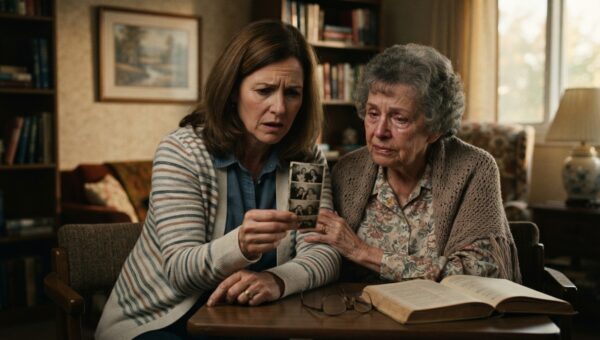
The cottage on Elm Street always smelled of peppermint and worn linoleum, a comforting scent that stayed the same through every season of my life. Walking through that front door last Christmas should have felt like coming home, but the air inside was dead and heavy. I dropped my canvas duffel bag by the entryway bench and called out, my voice echoing off the paneled walls.
There was no answering shuffle of slippers, just the faint, rhythmic hum of an ancient refrigerator fighting for its life in the kitchen.
When I found her sitting at the small round table, she looked like she had shrunk inside her own faded floral housecoat. Mom was seventy-eight years old, but the woman in that wooden chair possessed the frail, paper-thin skin of someone decades older. Her collarbones poked sharply through the thin cotton, and her hands trembled as she tried to smooth a napkin that was already flat. She didn’t look up right away when I stepped into the kitchen, and that absence of recognition hit me harder than a physical blow.
I didn’t think much of it at first beyond a dull pang of worry. I figured age was catching up to her faster than we realized, and I blamed myself for staying away too long on job sites across the state line.
I walked over to the refrigerator to pour her a glass of fresh water, but when I pulled the textured chrome handle, the sight inside stopped my breath cold. The shelves held a single yellowed head of iceberg lettuce, half a sleeve of saltine crackers, and a carton of whole milk that had expired nearly three weeks prior. Beside it sat six dented cans of store-brand corn, stacked in a neat little pyramid.
“Mom, are you only eating canned corn?” I asked, turning around with the milk carton still in my hand, my voice tight with sudden dread.
She gave a small, vague wave of her hand and offered a thin, apologetic smile that didn’t reach her cloudy eyes. “Brenda said it keeps well, dear. She does the market runs for me now.”
Brenda. My younger sister, who lived four hours south in a sun-bleached enclave of Lake Worth, Florida.
Brenda, who managed the family logistics spreadsheet and swore up and down at every Thanksgiving dinner that she was carrying the full weight of Mom’s golden years on her own shoulders. Brenda, who called twice a month to give glowing progress reports about doctor visits and fixed-income budgeting while I worked ninety-hour weeks laying commercial pipe three states away.
I checked the pantry. It was bare except for a box of expired oatmeal and a few stray tea bags. I checked the small ceramic jar on the counter where Mom used to keep emergency twenty-dollar bills for the paperboy. It was completely empty, coated in a fine layer of kitchen dust.
The weight of my own guilt turned sour in my throat, but beneath the guilt, a cold, hard knot of suspicion began to tighten. Mom’s pension from Dad’s railroad years, combined with her monthly Social Security distribution, came out to a steady, dependable sum.
It was more than enough for groceries, utilities, and the occasional prescription refill in a quiet town where the cost of living stayed stubbornly low. There was no earthly reason why my mother should be staring down a row of canned corn while living in a house she owned outright.
I didn’t argue with her then. I kissed the top of her thin gray hair, told her we were going for a proper drive, and bundled her into the passenger seat of my truck with a heavy wool blanket over her knees. I drove straight past the local diner and turned down Main Street toward the First National Bank of Limestone County, where my parents had banked since the Carter administration.
The bell above the heavy glass door jingled with a bright, cheerful chime that felt entirely out of place with the storm building in my chest. I helped Mom settle into a green velvet wingback chair near the loan officer’s desk before walking up to the teller window. Martha Jenkins, who had known our family since my Little League days, looked up from her keyboard with a warm, welcoming smile that faded the second she recognized my face across the counter.
“Well, hello there, Bryan. It’s been a minute. How is your mother holding up?” Martha asked, her hands resting flat on the mahogany ledge.
“She’s right over there, Martha,” I said, keeping my voice low and level, though my palms were slick against the wood. “I need to look at her account statements. All of them. For the last six years.”
Martha’s expression shifted from neighborly warmth to guarded caution. She glanced past my shoulder toward the corner where Mom sat staring quietly at a framed poster of local historical landmarks. “Bryan, you know the rules about privacy. Unless there’s a registered power of attorney on file giving you access, “
“I am her only living son, Martha, and she is sitting right twenty feet away in a coat that smells like mildew,” I cut her off, the edge in my voice carrying over the low hum of the lobby. “Look at the screen. Just look at the monthly activity. Something is wrong.”
Martha hesitated, her fingers hovering over the keys. She knew me, and she knew the family history. Without another word, she turned back to her terminal, typed a short sequence, and watched the monochrome screen reflect in her bifocals. The silence in the lobby dragged on for what felt like hours, punctuated only by the distant ticking of a wall clock.
When Martha finally looked back up at me, all the color had drained from her face. Her lips were pressed into a thin, white line.
“Bryan,” she whispered softly, leaning in close across the counter so the teller next to her wouldn’t overhear. “You need to look at this routing trail. For six years. Every single month without fail.”
She swiveled the monitor toward me. I stared at the neat rows of digital ledger entries, my brain refusing to process the numbers at first. It looked like a foreign language written in green phosphor. Then the totals registered in my mind, and the room seemed to tilt sideways.
$151,200.
That was the grand total siphoned out of Mom’s primary savings and checking accounts since Brenda took over the paperwork back when Mom’s mild forgetfulness first started showing. But it was where the money went that made my stomach drop into a bottomless pit.
Every month, $300 stayed in Mom’s account to cover her basic utility bills and whatever sparse supplies kept her quiet. The remaining balance, thousands of dollars every single thirty-day cycle, was systematically swept out via automatic electronic transfer. The destination account routing number wasn’t local. It belonged to a mortgage escrow account at a branch in Palm Beach County, servicing a spacious, modern single-family home with a white tile roof and an in-ground pool located at 414 Biscayne Way in Lake Worth, Florida. A $340,000 property purchased squarely in Brenda’s name.
I didn’t shout. I didn’t slam my fist on the counter. I just stood there because my brain kind of stopped working for a second, feeling the cold reality of what my sister had been building under the guise of family devotion while our mother starved on canned corn.
“Thank you, Martha,” was all I managed to say. My voice sounded like gravel grinding together in an empty bucket.
I walked back over to Mom, helped her up with a gentle hand under her elbow, and walked her out to the truck. I settled her into the cab, rolled the windows down an inch for fresh air, and then walked around to the driver’s side. Instead of getting in, I pulled my cell phone from my jacket pocket, hit speed dial, and let it ring until Brenda picked up on the third note.
“Bryan? Hey! I wasn’t expecting you to call until New Year’s,” Brenda’s voice trilled through the speaker, bright and rushed, no doubt interrupted in the middle of some comfortable household chore in Lake Worth. “Is everything okay with Mom? I sent her grocery money last week.”
“I am standing in the parking lot of the First National Bank in Limestone County, Brenda,” I said, every word clipping off my tongue like dry ice. “I just looked at her ledger. For six years. One hundred and fifty-one thousand, two hundred dollars.”
There was a sharp intake of breath on the other end of the line, followed by a heavy, metallic silence that stretched out for ten long seconds. When Brenda spoke again, the bright sisterly act had vanished entirely, replaced by a defensive, hard-edged snap.
“Mom doesn’t need that money bry. She barely goes anywhere,” Brenda said, her tone dripping with aggrieved justification as if she were lecturing a slow-witted child.
I gripped the steering wheel so hard my knuckles turned translucent under my skin, staring out across the sun-bleached asphalt toward the highway where transport trucks roared past.
“She barely EATS,” I shouted back, the fury finally breaking through the ice in my chest. “You’re starving her to pay the mortgage on a three-hundred-thousand-dollar house in Florida, you selfish thief.”
“You don’t understand how things work down here!” Brenda shrieked back, her voice cracking with sudden panic. “I’m the one who answers the phone calls! I’m the one who deals with her doctors! She wouldn’t even know what to do with that cash! It’s better off, “
I didn’t let her finish. I thumbed the red disconnect button, cutting her off mid-sentence. My hand was shaking so badly I dropped the phone onto the passenger seat rubber mat before I managed to scoop it back up.
The next few hours moved in a blur of cold, hard purpose. I drove Mom straight to Dr. Henderson’s office, where our old family physician took one look at her frail frame, ordered an immediate blood panel, and listened with a grim, tight-lipped expression as I laid out the bank records on the corner of his examination table.
“This isn’t just neglect, Bryan,” Dr. Henderson said, adjusting his glasses as he looked over the lab slips. “This is systemic physical decline caused by deliberate malnutrition. We need to act right now.”
I didn’t go home to the Elm Street house. Instead, I drove to the county courthouse and walked into the second-floor office of Adult Protective Services, carrying the bank printouts, the grocery receipts, and a determination that burned hotter than any anger I had ever known.
That was how I met Marcus Vance. Marcus was an APS senior investigator with quiet eyes and a voice that sounded like river gravel. He didn’t blink when I handed him the stack of bank statements showing the monthly wire transfers down to Lake Worth. He didn’t waste time offering empty sympathies or telling me how hard family betrayal was. He just pulled a yellow legal pad toward him, uncapped a black ballpoint pen, and started taking names, dates, and routing numbers.
“If she’s been siphoning this much for six years without Mom ever authorizing large cash withdrawals, there has to be legal cover,” Marcus said, tapping his pen against the desk. “A durable power of attorney. Check the county registry. Someone had to sign off on giving her full control of the financial accounts, or the bank wouldn’t have allowed automated escrow sweeps for that long.”
“I never signed anything,” I said immediately, leaning forward across the metal desk. “Mom never mentioned signing anything either. She barely knew what day of the week it was by year three.”
“Let’s pull the jacket,” Marcus replied, already reaching for his desk phone.
Three days later, Marcus called me back into his office. He didn’t look triumphant; he looked grim, the way a man looks when he pulls a dead weight out of a deep well. He slid a certified copy of a durable power of attorney across the desk toward me. It was stamped with an embossed seal from a notary public in a neighboring county, a notary who had since retired and moved out of state.
At the bottom of the document, right above the notarization stamp, was a signature line bearing my name.
My breath caught in my throat. I stared at the looping, unfamiliar script that purported to be my hand. It looked like a clumsy imitation drawn by someone who had glanced at my driver’s license signature once while distracted.
“That’s not my signature,” I whispered, my voice dropping to a harsh rasp. “I was working pipeline construction in Louisiana when this was notarized. I wasn’t even in the state.”
“I know,” Marcus said quietly, tapping the corner of the paper. “Your sister brought this in six years ago during a hospital visit when your mother was admitted for a mild bout of pneumonia. She slipped your name onto the proxy consent stack along with medical authorization forms. She had a private acquaintance stamp it without verifying identity in person. It’s textbook elder financial exploitation wrapped in forgery.”
The pieces fell into place with the cold, heavy click of a deadbolt sliding home. That hospital visit six years ago. Brenda had handed me a clipboard in the waiting room while I was half-asleep from a double shift, telling me to sign my name on the dotted line so we could get Mom admitted faster. I had trusted her. I had signed the top page without reading the fine print tucked underneath, believing my own sister had our mother’s best interests at heart.
That single stroke of a pen had signed away the financial safety net Mom had spent a lifetime building.
Two weeks later, the operation moved with the precision of a state machine. Marcus Vance coordinated with local law enforcement in Lake Worth, Florida, while I arranged for Mom to be safely transferred to a bright, secure assisted living facility in Huntsville where she could receive proper nutrition, daily medical monitoring, and a warm room overlooking a garden full of blooming azaleas.
The day the formal notice of investigation and asset freeze was served on the house at 414 Biscayne Way, my phone rang for the first time in weeks. I let it ring twice before I answered, pressing the receiver to my ear while standing in Mom’s new sunlit room as she happily spooned up a warm bowl of vegetable chowder with a nurse sitting gently beside her.
“Bryan? You have to call them off,” Brenda’s voice was hysterical, thin and panicked, background noise echoing against the hard tile floors of her Lake Worth living room. “They’re freezing my accounts! They’re saying the house is subject to restitution liens! How could you do this to your own sister over a few old banking technicalities?”
I looked down at Mom. She didn’t look at my phone; she looked at the fresh bouquet of yellow roses sitting on her bedside table, her shoulders visibly relaxed for the first time in six years, her frail hand resting securely and safely in mine without an ounce of fear or scarcity left in her eyes.
“You left her with canned corn, Brenda,” I said into the phone, my voice steady, quiet, and final. “Now you can explain to a judge how you managed a three-hundred-thousand-dollar mortgage on stolen money.”
I ended the call, slid the phone into my pocket, and sat down in the upholstered chair beside the bed, listening to the quiet, peaceful rhythm of my mother breathing easy in the sunlight.