Mr. Kessler asked me to help him die at home. I am his neighbor, not his nurse, but I spent thirty years working the floor at St. Jude’s, and he has no one else left in this world. His son David has been estranged for ten years. Mr. Kessler told me on the very first day I crossed his threshold to check his pillows: “Don’t call David.” Every afternoon since then, David has called my personal phone.
Every single day. He asks how his father is doing, and his voice always sounds polite and desperate and right on the edge of trying not to cry. His father does not even know David calls. Last night David mailed a physical letter to my address, and it sits on the kitchen table right now, unopened. Mr. Kessler is sleeping more now, breathing with that shallow, rattling hitch that nurses recognize down to their bones. The hospice nurse told me this morning that we have forty-eight hours, maybe less. The letter is next to the phone. David will call again at four o’clock. Mr. Kessler told me not to answer. At four o’clock I will either pick up the phone or I will let it ring into the quiet house.
Arthur Kessler used to keep his lawn so sharp you could cut yourself on the edges of it. Back when my husband Jim was still around to complain about the price of fertilizer, we used to look across the chain-link fence and joke that Arthur probably measured his grass with a ruler.
But Jim has been gone five years now, and Arthur’s lawn has gone to seed, patchy and brown in spots where the hose never reached.
When Arthur got the diagnosis back in August, stage four lung cancer that had already crawled up into his neck, he didn’t call an agency. He knocked on my back door at seven in the morning wearing a flannel shirt that hung off his shrinking shoulders like an old feed sack.
“Marta,” he said, and he didn’t look at my face, just at the screen door mesh. “I hear you got the pension. I need someone who knows how to change sheets without rolling a man over like a sack of potatoes.”
“Arthur, you have family,” I told him, wiping flour off my hands onto my apron.
“I have nobody,” he said, and his jaw set hard as river stone. “You help me here, till the end. And you swear to me right now. You don’t call David.”
I should have pushed back. Thirty years in nursing teaches you how to smell a family feud a mile away, and you usually stay out of the kitchen when the grease is flying. But Arthur looked so small standing on my porch, smaller than a man who used to haul timber for the county line, so I nodded. I agreed to his terms. I became his keeper, his cook, and his jailer.
Every afternoon at 3:58, I wash my hands at the kitchen sink and wait. At exactly 4:00 PM, my cell phone buzzes against the oilcloth table. It is always David.
“How is he today, Marta?” David asks. He always starts with that same stiff, polite sentence, like he is calling a business office.
“He’s resting, David,” I say, keeping my voice level because I am standing ten feet from Arthur’s bedroom door. “He ate a few spoonfuls of broth at noon. He’s holding on.”
“Does he… does he mention me at all?” David asks, and that is where his voice always thins out, catching on something rough in his throat.
“You know how your father is,” I tell him, and I hate myself every time I say it. “He’s stubborn. He’s quiet.”
“I just want to talk to him for one minute,” David pleaded yesterday. He was shouting over the sound of traffic in the background, probably calling from some parking lot in Columbus where he works. “Just one minute, Marta. Tell me if he’s dying.”
“I have to go, David,” I whispered, and I hung up before he could answer.
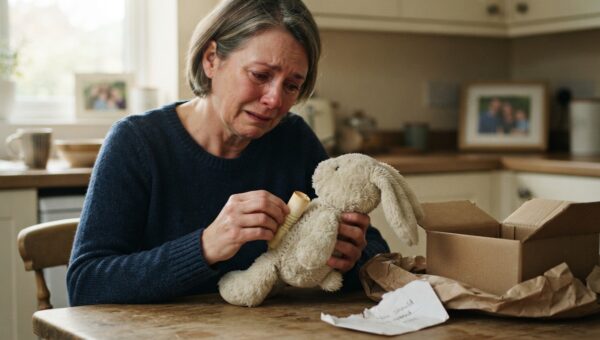
Then last night, a mail truck rattled down our gravel road around six o’clock, stopping at my box instead of Arthur’s because Arthur’s box has been rusted shut since the spring. I went out in my slippers to get it. Inside the small stack of circulars and electric bills was a heavy, cream-colored envelope addressed to my name in sharp, angular handwriting that looked nothing like Arthur’s trembling scrawl. I brought it inside, set it on the kitchen table beside the salt shaker, and stared at it until the sun went down behind the neighbor’s barn.
Brenda, the hospice nurse, came by this morning at nine. She is a no-nonsense woman with silver hair cropped close to her skull and a clipboard that she taps against her thigh when she is thinking. She checked Arthur’s pulse, listened to his chest with her stethoscope, and then pulled me out into the tiny hallway.
“He’s slipping into the terminal phase, Marta,” Brenda said quietly, checking her watch. “His kidneys are starting to shut down. He might not make it through tomorrow night.”
“Does he know?” I asked.
“Body knows before the mind does,” Brenda said, sliding her stethoscope into her canvas bag. “Sometimes people hold on because they’re waiting for permission. Sometimes they hold on because they’re scared of what they left behind. Either way, you keep him comfortable. You’re doing fine.”
She left through the front door, letting the screen slam just enough to rattle the glass. I went back into Arthur’s room. He was lying on the narrow hospital bed we had rented, his gray hair plastered to his forehead with sweat, his mouth slightly open. He looked like an old photograph left too long in the sun, faded around the edges.
“Arthur?” I said softly, laying my hand over his cool, dry wrist.
He didn’t open his eyes, but his thumb twitched against the sheet, a faint, blind motion of defense. He didn’t want comfort. He wanted his pride. He wanted to die the way he lived, alone behind a barricade of his own making.
I went back to the kitchen and sat down at the table. The cream-colored envelope was still there, mocking me with its clean, expensive paper. I picked it up. My thumb caught the flap. Arthur was sleeping down the hall, lost in the heavy haze of morphine and failing organs, and for ten years these two men had lived thirty miles apart because neither one of them knew how to say they were sorry.
I slipped my finger under the glued flap and tore it open.
Inside was a single sheet of heavy bond paper, folded once. David’s handwriting filled the page, dense and uneven, as if he had written it late at night sitting at a kitchen table just like this one.
*Marta,* it began. *I am writing this because I know my father won’t let me through the door. I don’t know if he’s told you why we stopped speaking, or if he’s told you his version where I’m the one who walked away and never looked back. Ten years ago, the night my mother died, I tried to tell him we needed to sell the house. It was too big, too full of ghosts for him to rattle around in alone. I thought I was helping him breathe. But he looked at me like I had spat on her coffin. He told me I was dead to him, that I wanted to clear her things out before her body was even cold. I was angry, and I was proud, and I walked out that door and drove away.*
My chest tightened as I read the lines, each word dragging a heavy weight behind it.
*I’ve spent ten years driving past his turnoff on Route 42,* David continued. *I’ve sat in my car outside the diner down the road, watching his truck sit in the driveway, wondering if this was the week he’d finally call. I didn’t care about the house. I just wanted my dad back. If he’s dying, Marta, please tell me. Don’t let him die hating me for something I said when my world was ending too.*
I sat there at the table with David’s letter in my hand, and the silence in the house felt heavier than any hospital ward I had ever walked through. Arthur’s rule wasn’t about protection. It was about fear. He was terrified that if he let David in, he would have to admit he was wrong, and an old man with a ruined body has nothing left to hold onto except his stubbornness.
The kitchen clock on the wall gave a loud, metallic tick.
It was 3:55 in the afternoon.
I got up from the table, walked down the hall, and checked on Arthur. He was breathing with a slow, rattling sigh, his chest barely rising beneath the thin blue blanket. He looked smaller than he had this morning, his skin taking on that gray, translucent look that comes right before the end. He wasn’t going to last forty-eight hours. Brenda was wrong; he had tonight, maybe tomorrow morning, but the tide was already going out.
I walked back to the kitchen and stood by the phone.
At exactly 4:00 PM, the screen lit up with David’s name and his cell number flashing against the dark glass.
The phone buzzed once against the Formica. Twice.
Arthur’s rule was clear. *Don’t call David.* He had made me swear it on my own mother’s grave, leaning on my nursing ethics, playing on my sympathy for a dying neighbor who wanted to slip out of the world without a fuss.
The phone vibrated again, a sharp, buzzing hum that seemed to shake the whole kitchen table.
I didn’t let it go to voicemail. I reached out, picked up the receiver, and pressed the green button.
“Marta?” David’s voice came through the speaker instantly, shaking and thin. “Is he okay? Is he still here?”
“David,” I said, and my own voice sounded raspy, like I hadn’t spoken all day.
“Marta, what’s wrong? Is he gone?”
“He’s still here,” I said, looking down at the open letter on the table. “He’s sleeping. But you need to listen to me very carefully.”
“I’m listening,” David whispered.
“I read your letter,” I told him, and I didn’t care anymore about Arthur’s rules or my promises or what the old man would say if he woke up right now. “And you need to get in your car right this second. Drive. Do not stop for gas, do not wait. You drive straight here.”
“Is he… is he conscious?” David’s breath hitched on the other end of the line.
“He’s slipping away, David,” I said, tears finally breaking hot down my cheeks. “He has maybe twelve hours, if that. But he’s breathing. He’s right down the hall. Come now.”
“I’m on Route 42,” David said, and I heard the sharp click of a car door opening and an engine roaring to life over the speaker. “I’m twenty minutes away. Marta… don’t let him go before I get there.”
“I’ll keep him here,” I said. “Just drive.”
I hung up the phone and set it back on the table beside David’s letter.
Twenty minutes. In the grand scheme of ten years, twenty minutes was nothing. But in the final hours of a dying man’s breath, it was an eternity.
I walked back down the hall and pushed Arthur’s bedroom door open. The room smelled of old linen and rubbing alcohol. I pulled a chair up right beside his narrow hospital bed and sat down, folding my hands in my lap.
Arthur didn’t move. His chest rose, hitched, and fell again.
“Arthur,” I said softly, leaning in close so he could hear me beneath the rattle of his breathing. “David’s coming.”
The old man’s eyelids fluttered, a tiny, involuntary twitch of muscle against bone. For a second, I thought he was going to roar at me, to summon whatever strength he had left to curse me out for breaking my word. His brow furrowed deep, lines of old stubbornness etching themselves into his forehead.
“It’s okay,” I whispered, reaching out to take his cold, spotted hand in mine. “It’s time to put it down, Arthur.”
He didn’t answer. He just let out a long, shuddering exhale that seemed to empty out the last ten years of fight from his chest.
I sat there in the quiet room, watching the headlights sweep across the front window as a car turned down our gravel road, crunching slowly over the stones until the engine cut out in the dark.