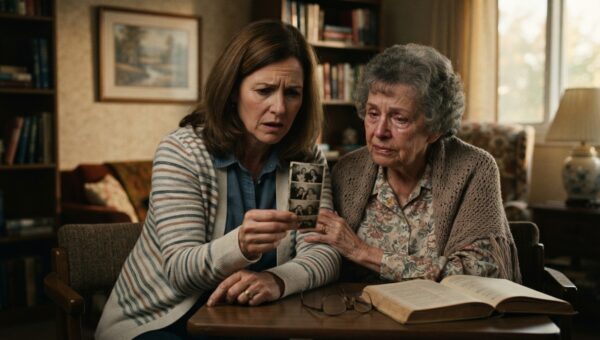
The laminate kitchen counter in my house has a small grease stain right near the kettle where I spilled beef broth back in November, and for weeks I kept looking at it instead of packing my bags for Franklin. Clara was getting married in June. She was twenty-four, with hair the color of sweet corn and a stubborn streak she must have inherited from both sides of the family.
When she asked to wear Mama’s wedding dress from 1954, I dropped the dish towel.
Mama was eighty-nine then. Her hands looked like pale dry leaves, but they still knew how to hold a needle without shaking too hard. When Clara brought the dress down from the cedar closet in the spare room, Mama sat on the edge of the floral sofa and touched the hem the way people touch old photographs of children who grew up and moved away. She didn’t say a word for nearly a full minute. Then she cried. It was a quiet sort of crying where her shoulders barely moved, just two thin tracks cutting down through the powder she always wore to church.
The dress was ivory silk organza with a high lace collar and tiny seed pearls stitched one by one down the back placket. Mama had taken it in three inches at the waist so it fit Clara like it was sewn that very morning in May.
Tyler, the boy Clara was marrying, had a mother named Evelyn who flew in from Chicago with three heavy leather suitcases and a voice that could carry over a church choir. Evelyn didn’t like Franklin. She didn’t like the heat, she didn’t like the church pews, and she certainly didn’t like the idea of her only son marrying a girl from a town where people still waved at mail trucks.
“We can certainly find something more modern for the pictures, darling,” Evelyn had told Clara over lunch at the diner three weeks before the wedding. She said it with that polite, tight smile that didn’t reach her eyes. “A young woman should look like she belongs in this century, not an estate sale.”
Clara had just smiled back, her fingers tracing the edge of her water glass. “I love the dress, Evelyn. It’s the only one I want.”
The reception was held at the brick-paved pavilion behind the old mill in Franklin.
String lights were strung across the cedar beams, and the tables were heavy with fried chicken, green beans cooked with salt pork, and silver trays of biscuits. It cost what it cost, but Tyler’s family had paid for the venue and the caterer because Evelyn made sure everyone knew she liked things done properly. My husband, Robert, had passed away three winters ago, so it was just me and Mama sitting near the head table, watching Clara and Tyler cut the first piece of lemon cake.
Evelyn sat two seats down from me, her silk dress the color of a bruised plum. She had spent the evening picking at her shrimp cocktail and checking her platinum watch every ten minutes as if the band were keeping her from something important. I watched her lean across the white linen tablecloth toward her sister, Pat, who had flown in from Peoria with the same sharp chin and the same habit of looking at people as though they owed her twenty dollars.
I was close enough to hear every word over the clatter of silverware. “Well, it’s a LOOK, isn’t it,” Evelyn murmured, her voice dripping like cold grease. “A secondhand dress at a wedding we paid this much for. I suppose when you come from nothing, you wear nothing proudly. I just hope it’s been CLEANED.”
Pat snorted right into her champagne flute, a sharp little bark that sprayed a few drops onto the tablecloth. “Honestly, Evelyn, I didn’t want to say anything, but the hem looks yellowed under the flashlights. You’d think they could have afforded dry cleaning.”
My chest went tight, the way it always did when Robert used to get that cough that wouldn’t clear. I looked over at Mama. She was three seats down, her small frame lost in her navy church dress. I saw her hands go still on her linen napkin. They didn’t shake. They just folded themselves together, patient as church on a Tuesday morning. Mama didn’t answer them. She didn’t look up or frown. She just turned her head back toward the dance floor where Clara was laughing at something Tyler had whispered in her ear, and she complimented the arrangement of white peonies in the center of our table, calm as could be.
“These flowers are lovely,” Mama said to me, her voice thin but steady. “The hydrangeas are holding up well in this damp air.”
I couldn’t swallow my water. My throat felt like sandpaper. “Mama, don’t pay them any mind. Evelyn doesn’t know anything about anything.”
“People who talk about where others come from usually haven’t gone very far themselves,” Mama murmured back, staring down at her lap.
The band took a break right around eight o’clock. The lead singer, a local boy named Bobby who usually played weddings and fish fries, laid his guitar against the amplifier and walked over to the soundboard to switch out a cable. The room was loud with the hum of a hundred people talking at once, the clinking of ice in glasses, the scraping of chair legs against the brick pavers.
Mama stood up. It took her a second to get her balance on the uneven floor. I reached out to steady her elbow, but she waved me off gently, her fingers light against my wrist. She walked past Evelyn without even turning her head, her black orthopedic shoes clicking softly on the stone. She didn’t look like an old woman who was tired. She looked like she had somewhere very important to be.
She walked straight up to the bandstand where Bobby was fiddling with his microphone stand. I saw her say something to him, her chin tilted up just enough for him to hear over the room noise. Bobby looked down at her, blinked twice, and then nodded, his face going sort of soft and respectful the way young men around here get when they talk to their grandmothers. He unhooked the black metal microphone from its stand and handed it over.
Then Mama reached into the black leather handbag she carried everywhere, the one with the brass clasp that always stuck if you didn’t press it just right. She took out a small, flat box wrapped in faded tissue paper. It was an object I have never once seen in my sixty years as her daughter. It wasn’t large, maybe the size of a deck of cards, but the way she held it in her palm was different from how she held anything else. She held it like it was heavy, or maybe like it was breakable in a way that couldn’t be fixed with glue.
The room didn’t go quiet all at once. It happened in ripples. A table in the back stopped talking, then the bartenders stopped shaking their tins, and finally even Evelyn stopped complaining about the air conditioning. By the time Mama tapped the metal grille of the microphone with her fingernail, a sharp, hollow *tink-tink* that rattled through the overhead speakers, you could hear the crickets in the grass out behind the mill.
Mama looked out across the tables, her eyes small and bright behind her wire-rimmed glasses. She didn’t look angry. She looked like she was inspecting a row of seedlings after a late frost. She looked straight at Evelyn, who had paused with a fork halfway to her mouth, her eyebrows pulled together in a sharp, irritated V.
“Good evening,” Mama said. Her voice didn’t shake. It was clearer than it had been at dinner. “I’m Eleanor Vance. Clara’s grandmother. And I understand there’s some confusion about where that dress came from.”
Evelyn dropped her fork. It hit the china plate with a sharp *clack* that made several people jump.
Mama adjusted the microphone in her hand, the wire rattling against the front of her navy dress. “Mrs. Miller was so kind to mention that the family came from nothing,” Mama continued, her tone conversational, almost light, the way she used to talk when she was explaining how to hem a wool coat without showing the stitches. “And she’s half right. In nineteen fifty-four, when I was twenty-two years old, I didn’t have much money in the bank. My father had lost his truck in the flood of fifty-one, and my mother was working three days a week at the laundry in town just to keep the stove burning through December.”
Evelyn’s mouth opened just a fraction, her face flushing a dull, muddy red under the yellow glow of the string lights. She tried to say something, but no sound came out past her teeth. Her sister Pat was staring down at her water glass as if it had suddenly turned into a snake.
“I didn’t come from money,” Mama said, and the silence in the pavilion grew so heavy you could hear the fat dripping from the barbecue pits fifty yards away. “But I had two hands and I knew how to use them. For four years, from the time I was nineteen until the day I married Robert in that little clapboard church on Mulberry Street, I worked sixty hours a week as a head seamstitcher at the Parisian Atelier down in Nashville. I didn’t buy that dress off a rack, Mrs. Miller. I designed every seam of it. I cut the silk myself from three bolts of imported French organza I saved three months of wages to buy. Every single one of those seed pearls along the back was hand-set by me, working by the light of a single kerosene lamp after the laundry shifts ended because we didn’t have electric power in the back room yet.”
Clara was standing near the edge of the dance floor now, her hands pressed over her mouth, her eyes wide and shining with tears she didn’t bother to wipe away. Tyler stood right beside her, his shoulders stiff, his face burning red as he looked from his mother to my mother on the stage.
Mama didn’t raise her voice. She didn’t have to. Every word dropped into the quiet space between the tables like a heavy coin hitting a wood floor.
“When people spend money they didn’t earn on things they didn’t make, they sometimes forget what real value looks like,” Mama said, her voice dropping an octave, steady and cold as well water. “They think a price tag is the only thing that gives a garment a history. But I’ll tell you something about this dress. It wasn’t secondhand when I wore it, and it wasn’t secondhand when my daughter wore it twenty-eight years ago, and it certainly isn’t secondhand today. It is a custom-made, one-of-a-kind couture piece built with three hundred hours of honest labor and enough love to last seventy years. And I am proud to see my granddaughter wearing something that wasn’t bought with someone else’s comfort.”
Mama reached down with her left hand, her fingers clumsy with the old paper tape, and peeled back the faded tissue on the flat box she had carried up in her purse. She lifted out a small object that caught the amber light of the lanterns, a pristine platinum-and-pearl pendant, shaped like an oak leaf with a single teardrop pearl dangling from the stem.
“Mr. Arthur Sterling, who owned the atelier back then, gave me this on the morning of my wedding,” Mama said, looking directly down at Evelyn, who looked smaller now, shrunk down into her plum-colored silk. “He told me that a girl who could stitch like that deserved something that wouldn’t tarnish when the weather turned. I kept it in the dark for sixty years because I was saving it for a bride who knew the difference between the price of something and what it actually cost.”
Mama turned her head, looking past the tables to where Clara stood frozen in the candlelight. “Clara, honey. Come up here a minute.”
Clara didn’t hesitate. She lifted the heavy ivory skirts of the dress in both hands, her heels clicking softly against the bricks, and walked up the three wooden steps to the bandstand. The crowd started clapping then, slow at first, just a few people near the bar, then a rolling wave of sound that filled the pavilion until the rafters seemed to shake. It wasn’t polite wedding applause. It was the kind of noise people make when they’ve seen something true and they want the person who said it to know they heard every syllable.
Mama didn’t smile as Clara reached her. She just reached up with those old, dry fingers, the ones that had spent sixty years mending shirts and sewing hems, and she opened the little clasp of the platinum chain. She fastened it around Clara’s neck, right where the high lace collar of the 1954 dress met her throat. The pearl rested against the ivory silk like it had been waiting there since Eisenhower was in office.
“There,” Mama said, her voice just loud enough for the microphone to catch before she switched it off with a dry click. “That looks right.”
She handed the microphone back to Bobby, who was grinning so hard his cheeks looked like they’d split, and she walked back down the steps without looking at Evelyn’s table once.
Evelyn stayed in her seat for the rest of the night. She didn’t dance. She didn’t talk to her sister. She sat there with her wineglass half-full, staring straight ahead at the brick floor as if she were trying to memorize the pattern of the mortar. When Tyler came over to her table around ten o’clock to say goodnight before the sparklers, he didn’t touch her shoulder. He just looked down at her with a flat, cold look I had never seen on the boy before, and he said three short sentences that everyone at the adjacent tables heard quite clearly.
“We’re leaving now, Mother,” Tyler said, his voice level. “You can call a cab to the hotel whenever you’re ready. Don’t wait up for us.”
He didn’t wait for her to answer. He turned on his heel and walked back to where Clara and I were standing by the edge of the lawn, waiting to help pack the rest of the cake into the boxes.
The party went on after that. The band played an old Hank Williams song, and the string lights hummed in the dark, and the smell of pine and fried chicken drifted off into the Kentucky hills where the cicadas had started up their late-summer roar.
At midnight, when the last of the cars had bumped down the gravel drive and the folding chairs were stacked against the back wall of the pavilion, the three of us walked back toward the old Dodge idling by the gate. Clara was still wearing the dress, the ivory silk gathered up in her arms so the hem wouldn’t drag in the dust.
Mama sat in the passenger seat, her small black handbag resting flat on her knees, her breath coming a little shorter now that the excitement had drained out of her bones. I walked around to open her door, but she reached out first and pressed her palm against the frosted window glass.
Outside, the moon was just clearing the top of the grain elevator down by the tracks, throwing a long, sharp silver line across the hood of the car. Mama reached down and smoothed the front of her navy dress with one hand, her fingers resting right there over the place where the small flat box had lived for an hour, before she turned her head and looked out into the dark.