Twelve years.
That was the exact number of calendar pages I had torn off the kitchen wall while telling myself that things would get better once Mark’s business finally turned a corner. We had not taken a single night away from home since our fifth anniversary in some cheap motel outside St. Louis. Every time I brought up a weekend trip to see my sister in Ohio or even just a couple of nights down by the lake, Mark would rub the back of his neck, look at the worn linoleum, and talk about cash flow.
He would explain how the lumber yards were raising their rates again, how the county inspectors were holding up his commercial bids, and how we had to watch every single penny if we wanted to keep the roof over our heads. I believed him because he looked tired. He worked sixty-hour weeks, coming home with drywall dust in his hair and grease under his fingernails, smelling of cheap instant coffee and damp earth. I adjusted the grocery budget down every three months. I learned to stretch a five-pound bag of potatoes into four different meals. I told myself that marriage meant pulling together when times were lean.
The Tuesday afternoon sun was beating down hard on the windshield of Brenda’s sedan when Mark’s truck finally died out on County Road 9. Mark had called me around two o’clock, his voice tight and frustrated, saying his alternator had given out right outside the old feed store and he needed a ride back to the job site.
My car was in the driveway with a slow leak in the front tire, so I had called Brenda, whose husband worked the same crew. Brenda had offered to drive me out in her car without a second thought. She was a friendly, talkative woman who always had the radio tuned too loud and a box of mints rattling in the center console. I appreciated her company because the silence in my own head had gotten heavy lately. We drove out past the grain elevators, the engine humming a steady, rhythmic note against the gravel.
We picked Mark up by the side of the road. He was sweating through his gray work shirt, wiping his forehead with a rag, looking every bit the stressed-out small-business owner he claimed to be. He tossed his heavy tool belt into the trunk of Brenda’s car and climbed into the front passenger seat next to Brenda, muttering something about losing half a day’s labor.
I sat in the back seat, staring out at the flat soybean fields rolling past, listening to the two of them talk shop. After a few miles, Brenda glanced in her rearview mirror, catching my eye with a bright, easy smile that didn’t hold any weight behind it. She tapped the steering wheel with her fingernails and started talking about how she and her husband were trying to save up for a camper, which led her right into the conversation she had apparently been having with Mark earlier that week.
“I hope you enjoy Hawaii next month,” Brenda said, her voice carrying easily over the hum of the tires. “$4,200 for a week is a steal, honestly.”
The world inside that car didn’t explode or go black. It just stopped moving. I remember the exact texture of the gray seat fabric beneath my fingers, rough and slightly dusty from the road.
I stared at the back of Mark’s head, watching the way his neck stiffened instantly, his shoulders bunching up toward his ears like he was bracing for a blow.
I stopped breathing for three seconds. “Hawaii?” I said. My voice sounded thin, almost polite, like I was asking about the weather in another town.
Brenda glanced over at Mark, then back at me in the mirror, her smile faltering just a fraction before she pushed right through it with the oblivious enthusiasm of someone who thought she was sharing good news between friends. “Yes! Your husband told my husband he booked the tickets yesterday. First class all the way. I told Tom I was jealous because we haven’t been on a real plane since our honeymoon.”
Mark didn’t turn around. He stared straight ahead at the dashboard, his hands clamped tight into fists resting flat against his thighs. Twelve years. Twelve years of scraping together grocery money, of patching my winter coat with iron-on mending tape, of listening to him sigh over the electric bill while the kitchen heater clicked and sputtered in the dark.
I didn’t scream. I didn’t lean forward to grab his collar or demand an explanation right there in Brenda’s car. Something inside me simply turned to cold, hard iron. I forced a tight smile for Brenda’s benefit, nodding slowly as she kept talking about airline baggage fees and resort taxes. I watched the side of Mark’s face, noting the tiny muscle twitching right below his right ear. He knew he was caught, but he was trying to figure out which lie to tell first.
When Brenda dropped us off in our gravel driveway, Mark got out of the car without looking at me, grabbed his tool belt from the trunk, and headed straight for the garage. I thanked Brenda, waited until her sedan turned the corner past the old maple tree, and walked slowly up the wooden front steps. The house was quiet, smelling of floor wax and stale coffee. I walked past the kitchen counter where the unpaid water bill sat beside a coupon for laundry detergent.
I sat down at the small oak table in the dining room and pulled my phone out of my pocket. I opened our banking app, typing in our password with fingers that didn’t shake at all. I scrolled through the joint checking account, then the savings account we barely funded, and finally the small credit union share account we used for property taxes. Nothing. The balances were exactly what they had been that morning: a combined total of $314.52. There was no $4,200 transaction anywhere in our records. He hadn’t used our money from the joint accounts. Which meant he had money I didn’t know about.
I stood up and walked to the front door, opening the metal screen to check the mailbox. Inside sat three items: a grocery store circular, a coupon for carpet cleaning, and a heavy, cream-colored envelope addressed simply to Mark at our home address. The return address in the upper left corner belonged to a major national bank I had never seen him use.
I took the envelope back to the kitchen table, picked up a butter knife from the drawer, and slit the top edge open. Inside was a monthly billing statement for a credit card in Mark’s name alone, opened eighteen months ago with an address tied to a post office box down on Main Street. The balance was sitting at $4,850.12. The most recent charge, dated yesterday afternoon, was a single line item: Hawaiian Airlines, $4,200.00. First class. Two tickets.
I didn’t cry. Tears are for people who are surprised by cruelty, and by that afternoon, the surprise had already worn off, leaving behind a cold, clinical clarity. I pulled my phone back out and dialed the number for Hawaiian Airlines customer service listed on the back of the statement. When the automated menu started rattling off options, I pressed the buttons for corporate accounts and executive assistance, pitching my voice down into a steady, authoritative register that sounded nothing like the woman who asked for extra coupons at the grocery store.
When a human representative finally came on the line, I didn’t hesitate. “Good afternoon,” I said, keeping my tone smooth and clipped. “This is assistant services calling on behalf of Mr. Mark Miller. We need to verify the seating arrangements and confirmation numbers for our upcoming Honolulu departure next month to ensure our corporate profile is correctly applied.”
The representative didn’t ask any questions. People rarely question someone who sounds like they belong in an office building. She clicked her keyboard a few times, her voice bright and helpful. “Of course. Let me pull up reservation number H-789-21. I show two first-class passengers departing on the twelfth. Mr. Mark Miller and Ms. Sarah Lind. Would you like me to send the confirmation to the primary email on file?”
The name hung in the air of our quiet kitchen like cigarette smoke. Sarah Lind. She was a twenty-six-year-old regional sales coordinator who had joined Mark’s contracting supply network about eight months ago, a young woman with bleached blonde hair and sharp perfume who occasionally dropped by the office when I brought Mark his lunch thermos. I had met her twice. She had smiled at me with bright, white teeth and called me Mrs. Miller with a tone that had always felt just a little too light, a little too amused.
“No, thank you,” I said, my voice barely wavering. “That’s all I needed.”
I hung up the phone and laid it flat on the laminate counter.
For the next two hours, the house was entirely silent except for the grandfather clock in the hallway ticking off the minutes. I didn’t pace. I didn’t break anything. Instead, I went into Mark’s small home office in the back of the house, a room he always kept locked with a cheap brass padlock that he claimed protected his client lists. I took a flat-head screwdriver from the utility drawer in the laundry room, walked back to the office door, and slid the tool into the latch. With one firm pop, the cheap wood around the strike plate splintered and the door swung open.
The room smelled of old paper and stale cologne. On his desk sat a locked metal cash box. I didn’t bother looking for the key; I took the hammer from his tool bucket by the back door and tapped the latch twice until the lid sprang open. Inside were deposit slips, bank statements from a separate account at a credit union in a neighboring county, and carbon copies of invoices paid directly to Mark’s personal venmo and cash apps over the last three years. The numbers added up in front of me with terrifying simplicity. While Mark was telling me that his business was barely breaking even, he had been clearing six figures annually in side contracts for commercial warehouse repairs, pocketing the cash and routing the checks through a secondary tax ID he had registered under a dummy LLC.
He hadn’t just been cheating on me with a girl half his age. He had been systematically treating me like an unpaid housekeeper and a financial shield, making me live on the edge of poverty while he built a private war chest for his own amusement.
I took my phone and photographed every single document in that box, capturing the routing numbers, the deposit slips, the bank balances showing nearly eighty thousand dollars in liquid funds, and the itemized receipts for dinners, hotel rooms, and jewelry purchases spanning back months. When I finished, I put the documents back exactly where I had found them, closed the metal box, and walked out into the kitchen.
Around five-thirty, I heard his truck pull into the driveway. It wasn’t his work truck, but the loaner sedan the repair shop had given him while his alternator was being replaced. The engine rattled as he cut the ignition.
The back door opened, and Mark walked in, carrying his empty lunch pail and dropping his keys onto the counter with a heavy, performative sigh. He looked tired, running a hand through his thinning hair and loosening the top button of his shirt. He was playing the part of the hardworking provider who had endured a terrible day out in the heat.
“Well,” Mark said, tossing his work gloves onto the chair. “The alternator was shot clean through. Cost me six hundred bucks just for the part. I swear, nothing in this town goes right lately. Every time we get a little ahead, something breaks down.”
I was sitting at the kitchen table with a cup of black coffee cooling in front of me. I hadn’t turned on the overhead light, so the room was dim, illuminated only by the amber glow of the streetlamp coming through the window.
“You look tired, Mark,” I said quietly.
He paused, walking toward the refrigerator to pull out a bottle of water. He unscrewed the cap and took a long drink, his eyes narrowing slightly as he looked at me across the room. He could sense something was off, but he didn’t know what. He was used to me being reactive, to asking questions or showing worry when he complained about money.
“Yeah, well, it’s been a long day,” he said, leaning against the counter. “Did you manage to get dinner started? I’m beat.”
I didn’t move. I reached out and slid two pieces of paper across the dark wood of the kitchen table so they stopped right near his elbow. The first was the printed airline itinerary showing the first-class booking for Mark Miller and Sarah Lind. The second was a printout of the hidden credit card statement with the $4,200 charge highlighted in bright yellow highlighter.
Mark froze. The bottle of water slipped an inch in his hand, a few drops spilling over the plastic rim onto the linoleum. For three seconds, his face went completely slack, all the color draining out from under his tan until he looked gray and old.
“What is this?” he muttered, his voice dropping into that defensive, grating register he used whenever he was caught in a lie he couldn’t talk his way out of.
“It’s a vacation, Mark,” I said, my voice level and calm. “Twelve years is a long time to wait for a trip. I figured you’d want company.”
He stared down at the papers, his jaw working as his brain scrambled for a narrative, a pivot, any excuse that would let him keep control of the room. “Where did you, this isn’t what it looks like, okay? Sarah needed a ride to the regional conference in Honolulu because her department head couldn’t make it, and the company booked it through my account by mistake, and, “
“Stop talking, Mark,” I said. It wasn’t loud. It wasn’t angry. It was just a flat, heavy command that cut him off mid-sentence like a pair of shears.
He blinked, staring at me like he was seeing a stranger sitting at his table. “Listen to me, Grace, I can explain, “
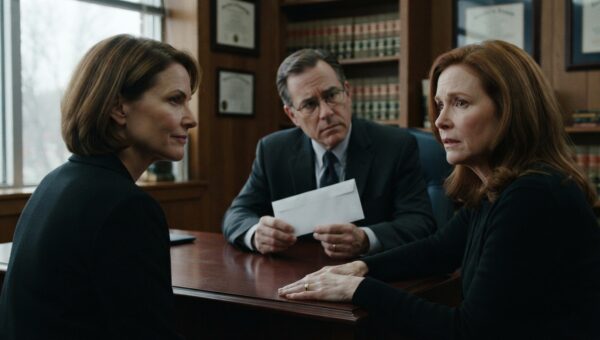
“You can explain it to the attorney whose card is sitting right under that coffee cup,” I replied, standing up slowly from the chair. “I went through the office box, Mark. I have the bank statements for the secondary account. I have the invoices from the warehouse jobs you’ve been hiding since the winter of twenty-twenty. I know about the eighty thousand dollars sitting in the county credit union. And I know you haven’t paid a single household utility out of our joint account in over a year without complaining about bankruptcy.”
He opened his mouth, but no words came out. The polished, confident contractor who projected financial strain while funding his own luxuries had completely vanished, leaving behind a small, cornered man who realized his entire house of cards had just collapsed from the bottom up.
“You’re taking my car keys,” I said, holding out my hand. “The loaner from the repair shop. You’re going to pack your clothes into a couple of garbage bags tonight, and you are going to go stay with whoever you want, as long as it’s not under this roof.”
“Grace, wait a minute, let’s not be rash, we can talk about this, we’ve been together twelve years, “
“Twelve years,” I repeated, tasting the words like something bitter and metallic. “And you couldn’t even spring for a tank of gas to see my mother, but you found four thousand two hundred dollars for a first-class seat to Hawaii with a twenty-six-year-old sales coordinator. Your math is terrible, Mark.”
I didn’t let him argue. I didn’t let him cry, though I saw the wet panic starting to pool in the corners of his eyes as he realized his comfortable life, his free housekeeping, and his respectable married cover story were evaporating in real time. I stood by the door, holding it wide open, watching him stumble down the hallway to grab a duffel bag from the closet. He tried to say something else as he pushed past me on the porch, his face twisted in resentment and disbelief, but I didn’t answer him. I just locked the heavy deadbolt behind him with a clean, solid click.
By ten o’clock that night, the house was entirely mine.
I walked out onto the front porch, stepping into the cool autumn breeze that carried the distant scent of dry corn husks from the fields down the road. I sat down in the old wicker rocking chair that had belonged to my grandmother, pulling my light cardigan tight around my shoulders. In my hand, I held my own passport, its blue cover worn at the edges from sitting untouched in the back of the cedar chest for more than a decade.
The twelve-year drought was over. The artificial scarcity, the endless apologies for wanting a simple weekend away, the quiet humiliation of budgeting pennies while he funded a second life, it was all gone, stripped away in a single afternoon. I looked out past the driveway where his loaner car had been parked, watching the distant headlights of traffic moving along the highway toward the interstate. For the first time in twelve years, my chest didn’t feel tight. I opened the passport to the first blank page, listening to the steady, quiet rhythm of the night air, and began to plan where I was going to go first, entirely on my own terms.