Mr. Kessler asked me to help him die at home. I am his neighbor, not his nurse, but I spent thirty years working the night shift on the cardiac floor at St. Jude’s, and he has no one else left in the world. His skin has taken on that yellowish, translucent look of parchment left too near a stove, and he sleeps most of the day now with his mouth slightly open, catching his breath like a runner who knows the finish line is miles behind him.
The hospice nurse, Martha, came by yesterday morning and checked his pulse against her silver watch, her face expressionless in that practiced way medical people have when they are counting down hours instead of days. She told me forty-eight hours, maybe less. She told me to keep the morphine drops coming every four hours and not to worry about anything else.
His son David has been estranged for ten years. Mr. Kessler told me on the first day I brought him a thermos of chicken broth: “Don’t call David.” He said it without heat, just a flat, dry finality that left no room for argument, the kind of tone men use when they have locked a door and thrown the key into a deep well. I did not argue with him because I know how stubborn old men get when they are dying, and because I figured some fights belong to the dead and the gone.
But every afternoon since then, right around four o’clock, my own cell phone has rung. Every single day. It is David on the other end, his voice tight and polite and trying not to crack, asking how his father is doing. He always asks if there is any change. He always sounds like he is standing outside in the cold, waiting for someone to unlock a door that he knows is bolted from the inside.
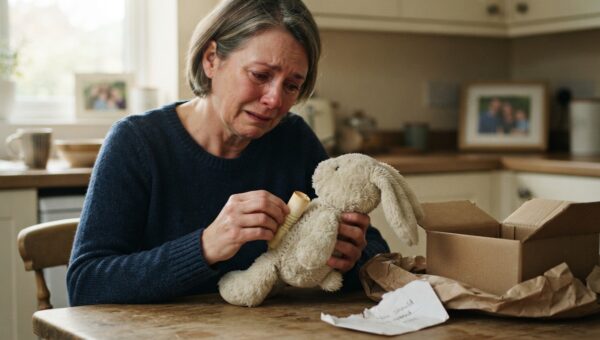
Last night, a mail truck stopped down by the curb at an unusual hour, its tires crunching on the gravel drive. A few minutes later, I went out to check the box and found a standard white envelope addressed to my house in neat, cramped handwriting. It sits now on the kitchen table right next to the telephone, unopened, feeling heavier than a brick. Mr. Kessler is sleeping through his breaths down the hall, the rattle in his chest sounding like dry leaves being dragged across concrete.
The hospice nurse is gone until tomorrow morning. The letter is next to the telephone, and the digital clock on the microwave says three-fifty-eight. In two minutes, David will call again at four o’clock. Mr. Kessler told me not to answer. At four o’clock I will either pick up the receiver or I will let it ring out into the empty kitchen.
I sat down at the table and stared at the paper. The postmark was from three days ago, mailed from a town about eighty miles north where the paper mills used to run twenty-four hours a day before the bottom fell out of the market. I turned it over twice, my thumb catching on the glued flap. Thirty years of hospital corridors taught me how to mind my own business, how to look past the family drama playing out in curtained cubicles and pretend I only saw IV bags and chart numbers.
But this kitchen is not a hospital. There are no charts here, only a ticking wall clock with a second hand that jumps in jerky, nervous intervals. I looked down the dark hallway toward the bedroom where Mr. Kessler lay drifting in and out of whatever quiet misery he had built for himself over the last decade. He had spent ten years wrapped in his own pride, letting the space between him and his only child widen into a canyon neither man knew how to bridge.
The clock ticked to three-fifty-nine. The digital numbers glowed a sharp, indifferent blue against the chipped white laminate of the counter. I thought about the way Mr. Kessler’s hands shook when he tried to hold a glass of water, the way he refused to let me call an ambulance when the pain started gripping his lower back last month. He wanted control. He wanted to manage his own exit the way he used to manage his small hardware store down on Main Street, locking up the front door at five sharp and turning off the lights himself. But dying is a messy business. It doesn’t care about closing times or locked doors. It spills over the edges and ruins the floorboards.
Then the phone rang.
It wasn’t a gentle ring. It was that sharp, shrill digital trill modern phones make, cutting through the silence of the house like a small blade. I didn’t move for the first three rings. I just sat there with my palms flat against the cool formica table, watching the little blue light blink on the handset. The screen displayed an incoming call from a number I had memorized over the last three weeks without ever meaning to. David was sitting somewhere on the other end of that line, holding his breath, waiting to hear if his father was still breathing or if he had finally run out of time.
On the fourth ring, I reached out. My fingers hovered over the plastic shell for a second, then I picked up the receiver and pressed it to my ear.
“Hello, David,” I said before he could speak.
There was a sharp intake of breath on the other end, followed by a long pause where neither of us said anything. I could hear the faint hum of traffic in the background on his end, maybe an engine idling or wind blowing against a car window.
“Is he…” David started, his voice catching halfway through the word. He stopped, cleared his throat, and tried again, sounding smaller than he did yesterday. “Is he still here, Martha?”
“He’s here,” I said softly. “But Martha says it’s forty-eight hours at most. Probably less. He’s sleeping mostly now.”
Another long silence stretched between us, filled only by the heavy rasp of Mr. Kessler’s breathing echoing through the baby monitor I had left switched on in the hallway. David must have heard it through the earpiece because I heard him swallow hard, a dry, painful sound.
“Did you get the letter?” he whispered.
I looked down at the white envelope sitting right beside my thumb. The corners were slightly dog-eared where it had been wedged into my metal mailbox.
“It’s sitting right here on the kitchen table,” I said. “I haven’t opened it.”
“You should open it,” David said, and for the first time his voice didn’t sound polite or careful. It sounded jagged and exhausted, the voice of a man who had finally hit the bottom of his patience. “Please. Just read what I wrote him. Or read it to yourself. I don’t care. But he needs to know. He has to know why I stayed away.”
“He told me not to call you, David,” I said, though my own words felt thin and useless even to me. “He was clear about that from the very first day I came over.”
“My father was always clear about things when he was angry,” David said, and a sudden, sharp bitterness cut through his grief. “He was so damn good at drawing lines in the dirt. After Mom died, I tried to talk to him about the bills, about the house, about how we were going to manage without her. He looked at me like I was a stranger who had wandered into his living room by mistake. He told me I was just like her family, always meddling, always telling him how to run his life. He told me to get out and not come back until I learned how to respect a man’s home. So I left. And he never called me. Not once in ten years. I waited by the phone for six months after that argument, waiting for him to tell me I was an idiot, waiting for him to say he was sorry. But he never did.”
“He’s dying, David,” I said, my voice dropping lower. “He’s eighty-two years old and he weighs about ninety pounds, and he’s lying down the hall wearing a flannel shirt that used to fit him like a glove and now hangs off his shoulders like a shroud. He isn’t keeping score anymore. He’s just tired.”
“Then let me come see him,” David said. His voice broke completely on the last word, turning into a rough, ragged plea. “Don’t let him die thinking I didn’t care. I’ve been living an hour away this whole time. I drove past this street twice a month just to see if the porch light was on. Please.”
I looked down at the white envelope. Without thinking, I slipped my index finger under the paper flap and tore it open. The sound was loud in the quiet kitchen, a sharp rip that felt like breaking a seal. I pulled out a single folded sheet of lined yellow notebook paper covered in that same cramped, careful handwriting.
I didn’t read the whole thing out loud to him. I didn’t need to. The first two sentences were enough to clear away ten years of stubborn garbage. *Dad, I still have the old red toolbox you gave me when I turned sixteen, and I still use the level you marked with your initials.* It wasn’t an apology for the fight, and it wasn’t a demand for an explanation. It was just an open hand held out across a decade of silence, showing that the bridge had never really burned down, it had just been left alone in the weeds.
“Get in your car,” I told him.
“What?”
“Get in your car right now,” I said, standing up from the chair so fast the metal legs scraped against the linoleum. “Take Route 9 north. Park down by the side of the garage so he doesn’t hear the muffler from the driveway. Come through the back kitchen door. It’s unlocked.”
“Martha, “
“I said get in your car, David,” I snapped, the old head-nurse tone coming back into my voice whether I wanted it or not. “You have about twelve hours before he stops knowing who anyone is. Move.”
I hung up the phone before he could answer.
The kitchen felt smaller after the call ended. I picked up the yellow paper, folded it back up, and slid it neatly beside the telephone. Then I walked down the narrow hallway toward the back bedroom, the smell of rubbing alcohol and old blankets growing stronger with every step. The door was half open. Mr. Kessler was lying on his back under the faded green quilt his wife had stitched back when Carter was in the White House. His chest rose and fell in that slow, uneven rhythm that nurses watch when the end is coming down the track.
I didn’t turn on the overhead light. I just pulled a straight-backed wooden chair over from the corner and sat down beside the bed, waiting for the gravel in the driveway to crunch under tires.
It took fifty-four minutes. I watched the luminous hands of my watch crawl around the dial, slow as molasses. At five-fifty-four, I heard the faint, dull thud of a car door closing out front, followed by the careful, quiet crunch of footsteps on the gravel path. A minute later, the back screen door squeaked open on its old spring, that same high-pitched groan it had made for thirty years, and soft footsteps padded across the kitchen floor.
The bedroom door creaked wider.
David stood in the doorway, his jacket half-zipped, his face pale and his eyes red around the edges, looking older than thirty-five but carrying the exact same stubborn set of the jaw that was currently pillowed on the mattress five feet away from him. He looked at me, then down at his father, and for a second he looked like he might turn around and run back out through the screen door.
“He’s sleeping,” I whispered, keeping my voice very level. “He hasn’t moved for an hour.”
David took one slow step into the room, then another, his boots making no sound on the worn braided rug. He stopped right at the foot of the bed, gripping the wooden bedpost with one hand so hard his knuckles turned white.
Mr. Kessler didn’t open his eyes right away, but the rhythm of his breathing hitched. A low, rattling sigh worked its way up his throat, and slowly, heavily, his eyelids fluttered open. He stared at the ceiling for a long moment, confused by the change in the air, before his gaze drifted down toward the foot of the bed.
He blinked once. Twice.
“Who’s that,” Mr. Kessler rasped out, his voice sounding like dry gravel rolling down a tin chute. He tried to lift his head from the pillow, but he didn’t have the strength for it, his chin falling right back down against the cotton slip.
David didn’t say anything for three or four long seconds. He just let go of the bedpost, took two steps closer, and reached out to rest his hand palm-down on the edge of the mattress, right beside his father’s thin, spotted wrist.
“It’s me, Dad,” David said, his voice shaking so hard he could barely get the words out. “I got your letter. Well, Martha got it. But I’m here.”
Mr. Kessler stared at him. The old man’s eyes moved over David’s face, taking in the lines around his mouth, the shape of his nose, the way he stood with his weight shifted onto his left foot, the exact same posture Mr. Kessler had used behind the counter of his hardware store every day for forty years. A slow, terrible realization seemed to pass behind the cloudy blue of the old man’s eyes, clearing away the fog of morphine and exhaustion.
“I told her…” Mr. Kessler started, his voice dropping off into a wet rattle. He tried to frown, tried to pull back into that ten-year-old shell of anger and pride, but he was simply too empty to hold it anymore. His chest hitched. A single, heavy tear broke loose from the corner of his eye and tracked down into the gray stubble on his cheek. “I told her not to call.”
“I know you did,” David said, his voice breaking as he reached out further and laid his hand right over his father’s cold fingers. “You were always stubborn as a mule. But I came anyway.”
Mr. Kessler didn’t answer him with words. He just let out a long, shuddering breath that seemed to deflate the last remaining tension in his frame, and slowly turned his hand over so his palm met his son’s.
I stood up quietly from the wooden chair, picked up my sweater from the back of the seat, and walked out toward the kitchen, pulling the bedroom door almost all the way shut behind me. The telephone sat silent beside the opened white envelope on the laminate table, the little red message light dark for the first time in weeks. Down the hall, through the narrow gap in the door, I could hear the low, steady murmur of two men talking through their tears, filling up a house that had been empty for far too long.