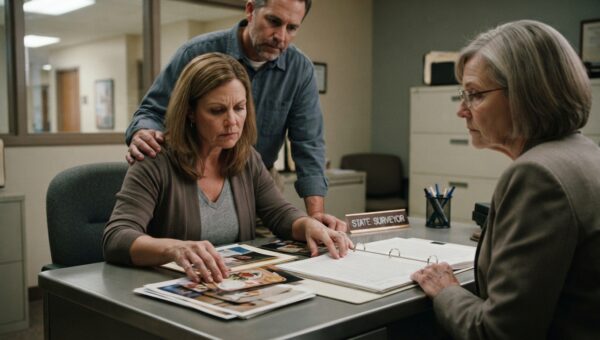
I got a lot of things wrong when I was nineteen years old, but the hardest part wasn’t the winter wind coming off the river in 1969, and it wasn’t even the cold linoleum floor of the intake room at Fairhaven. The hardest part was walking out of that brick building with empty arms while the nurse carried my baby down the hall.
I told myself it was for the best because that was what everyone in town said behind their cupped hands, but the truth is I just didn’t have anyone to fight for us. My father had already packed my cardboard suitcase two days after the test came back positive, dropping me off at the home for unwed mothers with a fifty-dollar bill and a stern lecture about shame. I spent every day of that spring looking at the red brick walls and the small barred windows, wondering how a person could love someone so fiercely and still have to let them go without a sound.
Fairhaven didn’t allow much, but they let us keep a basket of scrap cotton for mending. I spent three nights sitting on the edge of my narrow iron cot with a blunt needle and a spool of coarse blue thread I begged from the laundry room.
I didn’t have yarn or ribbon, so I cut a square from a torn hospital gown and stitched a crooked letter M right in the center. It was lopsided because my hands wouldn’t stop shaking from the morning sickness and the fear, but it was the only thing in this world that belonged to both of us. When they came into my room at four in the morning on a Tuesday to take her down to the nursery for the adoptive placement, I didn’t cry because I knew the matron would write it down as unstable. I just wrapped that tiny scrap of blue-stitched cotton deep inside the flannel receiving blanket right where she’d feel the warmth of it against her chest.
Arthur never knew about any of it. When we got married ten years later in the basement of St. Luke’s, we built a quiet life in a small house near the freight yards.
He was a good man who worked the third shift at the box factory and brought home coffee in a silver thermos every morning at six. He liked things steady and predictable, and I gave him that because I thought keeping my past locked in an iron box in the back of my mind was the price of being a respectable wife. When Arthur passed away from his chest trouble in the winter of 2018, I sat in our empty kitchen and realized I had spent forty years guarding a secret from a man who probably would have just put his big, grease-stained hand over mine and told me it didn’t change a thing. But by then the silence had grown so wide and deep that I didn’t even know how to start digging my way out of it.
Last month started like any other Tuesday. I walked down to the public library to drop off my library book, an old paperback mystery with a broken spine, and stopped by the community bulletin board near the water fountain.
The green felt has been there since the carpet was laid down in nineteen-eighty-four, covered in flyers for garage sales and church bake sales. But one little slip of white paper pinned with a red thumbtack caught my eye because it wasn’t printed from a computer. It was typed on an old manual typewriter with a ribbon that needed changing, the letters slightly crooked and uneven. I leaned in close, my glasses sliding down the bridge of my nose, and read the typed words. Woman born spring 1969 at Fairhaven home, searching for birth mother, remembers only a homemade bib with an M.
The library around me seemed to go dead silent, the hum of the overhead vents dropping out entirely. My fingers went cold on the edge of the corkboard, and I had to grab the wooden frame to steady myself because the floor felt like it was tilting sideways. Fifty-six years. I stood there staring at that little strip of paper until the blue ink started to blur behind my bifocals. My name was never on the adoption papers as a mother who had any say, but that crooked M belonged to me as surely as my own heartbeat. My thumb brushed the edge of the thumbtack, and before my brain could catch up with my hands, I pulled a small notepad from my purse and copied down the phone number written at the bottom in neat, careful handwriting.
I walked the four blocks home in a daze, the cold March wind cutting right through my wool coat, but I didn’t feel it. When I got inside my kitchen, the house smelled faintly of the pot roast I’d left in the slow cooker, a normal, boring smell that suddenly felt entirely foreign. I stood by the wall phone with the plastic receiver in my hand for nearly ten minutes, listening to the dial tone hum against my ear. My pulse was hammering so hard in my throat that I thought I might actually be sick right there on the linoleum. Finally, I forced my thumb to punch the seven digits, each button press sounding like a gunshot in the quiet room.
A soft voice answered on the second ring, clear and careful, as if she had been sitting beside the instrument for a week straight. “Hello?”
“I’m calling about the notice,” I said, and my voice sounded thin and raspy, like dry leaves scraping across concrete. “At the library.”
There was a sharp intake of breath on the other end, the kind of sound a person makes when they’ve been holding their breath under water for too long. Nobody said anything for a second and honestly that felt worse than shouting. “Did you… do you know something?” she asked, and her voice cracked right on the middle of the sentence.
“I made it,” I whispered, and the confession slipped out before I could stop it. “The bib. With the crooked M. I stitched it with blue thread on a piece of hospital cotton because I didn’t have anything else to give you.”
The woman on the line let out a sound that wasn’t quite a sob, more like a long, shuddering exhale that rattled through the speaker. “Are you sitting down?” she asked softly. “Because I’ve waited my whole life to hear somebody say those exact words.”
We talked for an hour, or maybe two, trading details like strangers who already knew each other’s secrets. Her name was Clara. She lived down in Lancaster County, worked as an art teacher in the middle school, and her adoptive parents had passed away years ago, leaving her with a wooden cedar box and a single yellowed square of cloth that she had kept tucked under her sweaters since she was a little girl. She told me she had known she was adopted since she was old enough to understand stories, but it wasn’t until her husband retired last year that she finally drove up to Fairhaven and found the old records office closed down for good. The library board was her last, desperate throw of the dice. By the time we hung up, my hand was cramping around the receiver, and my cheeks were wet with tears I hadn’t felt coming.
That Saturday morning, the sky was the color of wet slate, low and heavy with the promise of more rain. I didn’t clean the kitchen or make a pot of coffee the way I usually did on weekends; I just sat in the Windsor chair by the front window with my hands folded in my lap, watching the gravel driveway. At 10:17, a small blue sedan turned off the paved road and crunched up the lane, stopping right beside the lilac bushes.
I stood up and smoothed down the front of my navy cardigan, my knees trembling so badly I thought I might fold right onto the rug. I unlocked the front door and pulled it open just as the car door clicked shut. Clara stepped out from behind the wheel, wearing a sensible raincoat and carrying a canvas tote bag over her shoulder. She stopped at the foot of the three wooden porch steps and looked up at me through the gray mist, her eyes wide and shining with the exact same shade of stubborn gray that my mother used to have. Neither of us moved for a long, suspended beat, the distance of fifty-six years shrinking down to the twelve feet of painted pine between us.
Then she walked up the stairs, one slow step at a time, and opened her arms without a word.
When she stepped onto the porch and pulled me into a hug, all the careful walls I had built around my heart for more than half a century simply dissolved into nothing. Her coat smelled of rain and peppermint tea, and her shoulder felt solid and real against mine. She pulled back just an inch, her hands resting gently on my forearms, and reached into the front pocket of her coat. She pulled out a small, flat parcel wrapped in tissue paper and peeled back the corner with fingers that shook just as badly as mine.
There it was, resting right in the palm of her hand. A square of cotton, yellowed with age and stained with the faint shadow of time, but unmistakable. The blue stitches of the crooked M were still there, slightly frayed at the edges where the thread had worn thin, but holding firm.
“I kept it in my cedar box every single day of my life,” she said, and her voice was barely a whisper over the sound of the wind in the porch eaves. “I always knew somebody loved me when they made this.”
We went inside and sat at the round laminate table in the kitchen, the very table where Arthur and I used to eat our Sunday toast while the radio played local news. The afternoon sun finally broke through the gray clouds, cutting a bright, warm square across the tabletop and catching the edge of the two ceramic mugs of tea I had finally remembered to pour. Clara laid the yellowed square of cloth right between us, flat and smooth, like a map that had finally brought us home. I reached across the wood and covered her hand with mine, feeling the warmth of her skin, and for the first time in my life, the silence didn’t feel heavy at all.