PART 1
The hospital room smelled of lemon bleach and the cold green soap they use to wipe down bed rails. My husband Robert had his hand in mine when the monitor flatlined, a long steady tone that didn’t sound angry, just finished. We had been married for thirty-one years. We built a life out in the suburbs, raised two children who now had mortgages of their own, and shared thirty-one years of anniversaries, quiet breakfasts, and shared taxes.
I sat there in that vinyl chair holding his cold fingers until a nurse touched my shoulder and gently told me I needed to let go so they could move him.
The funeral was three days later, grey and wet with October rain. I stood under a black umbrella between our son David and our daughter Sarah, my eyes fixed on the varnished oak casket as it lowered into the damp Ohio earth. My children held me up, or pretended to, but I could feel the stiff distance in their shoulders. I thought it was just the heavy weight of grief. I thought we were all broken by the same sudden stroke that took Robert down in the kitchen while he reached for the coffee tin.
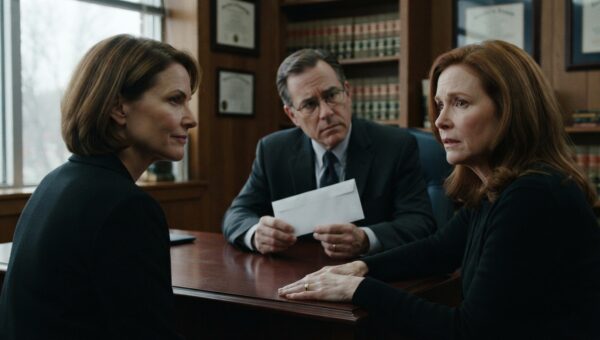
The reading of the will was scheduled for the following Tuesday morning in the glass-walled conference room of Robert’s longtime corporate attorney, a man named Henderson who had handled our joint tax returns since we bought our first starter home.
I arrived ten minutes early, carrying a leather folder containing Robert’s insurance documents and our original will from 1998, the one we signed together at a sticky wooden table when the kids were still in elementary school.
That will left everything to the surviving spouse, and then equally to David and Sarah. It was clean, simple, and fair.
David and Sarah walked in five minutes later. They didn’t kiss my cheek or sit beside me. Instead, they took chairs on the opposite side of the long mahogany table, staring down at their folded hands with red eyes and tight, guarded jaws.
“Where is Henderson?” David muttered, not looking at me.
Before I could answer, the frosted glass door swung open. Henderson walked in carrying a thick blue folder. But he wasn’t alone.
A woman walked in right behind him. She was younger than me by perhaps fifteen years, wearing an expensive camel-wool coat and dark tortoiseshell sunglasses that she didn’t bother to take off indoors. Her hair was pulled back into a sharp, flawless twist, and she carried herself with the calm, unhurried ease of someone who owned the building.
She didn’t look at me at all. She took a seat directly across the table, smoothing her skirt with manicured fingers.
Henderson cleared his throat, sat down at the head of the table, and opened his blue folder without looking up.
“Thank you all for being here,” Henderson said, his voice flat and professional. “Before we review the primary estate distribution, there is a legal document that supersedes the 1998 instrument on file.”
He slid a fresh stack of stapled papers across the polished wood toward the woman in the camel coat.
“This is the last will and testament of Robert Arthur Sterling,” Henderson continued, adjusting his wire-rimmed glasses. “Executed three weeks prior to his passing.”
PART 2
The room seemed to shrink. I looked from Henderson to my children, but neither David nor Sarah looked surprised. In fact, David let out a long, slow breath, staring straight ahead at the wall.
“What is this?” I asked, my voice shaking against the quiet of the room. “We never signed a new will. Robert and I had an agreement.”
The woman in the camel coat finally took off her sunglasses, laying them carefully beside her purse. Her eyes were hard and clear. Her name, as Henderson read it aloud from the document, was Chloe Vance.
“He changed it, Martha,” Chloe said, her voice smooth and unbothered. “People change their minds when they find someone who actually understands them. Robert didn’t want to spend his final years keeping up appearances in a house that felt like a museum.”
Henderson began reading through the legal clauses, and every word felt like a physical blow. The house in the suburbs, the two vehicles, our joint savings, and the 1.2 million dollar life insurance policy Robert had quietly restructured three months prior without my knowledge. Every single asset, down to the antique grandfather clock in our front hallway, was deeded and assigned directly to Chloe Vance.
I sat there frozen, watching the numbers stack up on the paper. One point two million dollars. Thirty-one years of building, saving, and sacrificing so Robert could retire comfortably, all handed over with a signature witnessed by two strangers in a downtown office building five weeks before he died of a heart attack.
“He loved me more,” Chloe said softly, leaning forward across the mahogany table. She didn’t sound angry or triumphant; she sounded pitying, which was infinitely worse. “He stayed with you because of the kids, Martha. But toward the end, he told me the truth. He just felt sorry for you.”
I turned my head slowly to look at my children. “You knew about this?” I asked Sarah, my voice cracking on her name.
Sarah finally looked up, her eyes swimming with tears, but her jaw set stubborn and defensive. “Mom, Dad brought her to dinner six months ago. We didn’t want to hurt you, but… she made him happy. He was suffocating at home.”
“For five years,” David added quietly, staring at his shoes. “They’ve been together for five years, Mom. Dad bought her the condo downtown. We tried to tell him to talk to you, but he was waiting for the right time.”
Five years. While I was packing Robert’s lunch for his Tuesday golf games, while I was nursing him through his shingles flare-up, while I was keeping the books and paying the heating bills, he had been living a second life in a downtown condo with a woman who now owned the roof over my head and every dollar we had saved.
PART 3
Henderson kept reading through the boilerplate legal language, his eyes darting nervously between Chloe and me. He reached the final pages, flipping the heavy paper over with a dry rustle.
“Furthermore,” Henderson read, his voice dropping an octave as he scanned the final paragraph. He stopped.
He didn’t turn the page. He froze, his eyebrows drawing together as he re-read the lines silently to himself.
Chloe shifted in her seat, her smooth facade cracking just a fraction. “Is there a problem, counselor? Just finish reading the asset distribution so we can get the deeds transferred.”
Henderson looked up from the paper. He didn’t look at Chloe. He looked directly across the table at me, his face pale, before looking back down at the document.
“There’s a third document,” Henderson said, his voice barely above a whisper.
Chloe’s hand snapped out, catching the edge of the table. “That’s impossible. I had the firm draft this exact instrument. There are no other active filings.”
“This isn’t a will, Miss Vance,” Henderson said, pulling a yellowed, folded legal envelope from the very bottom of his briefcase, underneath the blue folder. “This was deposited with our firm’s senior partner in trust twenty-nine years ago, with strict instructions that it only be opened in the event of an emergency dissolution of the primary marital estate or a certified probate contest.”
He unfolded the paper. It was an irrevocable spousal property agreement and corporate assignment from 1997, signed by Robert when his first commercial real estate venture was taking off, legally binding fifty percent of all accumulated assets and corporate holdings directly to me as an untouchable marital trust, completely independent of any future wills or secondary beneficiaries.
“Robert couldn’t legally assign the primary holdings or the insurance policy without your notarized signature, Miss Vance,” Henderson said, looking squarely at Chloe. “Because every single dollar of the seed capital used to launch Robert’s enterprise in 1997 came from Martha’s personal inheritance from her grandfather’s estate.”
The silence in the room became absolute.
Chloe stood up so fast her chair screeched against the wooden floor. “This is a fraudulent old piece of paper! My lawyers will tear this apart in twenty-four hours!”
“Your lawyers can try,” Henderson replied calmly, sliding the 1997 trust document across the table toward me. “But federal property law protects prior-vested spousal trusts from subsequent will transfers. The 1.2 million dollar policy and the corporate accounts legally belong to the primary trust holder.”
ENDING
David and Sarah sat in stunned silence, staring at the paper between my hands as the reality of what their father had tried to pull off finally settled into the room. They looked at me, waiting for me to say something, waiting for me to yell or cry or ask them for help.
I didn’t yell. I picked up the document, folded it twice with steady fingers, and slid it into my leather folder.
I stood up, smoothed the front of my wool coat, and looked down at Chloe Vance as she gathered her designer bag with shaking hands.
“You can keep the condo,” I said quietly. “And you can keep his clothes. But the house is mine, the trust is mine, and I am changing the locks before dark.”
I walked out of the glass-walled office, leaving my children sitting in the quiet room behind me, and drove home to the suburbs alone.