PART 1
The envelope sat on the kitchen counter between a half-empty box of cereal and a stack of junk mail that had accumulated over three days. Clara had left it there before the ambulance came. I kept looking at the corner of the envelope, noticing how her handwriting had changed over the last two years, growing smaller and shakier as the cancer took the strength out of her right hand.
We had been married for twenty-seven years. We raised two kids, paid off a modest mortgage on a three-bedroom house in Columbus, and argued about grocery prices just like every other couple we knew. I was an auto parts salesman, and Clara worked part time as a library assistant. We lived on a strict budget where every dollar was accounted for in a green ledger book that sat in the bottom drawer of our oak desk. Or so I always believed.
The doctor at the hospital had given us the final news on a rainy Tuesday morning. There were no more treatments to try, no new trials, and no more time to buy. Clara took the news with a quiet nod, thanked the doctor by name, and asked me to drive her home so she could sit on her own porch.
Three days later, she asked me to bring her laptop to the armchair in the living room.
Her breathing was shallow, and her skin had the pale, papery look of old parchment.
“I need to show you something, Arthur,” she said, her voice barely carrying across the room.
I sat on the edge of the footstool, my hands resting on my knees. “What is it, sweetheart? Do you need me to call the hospice nurse?”
“No,” she said, opening the lid of the silver laptop. “Look at the screen.”
I leaned in, peering past the glare of the afternoon sun hitting the window. A banking interface was open, showing an online savings account I had never seen before. Next to the institution name was a balance that made my breath catch in my throat.
Sixty-two thousand dollars. With interest.
I stared at the numbers, then looked up at Clara’s tired eyes. “Why?” I whispered. “Whose account is this?”
“Ours,” she said softly. “Mine. From the day we got married. I deposited one hundred dollars from every single paycheck into a separate account at the credit union downtown.
You never noticed because I managed the household grocery cash, and I always made sure the bills were paid first.”
I felt a strange, cold heaviness settle in my chest. “Twenty-seven years?” I asked. “Clara, how did you manage that without me seeing a statement?”
“Paperless statements,” she said with a faint, ghost of a smile. “They went to an old email address you never used. I wanted to tell you sooner, but then the diagnosis came, and I knew the timing was right.”
She reached out with a trembling hand, touched my wrist, and pulled a thick manila folder from beneath a stack of library books on the side table.
“Open it,” she said.
I opened the clasp and slid the contents out onto my lap. Inside were paid funeral arrangements for a plot beside her mother at the church cemetery. There was a life insurance policy I had never known existed, listing our children and me as beneficiaries.
There was a sealed letter addressed to our son and daughter, and a separate, smaller note folded neatly in half with my name written across the front in her neat cursive.
I unfolded the note and read the two lines inside.
*I loved every day. Even the hard ones. Especially the hard ones.*
I sat there on the footstool holding that piece of paper while the grandfather clock in the hallway ticked away the minutes, realizing that for nearly three decades, the woman sitting across from me had been quietly carrying a secret weight entirely out of love and fear for a future she knew she wouldn’t see.
PART 2
Clara passed away three months after that afternoon on the porch. The house grew very quiet in the weeks that followed. The space where her knitting basket sat by the sofa remained empty, and her heavy wool coat still hung on the peg by the back door, untouched.
Our children, Mark and Emily, came home to help me sort through her things. Mark was twenty-four, working as an assistant manager at a local hardware store, and Emily was twenty-one, finishing her degree at the state college. They took their mother’s passing hard, moving through the rooms like ghosts, packing away her clothes into cardboard boxes and wiping down the kitchen counters where she had spent so much of her life.
The funeral was held on a gray Thursday in late November. The church was full of people from the library, neighbors from our street, and cousins who drove in from out of state. The rain fell in steady sheets against the stained-glass windows as the pastor said the final prayers.
After the burial, we gathered back at our house for a small lunch with family. Mark stood up at the end of the dining table, holding a piece of heavy ivory stationery in his hand. It was the letter Clara had left for him and Emily inside the manila folder.
“Mom left a note for us,” Mark said, his voice thick with emotion as he cleared his throat. He looked around the table at his sister and me, then unfolded the paper.
He read the first two paragraphs smoothly, his voice echoing in the quiet dining room as he shared memories of how much she loved us, how proud she was of the lives we were building, and how she wanted us to look out for each other when she was gone.
Then Mark reached the final paragraph.
He stopped.
The room went completely silent, save for the hum of the refrigerator in the kitchen. Mark stared down at the paper, his eyebrows drawing together in confusion. He blinked twice, lowered the letter, and looked directly across the table at me.
“Dad,” Mark said, his voice dropping an octave. “Did you know about this?”
I put my coffee mug down on the wood. “Know about what, son?”
Mark turned the letter around and read the final lines out loud to the room.
*”Take the key from the blue tin in the attic crawlspace and open the small lockbox behind the chimney bricks. There you will find the truth about why I never spoke of my family in Chicago, and why I spent twenty-seven years saving every dollar I could to make sure you kids would never have to run from the past the way I did.”*
A cold wave washed over the back of my neck. I had known Clara since we were twenty. She always told me her parents had died in a car accident when she was a teenager, leaving her to be raised by an elderly aunt who passed away shortly before we met. She had never mentioned a Chicago family, never mentioned a lockbox, and certainly never mentioned running from anything.
PART 3
Later that evening, after the last of the relatives had gone home and the house was dark, I climbed the narrow wooden stairs up to the attic. The air up there smelled of dry dust and old cedar.
I found the blue tin behind a stack of out-of-season winter coats. Inside was a small brass key and a faded polaroid photograph of a stone house I had never seen before.
Mark and Emily stood at the attic door watching as I carried the tin back down to the living room. I didn’t wait until morning. I took a flashlight and a small crowbar, went back upstairs, crawled into the narrow space beneath the eaves near the chimney, and felt along the rough mortar behind the brick stack.
My fingers brushed against the cold metal edge of a small iron lockbox.
I pulled it out into the light of the attic bulb, slid the brass key into the old lock, and turned it. The latch clicked open with a sharp, metallic sound.
Inside were not financial records or birth certificates, but a thick stack of yellowed newspaper clippings from 1974, court transcripts from a municipal trial in Cook County, Illinois, and a handwritten journal bound in black leather.
I carried the box down to the kitchen table where Mark and Emily were waiting. I opened the journal to the first page and began to read Clara’s tight, careful handwriting under the overhead light.
It turned out the woman I had married, the quiet, gentle librarian who balanced her checkbook to the penny and saved one hundred dollars a month for twenty-seven years, wasn’t who she claimed to be.
When Clara was nineteen, her father had been involved in a massive embezzlement scheme at the regional freight company where he worked as a chief auditor. When the federal investigators closed in, he panicked, stole three hundred thousand dollars from the corporate vault, and tried to flee the state with his family. Clara had refused to go with them, turning herself into the local police department and handing over the ledger books that proved her father’s guilt before he skipped town.
Her father had been convicted in absentia and spent years a fugitive before dying in a cheap motel in Florida. But the corporate debts, the lawsuits, and the angry creditors had hounded Clara for years afterward, forcing her to change her name, abandon her hometown, and build an entirely new identity from scratch in Ohio before we ever met.
The sixty-two thousand dollars in the online savings account wasn’t just a rainy-day fund for medical bills. It was the exact sum of restitution her father had stolen from the lowest-paid workers at that freight company back in 1974, adjusted for inflation, which she had spent her entire adult life quietly trying to pay back through anonymous charitable trusts and direct restitution accounts.
ENDING
The house was silent when I finished reading the last page of the journal.
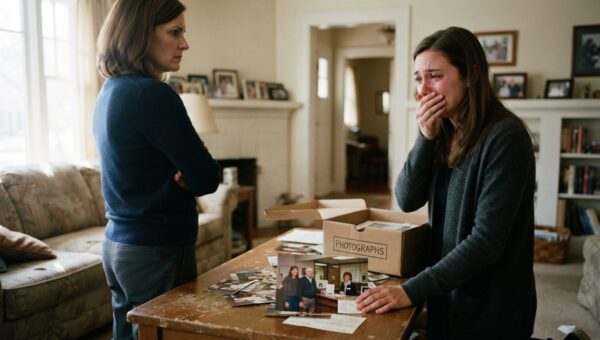
Mark sat with his elbows on the table, staring down at the faded newspaper clippings, while Emily wiped a tear from her cheek with the sleeve of her sweater. The woman we thought we knew, the mother who had baked cookies on rainy afternoons and worried over grocery coupons, had spent every day of her life carrying the heavy, invisible armor of a secret past she never asked for.
I closed the iron lockbox, laid my hand flat against the cold metal, and thought about the note she had left me on the porch before she died.
*I loved every day. Even the hard ones. Especially the hard ones.*
The next morning, I drove down to the credit union and transferred the balance of the account into the restitution fund listed in her papers, fulfilling the final promise of a woman who had spent twenty-seven years making sure the ledger of her life finally balanced out to zero.