PART 1
My older sister, Brenda, told everyone in our hometown that I had abandoned our father.
She told our cousins, the ladies in his church circle, and the neighbors on Maple Street. When I accepted a regional auditor job two states away six years ago, Brenda made sure people saw my move as selfish neglect. She stayed in town, twenty minutes from Dad’s brick ranch house. She drove him to his cardiology appointments, took him his weekly groceries, and received all the praise for being the devoted daughter.
Whenever I drove back for long weekends or holidays, Brenda would sit at Dad’s kitchen table, sigh heavily, and talk about how exhausted she was from carrying the entire load alone. If I offered to pay for a professional caregiver two afternoons a week so she could rest, she waved her hand and snapped that strangers would only upset him.
“You think writing a check replaces showing up every day, Karen?” she told me during Thanksgiving two years ago. “Some of us actually sacrificed our lives for him.”
I swallowed the insult because I felt guilty. Moving away had been my choice, and Dad had always told me to go build my career. But to keep close to him, I started calling him every single Wednesday evening by video. For four years, those Wednesday calls were sacred. Even when Dad began slipping into mild confusion, he would prop his tablet against his ceramic coffee mug at seven o’clock sharp. We talked about his vegetable garden, his old union days, and the house he had built with his own hands back in 1978.
Dad passed away in his sleep on a rainy Tuesday morning in March.
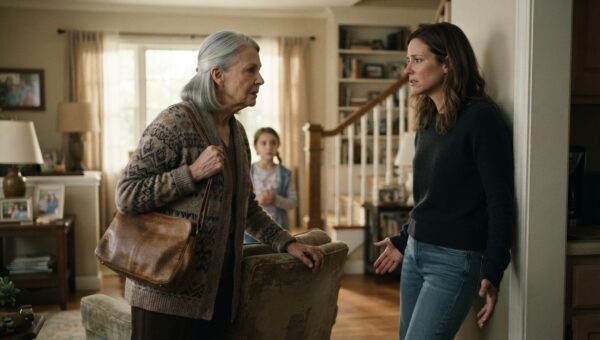
Two days after the funeral, Brenda asked me to come over to Dad’s house to settle his affairs. I walked into the living room expecting us to sit down with his old blue accordion folder where he kept his utility bills and life insurance policies. Instead, Brenda sat on the sofa with a fresh manila envelope and her arms crossed over her chest.
“We don’t need to drag this out,” Brenda said, sliding a typed document across the coffee table. “Dad updated his will sixteen months ago. He wanted everything kept simple.”
I picked up the document. It was a formal three-page last will and testament, dated October 14 of the previous year. It left the house, the savings account, and all personal property entirely to Brenda.
At the bottom of the second page, one short sentence was reserved for me: “To my daughter Karen, I leave the wooden crate of family photographs stored in the front hallway closet.”
I looked up at Brenda. “He left you the entire estate and gave me a box of pictures?”
“I was the one who changed his bedsheets and cleaned his kitchen while you were living your life in Chicago,” Brenda replied, her voice completely flat. “He knew who took care of him. The lawyer drew it up, Dad signed it in front of witnesses, and it’s already filed for probate. You don’t have a claim here, Karen.”
I felt the sting of her words, but beneath the hurt, something didn’t add up. Dad had spent forty years preaching fairness between us. Even when he was irritated with one of us, he never played favorites with money.
I took the wooden crate from the closet without another word and carried it out to the trunk of my car. That evening, sitting at the desk in my hotel room, I opened the heavy pine box. It smelled of cedar and old paper. Inside were hundreds of loose prints going back forty years: our childhood camping trips, Christmas mornings, and Dad standing proudly by his newly built back porch.
Near the bottom of the crate, underneath an album from 1994, I found a loose snapshot taken on a bright, sunny afternoon.
It was a candid picture of Dad sitting in the passenger seat of Brenda’s silver sedan. In the background, clearly visible through the car window, was the drive-thru canopy of First National Bank on Main Street. The digital time stamp printed in small orange numbers on the bottom right corner read: 10/14, 2:15 PM.
The exact date Dad supposedly signed the new will leaving Brenda everything.
Staring at that date, I remembered something that made my stomach tighten. I had called Dad on Wednesday, October 15, the very next evening. During that call, Dad had looked at my face on the screen, squinted with wide, frightened eyes, and apologized twice for forgetting my name. Yet he had spent ten minutes explaining the exact measurement of the copper plumbing pipes under the kitchen sink.
He didn’t know his own daughter’s face that week, but Brenda claimed he had competently disinherited me twenty-four hours earlier.
I tucked the photograph into my purse and pulled up my personal bank records. For three years, Dad had granted me secondary view access to his everyday checking account just so I could help him spot utility billing mistakes. I hadn’t looked at the account since he died. When I logged into the portal that night, the balance showed $142.10.
I scrolled back through the transaction history to October 14.
At 2:40 PM on October 14, exactly twenty-five minutes after that photo in the bank parking lot was taken, a counter withdrawal of $84,650 had been processed, emptying Dad’s lifetime savings down to double digits.
The withdrawal slip listed Dad’s account number, but the authorized signature was not Dad’s shaky, looping cursive. It was Brenda’s tight, slanted handwriting, signed under a durable power of attorney that none of us had ever discussed.
PART 2
I spent the next morning sitting in a booth at the diner near the county administration building, reviewing every scrap of information I had.
I had the photograph showing Dad sitting in Brenda’s car at the bank on October 14 at 2:15 PM. I had the online bank record showing his savings account drained of $84,650 less than half an hour later. And I had my own journal notes from my October 15 video call, where Dad had wept because he called me “Susan”—his late sister’s name—instead of Karen.
Dad had not been managing his money. Brenda had taken it.
At nine o’clock, I walked into the county probate clerk’s office and requested a copy of the paperwork Brenda had submitted. The clerk handed me a file containing the new will along with a medical power of attorney signed on the exact same date: October 14.
The medical power of attorney had two witness signatures at the bottom. One was an employee at a local shipping store who had notarized the document. The second signature belonged to a name I recognized: Evelyn Carter, RN.
Evelyn was the visiting home nurse who had checked Dad’s blood pressure and medication boxes twice a month during his final year. Dad had spoken highly of her on our Wednesday calls, saying she was the only one who didn’t talk down to him like a child.
I found Evelyn’s office number through the home health agency listed on the document. When I called, I didn’t accuse anyone of anything. I simply gave my name, explained that Dad had passed away, and asked if she had a few minutes to talk about his October care plan.
There was a long pause on the other end of the line.
“Karen?” Evelyn asked carefully. “The daughter who lived in Chicago?”
“Yes,” I said. “I’m in town handling Dad’s estate, and I’m looking at the medical proxy from last October.”
“Are you still near downtown?” she asked. Her tone was guarded, but there was an edge of urgency in it. “I have a thirty-minute break before my next client. Meet me at the small park behind the courthouse.”
Twenty minutes later, I was sitting on a green wooden park bench when a woman in navy blue scrubs walked up. Evelyn sat down beside me, holding a thick manila folder in her lap. Her hands were weathered, her expression solemn.
“I heard your father passed,” Evelyn said quietly. “I’m sorry for your loss, Karen. Thomas was a decent, proud man.”
“Thank you,” I said. I pulled the copy of the medical power of attorney from my purse and pointed to her signature. “I need to know what happened the day this was signed. Brenda produced a new will from that same afternoon. She took his entire life savings, and she’s taking the house.”
Evelyn looked down at the paper, then opened her folder.
“I was wondering if you would ever call me,” Evelyn said. “Your sister told me you never visited, that you didn’t care about anything except getting a check when Thomas died. But whenever I sat with your father on Thursday mornings, he talked about your Wednesday video chats. He kept a notepad by his recliner where he wrote down your job updates so he wouldn’t forget them.”
Her words brought a knot to my throat, but I kept my voice steady. “Did he understand what he was signing on October 14?”
Evelyn shook her head slowly. She tapped a document inside her folder. It was her clinical visit log from the morning of October 14.
“I went to his house at ten in the morning for a routine cognitive assessment and vitals check,” Evelyn said. “Your sister was already there, agitated and rushing him. I ran a standard Mini-Mental State Examination on Thomas. He scored twelve out of thirty. He didn’t know what year it was. He thought Jimmy Carter was still the president. He couldn’t draw the hands on a clock.”
She turned the page, pointing to her handwritten clinical notes.
“When Brenda brought out that power of attorney form and asked me to sign as a witness to his mental competence, I flatly refused,” Evelyn said. “I told her Thomas lacked the legal capacity to assign medical or financial authority. I wrote it down right here in my official charting: patient demonstrates severe cognitive deficit and cannot give informed consent.”
I stared at the page, then at the document from the courthouse. “Then why is your signature on the court filing?”
Evelyn looked directly into my eyes. “That isn’t my signature. Brenda forged it. And your sister was not the person your father believed she was.”
PART 3
Evelyn didn’t just have her clinical notes. She had already filed an internal incident report with her agency supervisor on October 15, noting that Brenda had tried to pressure her into signing a fraudulent capacity statement.
“I kept a certified copy of the report in my personal files,” Evelyn said, handing me the signed, stamped records. “If you take this to a judge, I will sit in that witness box and testify under oath. Thomas was being manipulated, Karen. I couldn’t stop her from taking him to the bank, but I can stop her from getting away with this.”
I thanked Evelyn, took the folder, and walked straight to an estate attorney whose office sat two blocks from the courthouse.
His name was David Miller. He spent forty-five minutes reviewing the documents: the forged power of attorney, Evelyn’s official clinical evaluation scoring Dad at twelve out of thirty on October 14, the timestamped bank withdrawal of $84,650, and the photograph of Dad sitting confused in Brenda’s passenger seat that exact afternoon.
“This isn’t a gray area,” Miller said, taking off his glasses. “The will and the proxy were executed on the same date. A person who scores twelve on an MMSE cannot execute a valid testamentary document under state law. On top of that, forging a witness signature on a filed court document is a felony. Your sister has exposed herself to severe civil liability and criminal charges.”
Miller drafted an immediate emergency motion to freeze the estate, suspend Brenda as executor, and petition the probate court to invalidate the October will based on lack of testamentary capacity and undue influence.
Before filing the papers, I asked Miller for two hours. I wanted to look Brenda in the eye myself.
I drove out to Dad’s house on Maple Street. When I pulled into the gravel driveway, Brenda’s car was parked near the garage. She was already carrying cardboard boxes out to the porch, packing up Dad’s belongings.
When she saw me get out of my car, she stopped and set a box down.
“I thought I told you we were finished,” Brenda said, wiping her forehead. “You got your photos, Karen. You don’t have any business here.”
I walked up the porch steps and held out the folder.
“You withdrew eighty-four thousand, six hundred and fifty dollars from Dad’s savings account on October 14 at two-forty in the afternoon,” I said, my voice level and quiet.
Brenda stiffened. The color drained from her cheeks, but she quickly forced a sneer. “I had power of attorney. I used that money for his ongoing care.”
“He was on Medicare and home hospice, Brenda. His monthly expenses were less than nine hundred dollars,” I replied. “And you didn’t have power of attorney. You forged Evelyn Carter’s signature after she refused to certify that Dad was competent.”
Brenda took a step back against the porch railing. “You don’t know what you’re talking about. Evelyn signed that paper.”
“Evelyn kept her agency logs, Brenda. Dad scored twelve out of thirty on his cognitive exam that morning. She filed an incident report against you the next day. I just came from a lawyer’s office, and his petition is sitting on his desk right now.”
I stepped closer, setting the copy of the forged document and the bank withdrawal slip on top of the cardboard box.
“You told the entire family I abandoned him,” I said. “You made everyone believe you were sacrificing your life while I ran away. But Dad didn’t forget me. He wrote down our Wednesday calls on a yellow pad by his chair. The only person he stopped recognizing was the sister who treated his final months like a bank heist.”
Brenda stared at the paperwork. Her defensive posture crumbled. She didn’t yell. She didn’t threaten me. She dropped her hands to her sides, her shoulders sagging.
“You don’t know what it was like,” she whispered, her voice cracking. “Being here every week. Watching him decline. My husband lost his subcontracting job last summer. We were drowning in credit card debt, Karen. I gave Dad three years of my life. I felt like the house and the savings were owed to me.”
“It wasn’t yours to take,” I said. “And you didn’t earn it by stealing from a sick man.”
ENDING
Brenda didn’t fight the petition.
Faced with Evelyn’s certified medical charting, the bank audit records, and the threat of criminal forgery charges, Brenda agreed to a formal settlement through her own attorney within three weeks.
The fraudulent October will was thrown out by the probate judge. The court reinstated Dad’s original will from eight years earlier, which divided the estate equally between the two of us.
Brenda was ordered to repay the $84,650 into the estate account. Because she had already spent nearly twenty thousand dollars paying off her husband’s credit card balances, her final half-share of the house sale was reduced by the exact amount she had stolen.
We put Dad’s house on the market in late spring. It sold six weeks later to a young couple with two small boys who loved the large backyard and the sturdy back porch Dad had built. Brenda didn’t attend the closing. She signed her paperwork at a separate title office across town.
She hasn’t spoken to me since the day on the porch. A few relatives tried to reach out to me, offering awkward apologies after learning what the probate court had uncovered, but I didn’t need their validation anymore. I realized Brenda’s lies had only worked because people preferred an easy story over an inconvenient truth.
Before I drove back to Chicago, I spent my final afternoon packing the rest of Dad’s workshop.
On the workbench, beside his collection of antique hand planes, lay the yellow legal pad Evelyn had mentioned. I picked it up and flipped through the pages.
There, written in Dad’s fading, uneven pencil, were short notes from our Wednesday calls stretching across his final year.
“Karen got the promotion.”
“Karen bought a new furnace.”
“Karen called at seven. Good girl.”
I closed the pad, carried it out to my car, and placed it safely inside the wooden crate alongside his old photographs. He had given me exactly what mattered most, and nobody could ever take that away.