All my life, my twin sister Clara was called the beautiful one, the child who would go far and make our family proud. I was the one who stayed home in our small Pennsylvania town to look after our mother, Helen. When Mom’s joints seized up with arthritis and her mind started wandering into the past, Clara was living two hours away in a tall brick apartment building, working as an administrative assistant at a regional hospital.
She sent expensive scented candles at Christmas and called once a month on a Sunday afternoon, while I bathed Mom, crushed her pills into applesauce, and scrubbed the yellowed linoleum.
Whenever Clara did visit, Mom looked at her like she was royalty stepping down into a barn. “Clara has sensitive nerves, Nora,” Mom always told me, her voice sharp enough to keep me from complaining. “She couldn’t handle the heavy lifting. You have broad shoulders. You were built for the quiet work.”
Mom passed away on a rainy Tuesday in late October, sitting right in her blue armchair by the parlor heater. The funeral was small. Clara cried softly behind a dark lace handkerchief, accepted the townspeople’s condolences, and left the reception before the tuna salad was even half eaten. She said she had an early shift the next day. That left me alone in the house where we had both grown up, surrounded by eighty years of clutter, dust, and quiet grief.
Two weeks after the burial, I started sorting through Mom’s sewing cabinet. It was an old Singer pedal machine mounted inside a dark oak cabinet that sat in the corner of her bedroom. Mom had guarded that cabinet fiercely. Even when her eyesight failed, she refused to let me move it or wipe down the interior drawers.
I pulled out the middle wooden drawer, the one where she kept her spools of heavy buttonhole thread and nickel needles. As I tipped the drawer upward to check the runner, a bit of clear, brittle yellow tape caught my thumb. Taped underneath the bottom board was a small, flat brass key.
Stuck to the key was a tiny strip of masking tape with Mom’s handwriting in blue ink: Locker 42, Union Depot.
Our town’s Union Depot had not run passenger trains since the late nineties, but the old stone depot still operated as a regional bus stop and commuter transfer station.
It had a row of olive-green metal parcel lockers bolted against the drafty back wall near the restrooms.
The next morning, I drove into town and walked into the depot. The floor smelled like damp concrete and stale floor wax. An older man with silver sideburns and a green utility vest sat behind the counter reading the morning paper. His name tag read Walter.
I showed him the key and asked if locker forty-two was still in use.
Walter adjusted his glasses and looked at the number stamped into the brass head. “Locker forty-two? That belongs to the long-term contract row. An older lady paid the quarterly rental fee by mail in cash every single spring. Twenty-five years running. She paid through this coming December.”
Mom had been paying for a locker since 1998.
My fingers felt cold as I walked over to the bank of lockers. I put the key in the lock, turned it to the right, and the heavy metal door clicked open with a dull pop.
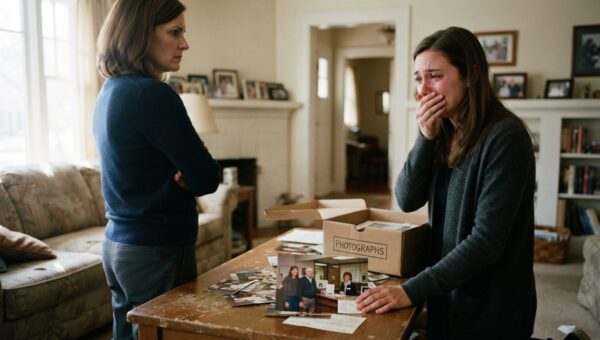
Inside was a single cardboard storage box, clean and dry. On top lay a blue United States passport and a black-and-white print of a color photograph.
I looked at the photograph first. It showed Clara standing beside Julian Vance.
Julian had been twenty-two when he vanished from our town in November of 1998. He had lived three doors down from us, working at the feed mill. The whole county had searched the woods and drained the creek beds for two weeks after his truck was found parked at the edge of the interstate. People said Julian had run off on debts, or worse, that someone had harmed him. The sheriff had questioned every family on our street, including ours. Clara had sworn to the police that she had barely known Julian, that she had only ever spoken to him in passing at the diner counter.
Yet here they were in the photograph, standing shoulder to shoulder in front of our own front porch steps, their arms hooked tightly together. They were wearing matching red wool coats with black horn buttons.
On the back of the photo, in Clara’s handwriting, was the date: November 14, 1998.
November fourteenth was my twenty-first birthday.
I remembered that night as clearly as if it were yesterday. Mom had baked a boxed yellow cake. When Clara did not show up for dinner by six, Mom told me Clara was running a high fever upstairs in bed and could not be disturbed. Mom had made me eat my slice of cake alone at the kitchen table, telling me not to be selfish about my sister’s poor health. She kept insisting all evening that Clara was fast asleep in her room.
Beneath the photograph in the box was a hardbound high school yearbook. Tucked beneath the cracked leatherette binding was a folded sheet of yellow legal pad paper covered in Mom’s tight, slanted handwriting.
PART 2
The note was written in the same faded blue ballpoint pen Mom had used for grocery lists.
“If Nora is reading this, Clara failed to do what was right. You stayed when everyone else ran, Nora. You never got to choose your life because I gave yours away to protect hers. The money in the envelope is yours. It was always yours. If Julian Vance is ever heard from, the boy died because of Clara’s temper, not his own choices. Lord forgive me for hiding it, but I could not bury two daughters in one lifetime.”
My breath hitched in my chest. The commuter bus outside hissed its air brakes against the curb, vibrating the concrete beneath my boots.
I reached back into the metal locker and pulled out the rest of the contents. Under the yearbook sat a thick manila envelope held shut with two rubber bands that had rotted and cracked against the paper. Inside was ten thousand dollars in crisp, banded one-hundred-dollar bills from a 1996 bank wrap, along with Julian Vance’s leather wallet and his state driver’s license.
His wallet held four one-dollar bills, a punch card for the town barber, and a folded receipt from a roadside motel twenty miles north, dated the morning of November 14, 1998.
I stood there in the drafty locker corridor, holding the wallet of a boy who had been missing for over twenty-five years. Mom had not kept this locker to store keepsakes. She had kept it as leverage, or as insurance, or because she could not bring herself to throw away evidence of a crime she had spent a quarter-century covering up.
I packed the box, walked back out to my station wagon, and placed it on the passenger seat. My hands were shaking so hard I could barely slide the car key into the ignition.
Clara was supposed to come by the house that evening to pick through Mom’s costume jewelry and take her pick of the silver-plated spoons. She had made a point of telling me that morning over the phone that she didn’t want the bulky furniture, only the pieces with sentimental value.
I drove home and set the box on the kitchen table, right next to the salt shaker and the napkin holder Mom had kept in the exact same spot since we were girls. I opened Julian’s wallet again. Behind the plastic sleeve of his driver’s license was a small piece of folded loose-leaf paper. On it, Clara had written: “Meet me by the old quarry gate after Helen goes to sleep. I have the cash.”
I sat in the quiet kitchen until four in the afternoon, listening to the grandfather clock in the hall tick its steady, hollow rhythm. Every family story I had ever been told began to unravel in my head. Clara had not been delicate. She had not been fragile or sickly or gifted with sensitive nerves that needed shielding from the world. Clara had been protected at my expense. Mom had tethered me to that house, loading me down with cooking, chores, and elder care, so that Mom would never be left alone with the secret of what Clara had done.
At four-thirty, Clara’s sedan pulled into the gravel driveway. The headlights cut through the gathering twilight and swept across the kitchen windows.
Her car door shut with a solid clunk. She walked up the back porch steps, her heeled leather boots clicking sharply against the painted wood. She let herself in without knocking, shaking the autumn chill from her camel hair coat.
“It’s freezing out there, Nora,” she said, pulling off her leather gloves. “Did you set aside Mom’s garnet brooch like I asked? I have to head back before seven because the highway gets icy.”
She stopped mid-sentence when she looked at the table.
I had laid out the photograph of her and Julian in their matching coats, Julian’s driver’s license, and Mom’s yellow handwritten note directly under the overhead light.
PART 3
Clara’s face tightened. She didn’t gasp, and she didn’t scream. She simply stopped taking off her coat, her hands lingering on the buttons.
“Where did you get those?” she asked. Her voice was flat and steady, stripped of the sweet, breathless tone she always used when talking to family.
“Locker forty-two at the bus depot,” I said. “Mom rented it twenty-five years ago. The key was taped to the underside of her sewing drawer.”
Clara took two slow steps toward the table, her eyes scanning the items. “She promised me she burned all of it. In the burn barrel out back, the morning after.”
“What happened to Julian, Clara?”
Clara looked at the wall behind me, at the faded wallpaper with the blue cornflowers Mom had put up when we were in eighth grade. “He wanted to leave town. He told me he was leaving for Ohio and taking his mother’s savings with him. We had been seeing each other in secret for six months. He said if I stole five thousand from Mom’s cedar chest, he would take me with him.”
She pulled out the wooden kitchen chair, the one Mom used to sit in when she snapped green beans, and sat down without taking off her coat.
“I took the money,” Clara said. “I met him at the old quarry road by the water tower. But when I got in the truck, he laughed at me. He said he was just using me to get travel cash. He told me I was plain and stupid, and that he had another girl waiting for him in Youngstown. He tried to push me out into the dirt while the truck was still running.”
“Mom’s note says he died because of your temper,” I said quietly.
“He grabbed my arm to pull my coat off,” Clara whispered, looking down at her hands. “I had Mom’s heavy steel pruning shears in my pocket. I brought them because I was scared of being out in the dark woods alone with him. When he shoved me against the doorframe, I swung them at him. I didn’t mean to hit his throat, Nora. I swear on my life I didn’t. He choked on his own blood. He was gone before I could even get the truck door open.”
The room was completely silent except for the refrigerator compressor humming in the corner.
“I ran all the way home through the creek path,” Clara continued, her voice trembling now. “My coat was soaked in blood. I woke Mom up. I was hysterical. Mom didn’t yell. She didn’t call the doctor. She drove his truck down to the interstate, wiped down the steering wheel, and walked four miles back along the shoulder in the dark. Then she went out to the quarry with his body in the trunk of our old Plymouth.”
“Where is he?” I asked.
“The bottom of the flooded strip pit behind the gravel works,” Clara said. “Mom weighted him down with two bags of quick-dry concrete from the shed. Then she came home, washed my coat, and hid his wallet and passport. She told me if I ever spoke of it, she would hand the box over to Sheriff Miller herself. She told me I had to move out of town, get a clean job, and make something of myself so our name wouldn’t be dragged through the mud.”
“And what about me?” I asked, my voice cracking for the first time. “What was I supposed to do?”
Clara looked up at me, her eyes wet and hard. “Mom told me she kept you here to keep an eye on things. She said you didn’t have anywhere else to go anyway. She said you were simple, Nora. She said you liked the garden and the housework, and that you’d never ask questions.”
A cold, heavy certainty settled over me. All those years of praise poured over Clara, all those small cruelties disguised as concern for my sister’s delicate nature, were nothing more than a mother protecting a killer while using her other child as an unpaid guard dog and housekeeper.
“Mom kept the ten thousand dollars,” Clara said, nodding at the envelope. “Julian had five thousand of his own in the glove box, plus the five I took from Mom’s chest. She kept it in that locker so neither of us could touch it.”
“It’s not your money,” I said.
“Nora, listen to me,” Clara pleaded, reaching across the table to grab my wrist. Her fingers were cold. “Mom is gone. There’s no one left who knows about this except you and me. The pit is sixty feet deep and covered in silt. Nobody has looked for Julian Vance in twenty years. If you go to the police, our family name is ruined. Everything Mom worked for, everything I’ve built at the hospital, it all disappears. For what? For a boy who was no good anyway?”
I pulled my wrist out of her grip. “Mom didn’t work for anything, Clara. She lied to cover up a murder, and she turned me into her servant to keep herself company while she lived with the guilt.”
“What are you going to do?” Clara asked, her breath catching.
“Sit there,” I told her. “Don’t touch that table.”
ENDING
I didn’t call the local town police. I called the State Police barracks three towns over, out of county jurisdiction, and asked for an investigator.
Two troopers arrived at the house at eight that evening. Clara sat on the sofa with her hands folded in her lap, completely silent, while the older investigator photographed the table, the passport, the wallet, and the note Mom had left behind. When the investigator asked Clara if she wanted to make a voluntary statement, she looked at me with an expression that had no sisterly warmth left in it.
“I want an attorney,” she said.
They took the evidence box in an evidence bag, and Clara left the house in the passenger seat of an unmarked cruiser to be questioned at the barracks in Greensburg.
The recovery team spent three days out at the abandoned strip pit behind the old gravel works. On the fourth morning, a tow rig pulled the rusted frame of Julian’s toolbox and human remains from the black water beneath twenty feet of silt.
Because of the age of the case and Mom’s passing, the legal proceedings took months. Clara was formally charged with voluntary manslaughter and tampering with evidence. Her attorney worked out a plea agreement through the county prosecutor the following spring, taking into account Clara’s self-defense claim regarding the assault in the truck cab, her clean record since 1998, and Mom’s active role in concealing the death. Clara was sentenced to six to twelve years at the state correctional institution in Muncy.
The ten thousand dollars in the envelope was turned over to Julian’s surviving older sister, who still lived two counties away in Altoona, to pay for his proper burial and a headstone in the veterans’ cemetery where their father was buried.
I stayed in the house through the winter to settle Mom’s estate. The bank accounts were nearly empty, drained over the years by Mom’s medical expenses and the steady rental fees she had mailed to the Union Depot. In April, I put the house on the market. It sold to a young couple from the next county who planned to tear down the drafty back porch and turn the side garden into a play yard for their two toddlers.
Before the new owners took the keys, I went through the house one last time to clear out the remaining odds and ends. The old Singer sewing machine was still sitting in the bedroom corner. The antique dealer in town had offered me seventy-five dollars for the oak cabinet, but I didn’t want anyone else buying it, and I didn’t want the money.
I took a crowbar from the shed, walked upstairs, and broke the cabinet down into flat boards. I hauled the splintered wood out to the yard, loaded it into the back of my wagon, and took it to the municipal transfer station behind the railroad tracks.
When I tossed the last piece into the dumpster, the little brass drawer pull hit the metal rim with a sharp clink before dropping out of sight.
I got back into my car, adjusted the rearview mirror, and drove out toward the state line without looking back down our street.