The autumn wind had a sharp, bitter edge to it that Sunday morning, rattling the old leaded glass windows of First Methodist right down to the floorboards. I sat in the middle of the third row, my fingers hooked into the spine of a red hymnal that felt heavier than usual. I had sung every verse of that opening hymn for thirty-eight years, keeping my pitch steady even when the organist dragged her tempo, but when the bulletin announcements started, I kept my mouth shut.
Our choir director, a nervous young man who always wore suits that were a size too small, cleared his throat into the brass microphone. He thanked the congregation for the quarterly upkeep pledges, mentioned the youth bake sale, and then paused to read from a cream-colored card he pulled from his breast pocket. He wanted to recognize a local contribution to the county family shelter. The amount was twenty-seven thousand five hundred dollars. The donor was Dr. Celia Monroe.
My daughter.
The name hung in the damp air of the sanctuary, bouncing off the oak rafters and settling over me like a wet wool blanket. I didn’t drop my hymnbook, but I didn’t open it to the responsive reading either. I just sat there with my hands folded over the dark cloth cover, staring straight ahead at the brass cross on the altar while the woman behind me whispered to her husband about pediatric dentists and how wonderful it was for the community.
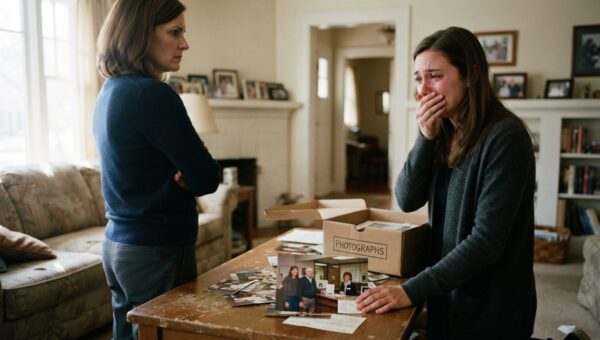
Eleven years of returned envelopes with their green holiday stamps crossed out in thick black marker flashed behind my eyes. Eleven years of silence that I had polished and guarded like church silver.
When the final benediction was spoken, I didn’t linger in the vestibule to trade small talk about the weather or the blight on the corn crop. I walked straight out the heavy oak side doors, past the slate steps where I used to watch Celia jump down two at a time when she was seven years old, and got straight into my sedan.
The drive across town took twelve minutes. I watched the dry corn stalks sway in the ditches along Route 9, their brown leaves rattling against each other in the October gusts. I kept thinking about the summer of 2015, when Celia sat across from my kitchen table and told me she was marrying Mark.
He was thirty-four, divorced with two children already in school, and worked down at the grain elevator with grease permanently etched into the lines of his thumbs.
“You’ll spend your life cleaning up somebody else’s mess,” I told her that afternoon. My voice hadn’t even shaken; I had said it like I was reading a recipe from a box.
Celia hadn’t yelled back. She had just looked at me with those quiet, steady eyes she must have inherited from her grandfather, the ones that never blinked when things got hard. “It’s not a mess, Mom. It’s just a family,” she said.
I skipped the wedding. I didn’t send a toaster, I didn’t send a check, and I certainly didn’t go to the small backyard ceremony behind her rented duplex. When the first Christmas card arrived in December of that year, bearing a photograph of Celia in a simple blue dress standing between Mark and two sticky-faced children who weren’t hers by blood, I carried it to the trash can without opening the flap.
I did that every December for over a decade. Every time I saw her car parked down at the grocery store or caught a glimpse of her dark hair turning an aisle at the pharmacy, I turned my cart around and walked the other way. I had drawn a line in the dirt, and by God, I intended to stay on my side of it.
Until the choir director said her name over the PA system.
Twenty-seven thousand five hundred dollars. The exact figure of the educational trust fund my own father had left me, the one I had publicly locked away in a separate account back in 2015 with instructions that not a single cent of it would go toward a broken family. She hadn’t asked for it. She hadn’t begged. She had taken that exact number and thrown it back into the teeth of the town as a shelter donation, proving every single thing I believed about her ruin was a lie.
I pulled my car into the small gravel lot behind the dental office on Maple Street. The sign on the brick wall read Monroe Family Dentistry in neat, understated brass letters. The building used to be an insurance agency, but someone had put up window boxes full of hardy mums that were still holding their color against the frost.
My palms were dry and cold on the steering wheel. I sat there for three full minutes, watching the exhaust pipe of a pickup truck puff gray clouds into the bright, thin sunlight. My first instinct, the one I had practiced for eleven years, was to put the car in reverse, go home, and pretend I had never heard the announcement at all. I could pull the shades, make a pot of tea, and wait out the afternoon.
Instead, I killed the engine. The key made a little chime in the ignition that sounded too loud in the quiet car.
I pushed through the glass front door of the clinic, and the smell hit me immediately. It wasn’t the smell of old medicine or damp carpet that I half-expected. It smelled like fresh lemon oil and mint, clean and bright and entirely unbothered by my presence.
A young woman with neat blond hair and wire-rimmed glasses sat behind a high curved desk of light maple wood. She looked up from her computer screen the second the door latch clicked shut behind me. She didn’t look startled or confused. She looked like she had been waiting for me since nine o’clock that morning.
“Can I help you?” she asked. Her voice was polite, flat, and entirely professional.
“I’m looking for Dr. Monroe,” I said. My tongue felt thick, like I had been chewing on cotton.
The receptionist didn’t touch her keyboard. She rested her hands flat on the desk, right beside a clear plastic jar filled with sugar-free suckers.
“She knows you’re here,” the receptionist said, and the air in the small room seemed to drop ten degrees. “She asked whether you came to apologize or…”
She let the sentence hang right there between us, hovering over the polished wood like a dropped tool. She didn’t finish the “or.” She didn’t have to. The silence did the work for her.
“Or what?” I asked, though my voice came out smaller than I wanted it to.
“Or if you just came to see that you were wrong,” the receptionist said simply, not unkindly, but with a total lack of fear that told me she knew every single returned Christmas card by heart.
I didn’t answer. I couldn’t. My throat felt like it was full of dry grass.
“Third door on the right,” the receptionist said, nodding down a narrow hallway where the walls were painted a pale, restful green. “Go on back. She’s between appointments.”
My boots felt heavy on the commercial carpet. Every step sounded like a mallet hitting a floorboard. The walls were lined with framed certificates from the state university and pediatric dental boards, dates stretching from 2018 all the way up to last spring. I passed an open door where a small dinosaur mobile hung over a child’s chair, the little plastic triceratops spinning slowly in the draft from the vent.
The third door on the right was standing half an inch open.
Celia was sitting at a glass-topped desk, her reading glasses pushed up into her dark hair. She was signing a stack of purple chart folders with a black fountain pen, her hand moving in short, decisive strokes. She wore a simple gray tunic with her white coat draped over the back of her ergonomic chair. She looked older than the girl who sat at my kitchen table eleven years ago, but the line of her jaw was exactly the same, stubborn and square and carved out of the same stubborn stone as my own.
I tapped twice on the wooden frame of the door.
Celia didn’t jump. She finished the signature on the folder, closed the cover with a soft snap, and then slowly looked up. Her eyes were the exact shade of gray as my father’s, the kind of eyes that don’t need to yell to let you know they’ve taken your measure.
“You missed church,” I said. It was the stupidest thing I could have possibly uttered, the kind of defensive little jab my mother used to throw when she burnt the Sunday roast.
Celia didn’t smile. She didn’t frown either. She just crossed her hands over the closed chart folder on her desk.
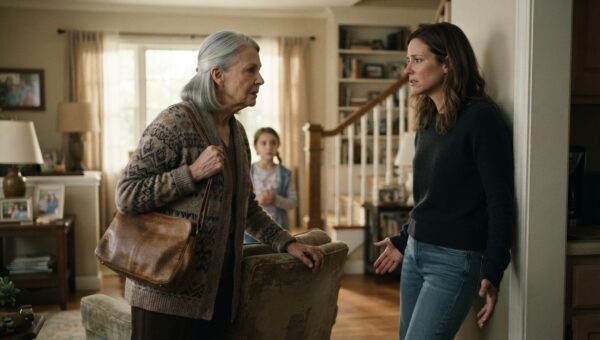
“I haven’t been to First Methodist in nine years, Mother,” she said. Her voice was quiet, completely level, without a single tremor of anger in it. “Mark and the kids go to the fellowship over on 4th Street now. They have a good Sunday school.”
“I heard about the shelter,” I said, standing there in the doorway with my hands clutched around the straps of my purse like I was holding onto a raft in deep water. “The twenty-seven thousand. The choir director read it out.”
“It’s a good shelter,” Celia said. She leaned back in her chair, the leather creaking slightly. “They helped Mark’s sister get back on her feet after the bad winter we had back in eighteen. We try to give back what we can.”
“That was the exact amount…” I started, but my voice hitched on the middle of the sentence.
“The trust fund,” Celia finished for me, her tone still completely flat, like she was reading off a dental chart. “Yes. Father’s trust. You had the lawyer draft the exclusion papers down at the county seat in November of fifteen. You made sure everyone at the bank knew why it wasn’t coming to me.”
I swallowed hard. The taste of dust was back in my mouth. “You put yourself through the dental residency with three kids in the house? How did you manage the tuition?”
Celia looked at me for a long time, her gaze dropping down to my knuckles where they were white against the leather of my bag.
“Night shifts at the regional medical center cleaning trays,” she said plainly. “Mark took the kids on Tuesdays and Thursdays while I studied organic chemistry at the community college kitchen table. We ate a lot of pinto beans and corn bread. But we didn’t miss a mortgage payment, and we didn’t take a dime from anyone who thought our family was a mistake.”
The words hit me right in the chest, not like a blow from a fist, but like a cold draft through an unlatched door. I had spent eleven years imagining her drowning in the mess I had warned her about. I had pictured her broken down, exhausted, coming back to my back porch with her hat in her hand to admit that her mother had been right all along. I had saved my judgment like money in a rainy-day jar, waiting for the day I could spend it.
Instead, she had built a life so solid and clean that my judgment didn’t even leave a mark on it.
“I returned the cards, Celia,” I whispered, the confession coming out before I could stop it, tasting like old tin. “Every single one of them for eleven years. I put ‘Return to Sender’ right across your handwriting.”
Celia finally moved. She reached out, picked up a small blue appointment card from the corner of her desk, and turned it over once between her fingers.
“I know,” she said softly. “We stopped sending them around twenty-twenty. Mail costs add up, and I figured you had enough paper in your trash can.”
The silence came down then, heavier than the one in the church pew, but this time there was nowhere to hide behind a hymnbook. My knees felt weak, and for the first time in my life, I didn’t care what the receptionist was hearing out through the frosted glass.
“I was wrong,” I said. The words tasted like iron and salt, but once they were out of my mouth, the room seemed to clear a little bit. “I was wrong about the family. I was wrong about you.”
Celia didn’t jump up to hug me. She didn’t weep or throw her arms around my neck like they do in the movies. She just nodded once, slow and deliberate, and laid the blue appointment card down on the corner of the glass desk.
“It took you a long time to get here, Mom,” she said quietly. She picked up her fountain pen again, tapping the silver nib gently against the edge of the blotter. “The door was always unlocked. You just had to stop carrying so much baggage on the porch.”
I stood there in the doorway for another ten seconds, the cold wind outside rattling the mums in the window boxes. Then I let go of my purse strap, took two steps forward, and set my leather bag down on the edge of her desk.
Celia watched me without moving.
“I’m not doing anything on Tuesday,” I said, my voice barely audible over the hum of the small air purifier in the corner of the office. “If you still have room for coffee.”
Celia looked down at the desk, then back up at me, a tiny, tired shadow of a smile finally touching the corners of her mouth. She reached out and slid the blue appointment card across the glass toward my hand, her handwriting neat and precise in black ink.
“Tuesday at ten,” she said. “Don’t be late.”