The heavy legal folder sat on the passenger seat of my sedan, bound with a thick rubber band that smelled faintly of old rubber and municipal dust. I had kept it tucked behind the spare tire in the trunk for four months, wrapped in a plastic grocery bag so the damp wouldn’t get to the ink. It was four hundred and twelve pages of canceled checks, county property assessments, signed contractor affidavits, and bank statements dating back to the winter my father’s heart scare landed him in Mercy General and I sold my small townhouse to bail out their second mortgage.
My phone buzzed against my thigh while I was doing seventy-five on the highway coming back from the airport, the third time in ten minutes the screen lit up with the local area code. I didn’t look at it until I pulled off at the exit ramp near the interstate diner with the neon sign flickering in the grey afternoon mist. When I tapped the screen, Chloe’s face popped up in the little circle, and I knew before I slid the green bar across. Fourteen-year-old kids don’t call their mothers in the middle of a Tuesday unless the roof is literally falling in.
Her voice didn’t even sound like her own when she finally picked up. It was thin, shaking so hard she could barely get the syllables out between her gasps for air. She was sitting on the wooden bench outside the public library two miles from my parents’ house, clutching her red canvas backpack against her chest like a shield.
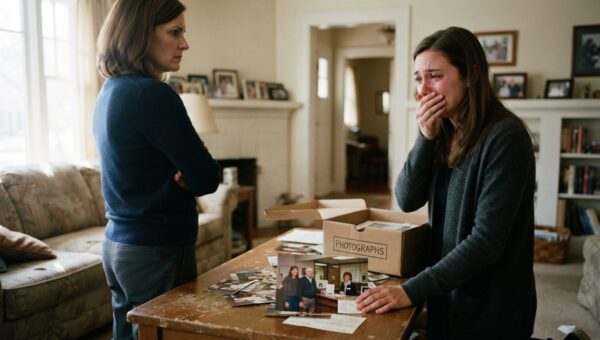
My father had stood in the foyer with his arms crossed over his chest while my mother handed her a blue plastic grocery sack filled with six t-shirts and a pair of sneakers.
She told me what they said. They didn’t even try to soften it.
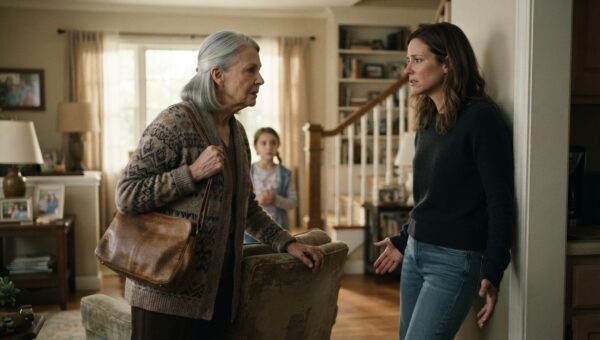
“Pack your things,” my mother had told her, her voice flat as tap water. “Ethan is coming down from college for the entire semester to help your grandfather with the yard work, and we need your room back. You’re fourteen. You can stay with your aunt in the city or find somewhere else. Your mother’s out of town anyway.”
That was the moment the earth stopped spinning for a second. I didn’t scream. I didn’t cry. I just gripped the steering wheel until my knuckles turned yellow and felt something cold and hard settle right behind my ribs.
I had spent the last three years living under their roof in that rambling ranch house on Maple Street.
After my divorce, when the legal fees ate every penny of my savings, my parents had offered the spare bedroom. They said it was family duty. They said nobody should weather a storm alone. But every single month, my father reminded me whose name was on the deed, and every single weekend, my sister’s golden-boy son Ethan treated the place like his private fraternity annex. Chloe had been sleeping on a pull-out couch in the converted den for eighteen months while Ethan kept his old childhood bedroom untouched, complete with a flat-screen TV and a double bed he used twice a year.
When Ethan called two days ago to announce he was taking a semester off to “find his center,” my parents didn’t hesitate. They didn’t ask where Chloe would go. They just looked at my fourteen-year-old daughter as if she were a piece of stray luggage left in the hallway.
I didn’t go back to the office. I didn’t call my boss to explain the missed quarterly review in Chicago. I simply turned the rental car around at O’Hare, drove straight to the ticket counter, and paid four hundred dollars cash for the first seat heading south.
Three hours after landing, I pulled into the gravel driveway on Maple Street with the trunk lid unlatched and the legal folder clutched in my left hand like a weapon. The house looked exactly the same as it had for thirty years. The same faded blue shutters, the same overgrown boxwood bushes my father refused to trim, and the same heavy oak front door with the brass knocker shaped like an eagle’s head.
I didn’t knock. I pushed the door open with my shoulder.
The smell of pot roast and boiled cabbage drifted out from the kitchen, heavy and familiar. My mother was standing by the stove stirring a pot of gravy, while my father sat at the head of the oak dining table reading the evening paper with his reading glasses perched on the tip of his nose. They both looked up when the latch clicked, expecting Ethan with his duffel bags or maybe the mailman with a flyer.
Instead, they saw me standing in the entryway with my travel coat still zipped up and my eyes locked dead on theirs.
“Well,” my father said, lowering the paper an inch. “I thought you were in Illinois until Thursday. Did your meeting get canceled?”
I didn’t answer him right away. I walked across the linoleum, my boots making a sharp, hollow sound that made my mother flinch. I reached the head of the table where my father sat, raised the heavy manila folder, and dropped it right in the center of the crossword puzzle. The sound it made was heavier than I expected, a dull thud that rattled the salt shaker.
“Open it,” I said. My voice didn’t shake. It was lower than usual, almost quiet. “Page one.”
My father stared at me, his jaw tightening into that stubborn, arrogant line I had grown up fearing. “What is this nonsense? Have you lost your mind? Your mother has been cooking all afternoon, and you walk in here like, “
“Read the first page, Arthur,” I said, using his first name for the first time in twenty years.
He reached out slowly, his thick fingers catching the corner of the heavy cardstock cover. He lifted it back. His eyes scanned the top paragraph, moving from left to right with the slow, deliberate pace of a man who still believed he held all the cards. Then his thumb stopped moving. The color drained from his ruddy cheeks so fast it looked like someone had turned off a lamp behind his skin.
My mother abandoned the gravy spoon. She hurried over, wiping her hands on her floral apron, her forehead wrinkled in that familiar, defensive frown. “What is going on here? Stop being so dramatic. We had to make room for Ethan, you know how hard things are for his mother, “
“Shut up, Helen,” my father whispered. It wasn’t loud, but it had a strange, flat terror in it that made my mother snap her mouth shut.
She leaned over his shoulder, her eyes dropping to the second page where the bank routing numbers and the certified municipal seal were stamped in bright red ink. She reached out a trembling hand to touch the paper, but her fingers shook so badly she missed the corner entirely.
“Wait,” my father said. His voice came out thin and raspy, like dry leaves scraping across concrete. He looked up at me, his eyes wide and blinking behind his bifocals. “How did you get this? Where did you get the county seal?”
“You think I was just sitting here saving for a down payment on a cute little two-bedroom across town, Dad?” I leaned down, resting both palms on the edge of the mahogany table so he had to look straight up into my face. “You think I didn’t notice when you took my name off the secondary title transfer back in nineteen-ninety-eight? You think I forgot the forty-two thousand dollars I wired from my personal savings account to pay off the back taxes on this exact land when the county threatened foreclosure?”
He tried to clear his throat. “That was… that was family money. We had an agreement, “
“There was no agreement,” I said, every word dropping like a lead weight. “There was you taking my money to save your retirement while you treated my daughter like an uninvited guest. That folder contains a certified petition for partition of this property, a complete financial accounting of every dime I’ve put into these walls since the day I moved back, and a formal eviction notice for anyone living here who isn’t named on the original deed my grandfather left me before he died.”
My mother let out a small, sharp sound, half-gasp and half-sob. “You wouldn’t. We’re your parents. We gave you a roof when your husband left you with nothing!”
“You gave me a room with a broken lock and made my fourteen-year-old child sleep on a folding cot for a boy who hasn’t worked a day in his life,” I said, my voice rising just enough to echo off the plaster walls. “And now you’re going to pack his bags instead. Because if he’s still sleeping under this roof by noon tomorrow, the sheriff is going to serve these papers personally, and the court is going to force a public auction on this house before the first snow.”
My father sat frozen, his hands flat against the table as if the paper beneath them was burning his skin. The arrogance that had kept him upright for seventy-two years simply evaporated, leaving behind a tired, small old man in a flannel shirt who suddenly realized he had pushed the wrong person too far.
“We can talk about this,” my mother stammered, her hands fluttering toward me like wounded birds. “Chloe can have her room back. We didn’t mean it like that, it was just temporary, just for the weekend, “
“The weekend is over,” I said.
I didn’t wait for them to say another word. I turned on my heel, my boots clicking once more against the kitchen floor, and walked out the back way toward the garage where Chloe’s remaining boxes were stacked against the water heater.
Ten minutes later, the heavy front door of my parents’ house closed behind us for the final time.
We drove in silence down Maple Street, the dashboard lights casting a soft, warm glow across the interior of the car. Chloe sat in the passenger seat with her window rolled down an inch, letting the cool autumn air brush against her face, holding a small framed photograph of the two of us in her lap.
We didn’t go back to the motel, and we didn’t go back to the city. We drove straight to the small apartment complex on the edge of town where I had signed a twelve-month lease three weeks ago, keeping it a secret in the back of my mind just in case the worst ever happened.
When we pulled into the designated parking spot, I turned off the ignition, and the engine gave a soft, settling tick in the quiet evening air. I reached across the console, took Chloe’s small, cold hand in mine, and squeezed it until she looked up and gave me a tiny, real smile.
We walked up the concrete steps together, past the manicured hedges and the small porch light that burned steady and bright in the dusk. I slipped the brass key into the deadbolt of apartment 4B, and with a clean, satisfying click that belonged to us and nobody else, the door swung open to our own home.