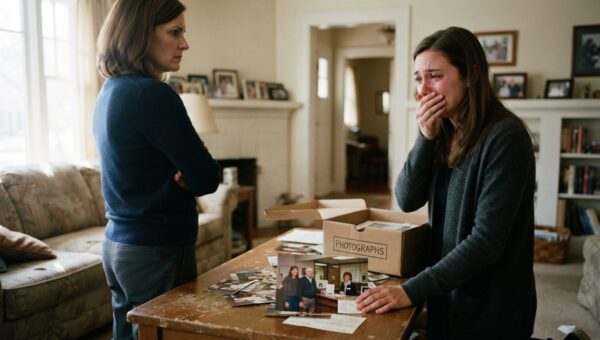
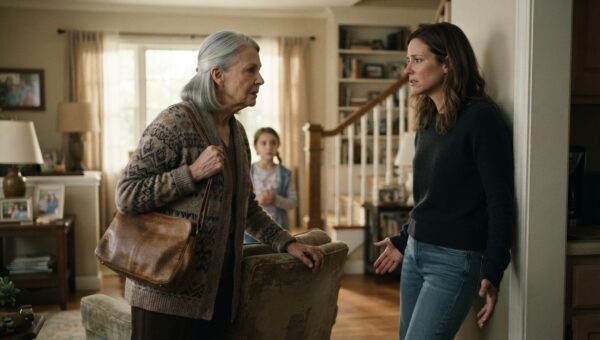
The envelope sat right there on the dark granite island, propped against a bottle of imported olive oil that cost more than my weekly groceries. Brenda had left it out deliberately, I figured. She liked things neat, and she liked them settled.
I stood in the center of their pristine kitchen with my purse strap digging into my palm, listening to the hum of the refrigerator and the faint sound of cartoons drifting from the living room where eight-year-old Leo and five-year-old Maya sat glued to the screen.
Brenda came clicking down the hallway in her sensible loafers, her car keys dangling from one finger.
She didn’t look at me directly. She looked past me, toward the front window where my old sedan was parked in the driveway.
“Everything is restocked,” Brenda said, her voice tight with that crisp edge she used whenever she spoke to me about logistics. “The kids have their snacks in the pantry. Don’t let Maya have juice after six o’clock or she gets wired. And make sure David wipes down the counters before you leave.”
David, my thirty-nine-year-old son, appeared behind her in the doorway. He looked smaller than he was, his shoulders slightly rounded, his gaze fixed somewhere near the baseboard heater. He had always been quiet, but over the last few years, his quiet had turned into something hollow.
“Mom,” David murmured, clearing his throat. “Thanks again for doing this. Brenda really needed this weekend at the spa.”
I gave him a small nod because he was my boy, even if he had grown spineless somewhere around his tenth wedding anniversary. “Have a nice time, David. Drive carefully.”
Brenda tapped her keys against her thigh. She reached into her leather handbag, pulled out a folded slip of thermal register tape, and laid it flat on the counter beside the olive oil. She smoothed it down with her thumb.
“Oh, before I forget,” Brenda said, her tone light in that way that always meant trouble. “I went over the utility tallies from last week. With you coming down here every Friday for the full day, the paper product consumption has gone up noticeably.”
I blinked. “The paper products?”
“The toilet paper, Evelyn,” she said, offering a tight, patronizing smile that didn’t reach her eyes. “We buy the triple-ply bamboo rolls from the co-op. They aren’t cheap. It came out to six dollars and eighty-four cents for your share of last month’s usage. I just figured we should square it now so we don’t lose track.”
The silence in the kitchen stretched out, heavy and sharp. I looked from the thermal slip to Brenda’s face.
Then I looked at David. My son shifted his weight from one foot to the other, staring intently at a smudge on the refrigerator door. He didn’t say a word. He didn’t tell his wife she was being ridiculous. He just let her stand there and charge his mother six dollars and eighty-four cents to use the bathroom after driving forty-two miles each way to give them free childcare.
“This isn’t a free hotel, Evelyn,” Brenda added, as if I might need the clarification.
I didn’t argue. I didn’t raise my voice. I reached into my canvas purse, pulled out my worn leather wallet, and extracted a five-dollar bill, a one-dollar bill, and three quarters. I laid them neatly on the counter, right next to her receipt, and pushed the extra sixteen cents toward her.
“Keep the change, Brenda,” I said quietly.
She took the money without missing a beat, scooped up the coins, and turned toward the door. “Have a good weekend. We’ll be back Sunday evening.”
They were gone ten minutes later, their luxury SUV backing down the suburban driveway with a soft hum. I stood on the front porch and watched them go, feeling the familiar, dull ache in my lower back that always came from the long drive.
When I went back inside to start lunch for Leo and Maya, I opened the refrigerator to get the milk. It was nearly empty. There was half a jar of Dijon mustard, a withered lime, and a carton of almond milk that had expired four days ago. In the freezer, I found a box of freezer-burned waffles and nothing else. There was no household cash left on the counter, no grocery card, and no emergency envelope. They had left two growing children for three days with nothing to eat except whatever scraps remained behind their fancy condiments.
I sat down at the kitchen table and let out a long breath. My monthly Social Security check was one thousand four hundred and eighty-six dollars. After rent, prescriptions, and insurance, I didn’t have a great deal of margin for error. But I had my savings passbook tucked in my drawer back home, and I had two hungry grandchildren sitting in the next room asking when sandwiches were coming.
“Grandma, can we have grilled cheese?” Maya asked, peeking around the corner with her thumb near her mouth.
“We sure can, sweetheart,” I said, smoothing back her fine brown hair. “Go wash your hands. We’re going on an adventure.”
The trip to the neighborhood market cost fifty-four dollars and twelve cents before we even reached the produce aisle. By the time I loaded up the cart with whole wheat bread, sharp cheddar, fresh apples, ground turkey for taco night, milk, cereal, a package of chicken tenders, and a couple of frozen pizzas for emergencies, the register tape read two hundred and fourteen dollars and fifty cents. Then there was the pharmacy run on Saturday morning when Leo woke up with a dry, hacking cough and needed pediatric cough syrup and throat lozenges, which added another twenty-eight dollars and thirty-five cents. By Sunday afternoon, between groceries, fresh fruit, a pack of printer paper Maya needed for a school project due Monday, and a quick box of bandages after Leo scraped his knee on the driveway, my wallet was lighter by three hundred and twenty-seven dollars and eighteen cents.
I didn’t mind spending it on the children. I would have spent my last dollar on them if they needed it. They didn’t ask to be born into a house where their mother measured affection in bathroom tissue quotas and their father stood by like a mute spectator.
We had a wonderful weekend, despite the empty cupboards. We made pancakes from scratch on Saturday morning, using flour I had to buy myself. We read library books on the living room rug, and I taught Maya how to play gin rummy with an old deck of cards I found in the desk drawer. Whenever Leo laughed, throwing his head back just the way David used to do when he was seven, my chest tightened with a fierce, protective warmth. I loved those children more than I loved breathing. But as Sunday evening drew closer, watching the headlights sweep across the ceiling as neighbor cars passed outside, my mind began to settle into a cold, hard focus.
When the children were finally tucked into bed at eight o’clock, the house fell completely silent.
I turned on the desk lamp in the small guest room and pulled a clean sheet of yellow legal paper from my bag. I reached into my purse and spread every single receipt across the wood grain, lining them up in neat chronological rows. The supermarket tape. The pharmacy receipt. The craft store receipt for Maya’s project supplies.
With a blue ballpoint pen, I wrote a column down the margin. I added the numbers twice to make sure there were no mistakes. Three hundred and twenty-seven dollars and eighteen cents.
Then I subtracted the six dollars and eighty-four cents I had paid Brenda on Friday for using her bathroom.
The remaining balance came out to three hundred and twenty dollars and thirty-four cents.
I didn’t rush. My hand was steady as I wrote out the note. I didn’t use harsh words or insults. Anger is a wasted emotion when arithmetic does the job much better. I simply laid out the facts in plain English, the kind of language Brenda liked so much.
When the note was finished, I folded it twice and placed it directly in the center of the kitchen island, right where Brenda had left her olive oil bottle. On top of the folded paper, I laid the neat pile of itemized receipts, weighted down by my car keys.
I packed my overnight bag, zipped it shut, and carried it out to the sedan. The night air was cool and smelled of dry dust and distant eucalyptus trees. I started the engine, backed out of the driveway without turning on the radio, and drove the forty-two miles back to my quiet little apartment in town, arriving just as the streetlights hummed awake.
Monday morning broke gray and overcast, the kind of heavy sky that promised rain over the foothills.
I was sitting in my kitchen drinking black coffee when the phone rang at 8:14. I knew it was David before I even looked at the screen. His name glowed against the glass, steady and persistent.
I let it ring until it went to voicemail.
Ten minutes later, it rang again. Then a text message popped up. It was from David. *Mom, where are you? Brenda is freaking out. What is this note on the counter?*
I picked up the phone and typed back a single sentence. *I am at home. Read the receipts, David.*
The phone didn’t ring again for nearly an hour. When it finally buzzed at nine-thirty, I answered it.
“Mom?” David’s voice sounded ragged, thin around the edges like cheap cotton. In the background, I could hear Brenda’s voice rising, sharp and shrill, shouting something about disrespect and boundaries and insolence.
“I’m here, David,” I said evenly.
“Mom, what is this?” he asked, his voice cracking slightly. “Brenda is furious. She found these papers on the counter and, and she says you’re keeping score. She said you can’t just bill us for groceries.”
“Did you read the note, David?” I asked.
There was a long pause on the other line. I could hear him breathing, shallow and fast.
“I read it,” he whispered.
“And was it accurate?”
“Mom, you can’t just leave like that. The kids woke up looking for you.”
“The kids woke up hungry because the refrigerator had nothing in it except expired milk and a jar of mustard,” I said, my voice dropping into that low, steady register I used when I taught middle school history thirty years ago. “I spent three hundred and twenty-seven dollars and eighteen cents of my fixed monthly income feeding your children this weekend because you and your wife left for a resort without buying groceries. And on top of that, your wife charged me six dollars and eighty-four cents for toilet paper on Friday. I subtracted it from your total. You owe me three hundred and twenty dollars and thirty-four cents, David.”
Brenda must have grabbed the phone because her voice suddenly filled the receiver, loud and hysterical. “You think you can come into my house, judge my housekeeping, and leave an invoice like a common tradesman? This is unbelievable! You’re toxic, Evelyn! You’ve always tried to undermine our household!”
I didn’t yell back. I didn’t sigh. I just held the phone a fraction of an inch away from my ear until she paused to draw breath.
“Brenda,” I said softly into the silence. “You told me yourself on Friday that this isn’t a free hotel. You were entirely right. And I am no longer your free staff. If you want me to watch your children again, they will come to my house. And if you ever speak to me about toilet paper or hotel fees again, you will be paying professional daycare rates starting at fifteen dollars an hour. Do we understand each other?”
The line went dead. Brenda had hung up.
I placed the phone facedown on the laminate table, took a sip of my coffee, and stared out the window at the parking lot where my old sedan sat gleaming under the gray sky. My hands didn’t shake. Not once.
It was nearly two o’clock in the afternoon when I heard a familiar rumble in the alley behind the apartment complex. I looked through the kitchen blinds and saw David’s sedan pull into an empty visitor slot.
He got out alone. Brenda wasn’t with him. He walked up the concrete stairs, his head down, carrying a plain white envelope in his hand.
When he knocked on my door, I didn’t rush to open it. I waited a moment, wiped my hands on my apron, and turned the deadbolt.
David stood on the narrow landing looking tired, his hair slightly uncombed, his jacket unzipped against the wind. He looked like the boy who used to scrape his knees playing league baseball and come home expecting his mother to fix it all with iodine and a dry bandage.
He didn’t look at my eyes. He held out the white envelope.
“She’s… she’s upset, Mom,” David said, his voice thick. “She wants an apology.”
I didn’t take the envelope immediately. I folded my arms across my apron. “Did you bring what you owe, David?”
He swallowed hard, looking down at the paper in his hand. He pulled out a thick wad of bills, twenties and tens, crisp and new, and held them out. “Three hundred and twenty dollars and thirty-four cents. Exactly what was on your list.”
I reached out then, took the money from his fingers, and counted it right there on the threshold. Every last bill. I slid it into my apron pocket.
“Thank you, David,” I said.
He stood there for a second longer, shifting his weight, hoping I would invite him in for coffee, hoping I would smooth it all over and tell him everything was fine, the way I had done a thousand times before when he was too afraid to face the music at home.
“Can you… can you still watch the kids on Friday?” he asked quietly.
“I would love to watch my grandchildren, David,” I replied, keeping my voice gentle but absolute. “Every other weekend, right here in this apartment. They can sleep in the spare room. I’ll have groceries in the pantry, and I won’t charge them a single penny for the toilet paper.”
David looked up, finally meeting my eyes, and I saw something break behind his gaze, some long-standing illusion that he could keep the peace by letting everyone else chip away at his mother’s dignity. He didn’t argue. He just nodded once, slow and heavy.
“Okay, Mom,” he whispered. “I’ll tell her.”
He turned around, walked back down the metal stairs, and got into his car without looking back.
I closed the door, locked the deadbolt twice, and walked back to the kitchen. I pulled the cash from my apron pocket, laid it on the counter, and smoothed the wrinkled twenties with the palm of my hand. The kitchen was quiet, warm, and entirely my own.
On Friday afternoon, the doorbell would ring, and Leo and Maya would come running up those stairs with their backpacks bouncing against their jackets, eager for pancakes and card games in a house where nobody ever kept score.