The kettle on the stove always made a low, whistling wheeze right before it boiled over, a sound I had come to rely on for setting the rhythm of my mornings. For fifteen years, my kitchen had been my fortress. I kept the counters clear of crumbs, the mail sorted into neat stacks by date, and the deadbolt thrown twice every single night.
I didn’t go to funerals for ghosts. When the parish clerk called to tell me Clara had passed away during delivery at thirty-seven years old, I was halfway through folding a basket of linen towels. I didn’t drop the pillowcase. I didn’t even stop folding.
“She’s been already dead to me for years,” I told him, and then I hung up the wall phone before he could offer me any of that small-town sympathy I never asked for and never wanted.
Fifteen years earlier, I had walked down the hallway of our small house and found Dennis and Clara standing in the kitchen in the gray light of dawn. Dennis didn’t even try to hide it. He just looked at me with that tired, blank expression men get when they are sick of pretending they care about anyone besides themselves. Clara was twenty-two then, wearing my favorite wool sweater and looking away like she was embarrassed by the wallpaper instead of what she had just broken.
I didn’t scream. I packed two suitcases, walked out to my old blue pickup truck, and drove straight to a lawyer’s office downtown. I never spoke to either of them again. I didn’t care about the divorce settlement details beyond making sure my name was stripped of everything tied to them.
When the local gossips whispered about Clara living alone in a small rental trailer down by the bayou over the years, I turned the radio up whenever I saw them coming. When my mother tried to slip Clara’s name into a phone call back before she passed, I simply stopped picking up until the subject changed. You build a wall brick by brick until it is tall enough that you forget what the landscape looked like before the stones went up.
So when the heavy knock hammered against my front door at 4:14 in the afternoon, right when the shadows were stretching long across the porch floorboards, I thought it was just the rural mail carrier dropping off a parcel that wouldn’t fit in the box.
Instead, Attorney Vance stood on my welcome mat. He looked older than he had fifteen years ago, his gray suit a little too large for his shrunken shoulders, holding a worn brown leather briefcase in one gloved hand and a thick manila envelope in the other.
He didn’t smile. People didn’t usually smile when they came to see me because I had spent a decade and a half making sure they knew I wasn’t the welcoming type.
“Darlene,” Vance said, shifting his weight onto his left hip. “I know you weren’t at the service yesterday. But there’s something inside this packet that belongs on your kitchen table.”
“Nothing of Clara’s belongs in my house, Arthur,” I said, my hand resting flat against the edge of the screen door. “You can take it down to the county clerk or whoever handles the estate cleanup. I am not interested.”
“It isn’t an estate cleanup,” Vance replied quietly, and he didn’t move an inch. “It’s a guardianship filing, Darlene. Clara named you on page four, and the court already signed off on the temporary emergency placement because there is nobody else left.”
My thumb tightened on the latch of the screen door until the wire bit into my skin. “There are cousins. There are aunts.”
“They all refused,” Vance said simply. “And the father isn’t in the picture. He cleared out six months ago when he found out she was keeping it. The baby is sitting in a bassinet at St. Jude’s regional intake office right now, and by court order, you have forty-eight hours to accept custody or the state takes her into foster care.”
He didn’t wait for an invitation. He stepped past me into the hallway, laid the heavy manila packet right on the laminate counter next to the electric kettle, and walked back out without another word. The front door clicked shut behind him, leaving me alone in the quiet kitchen with the hum of the refrigerator and a pile of papers that smelled faintly of old hospital sheets and cheap lavender soap.
I stood there for a long time, staring at the brass corner of the envelope. The kettle gave its little wheezing whistle on the burner, and I walked over mechanically to turn the dial off. My hands didn’t shake. I pride myself on that. I have always been the one who stays steady when everyone else is falling apart.
I sat down at the table, pulled the thick stack of documents out, and let the first page slide across the wood. It was a birth certificate from St. Jude’s General Hospital, dated twelve days ago. Mother: Clara Marie Hayes. Father: Unknown. Child: Baby Girl Hayes, birth weight six pounds four ounces.
Stuck behind the medical forms was a folded piece of yellow legal pad paper covered in Clara’s familiar, hurried handwriting. It looked almost identical to the grocery lists she used to leave on our kitchen counter back when we still shared a roof and a last name.
I didn’t want to read it. I told myself I wouldn’t. But my eyes caught the first line before I could look away, and the words pulled me in by the throat.
“Darlene, if you are reading this, it means I didn’t make it off the table and Arthur found you,” Clara had written. “I know what you think of me. You were right to think it. I spent fifteen years watching you from across town, seeing how you built a good, honest life out of the ashes I made for you, and I never had the courage to look you in the eye and say I was sorry. This little girl doesn’t have anyone in the world except for the sister I betrayed. I left her my savings account, all sixty-nine thousand one hundred and thirty-six dollars from the bakery job, so she wouldn’t cost you a dime. Please don’t let them put her in a stranger’s house. Please let your justice have a little room for mercy.”
I sat there at the kitchen table until the sun went down behind the oak trees and the room turned the color of wet slate. Sixty-nine thousand dollars. A bakery job she worked through swollen ankles and late-night sickness while living in that drafty trailer by the water. She had spent fifteen years saving every penny, not to buy herself out of her misery, but to pay a debt she knew she could never settle with words.
The anger that had kept me warm and hard for half my life suddenly felt thin and brittle, like old parchment left out in the sun. It didn’t feel like a shield anymore. It felt like a cage I had locked myself inside, throwing away the key just to prove I was stronger than the pain.
At 6:30 the next morning, my blue pickup truck was idling in the gravel parking lot behind the St. Jude’s intake annex. The interior smelled of old coffee and damp upholstery, the same way it had the day I drove away from Dennis and Clara with my life packed into two cardboard boxes.
The intake nurse was a tired-looking woman with gray hair pinned up in a messy clip and a blue scrub top with little embroidered sunflowers on the pocket. She led me down a linoleum-floored corridor that smelled of formula and bleach, stopping in front of a small glass-walled nursery where three plastic bassinets sat in a row.
“She’s been sleeping most of the morning,” the nurse said, unlocking the door with a quiet click. “The social worker left the discharge papers on the desk. You just need to sign the bottom line.”
She walked over to the middle bassinet and lifted a small, blanket-wrapped bundle out, cradling it against her shoulder before turning to hand her over.
When I reached out and took the baby, my arms felt stiff and awkward, like I had forgotten how to hold anything fragile. The infant was tiny, her face pink and crumpled, with a shock of dark hair that stuck up in a little tuft right at the crown of her head. She didn’t cry. She just shifted against my chest, let out a tiny, fluttering sigh, and tucked her small hand up under her chin.
She looked nothing like Dennis. She looked nothing like Clara, either. She just looked like a beginning.
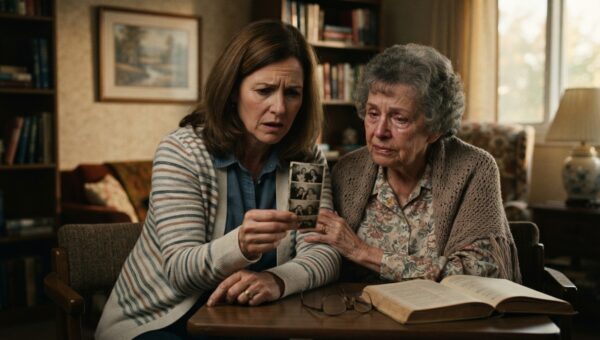
I signed the papers on the high metal counter in the hallway, my signature steady and dark against the white form. Arthur Vance was waiting by the front doors with a final file box containing Clara’s few personal effects, a worn Bible, a silver locket with the chain broken, and a small envelope of photographs from when we were girls before any of it happened.
I drove home with the car seat strapped securely into the passenger side front seat, glancing over every time I stopped at a red light to make sure the little bundle was still breathing.
By evening, the house was too quiet again, but it was a different kind of quiet. It wasn’t the dead, empty silence I had guarded for fifteen years. It was the heavy, breathing stillness of a home that had just been forced wide open.
I sat in my usual armchair under the amber glow of the single floor lamp, gently rocking the sleeping infant against my chest while my left hand reached down into the cardboard box Vance had dropped off. My fingers brushed against the cold metal snap of an old photograph frame from 1998, showing Clara and me smiling on the back porch before everything went wrong.
Without looking down at it, I dropped the frame straight into the recycling bin by my feet, letting the cardboard rattle against the bottom. Then I pulled the blanket a little higher around the baby’s shoulders, resting my chin against her soft, warm head as the porch light flickered on against the gathering dark outside.