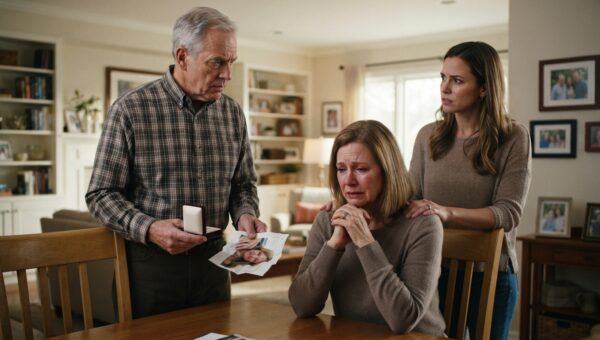
The flowers came to our house by mistake on Mother’s Day. A big spring bouquet, eighty dollars on the receipt taped to the wrap, and I don’t have children. I read the little card twice. To Mom, from Daddy and the twins. My husband Wilford was out in the garage sorting through old spark plugs. I lowered myself onto the porch step because my knees felt funny.
Thirty-one years married, and I had made my peace with childlessness a long time ago. Or at least I thought I had.
I called the florist to report the wrong address. The girl was cheerful, the kind of bright-eyed kid who probably still thought life made sense.
“Oh, Mr. Sowards’s standing order,” she said, tapping her keyboard. “Every Mother’s Day since 2014.”
Same name. Same card. I asked, real quiet, for the delivery address on file. She read me a street four miles from my church. Then she read me the name he had written under the twins’ names.
I sat there on the cedar porch for a long time after hanging up. The screen door of the garage creaked open, and Wilford came out wiping his greasy hands on a blue shop rag. He looked seventy-one years old in the harsh noon sun, his graying hair sticking to his forehead, wearing the same canvas jacket he wore when we bought this place.
He didn’t look like a man keeping secrets. He looked like the man who fixed my kitchen sink last Tuesday without being asked.
“Everything alright out here, Ruth?” he asked, tossing the rag into the metal bin.
“Misdelivered flowers,” I said, holding up the heavy glass-wrapped bunch. “Wrong address.”
“Ah. Florists get mixed up sometimes,” he muttered, not meeting my eyes. He turned back toward the garage before I could say another word. That was the first wrong note. Wilford never brushed off a mistake like that. Usually, he would have lectured me about calling customer service to make sure the poor kid didn’t get docked her pay.
I waited until he drove down to the hardware store for his usual Sunday supply run. He always went on Sundays at one o’clock. Said the aisles were empty and he could think. I got into my sedan, the engine whining twice before catching, and I drove four miles away from our quiet street toward the edge of town where the houses got smaller and the lawns had more weeds than grass.
The address the florist gave me belonged to a small, yellow-trimmed bungalow with peeling paint on the porch rail. A red tricycle lay on its side in the patchy grass. I parked three houses down, my hands gripping the steering wheel so hard my knuckles went bone white. A young woman with her hair pulled back in a messy clip came out the front screen door carrying a basket of wet laundry, her movements hurried and tired. Two little boys, maybe six or seven, tumbled out behind her, chasing a yellow plastic truck.
I sat in my idling car and watched them for twenty minutes. My chest felt tight, like someone had cinched a belt around my ribs.
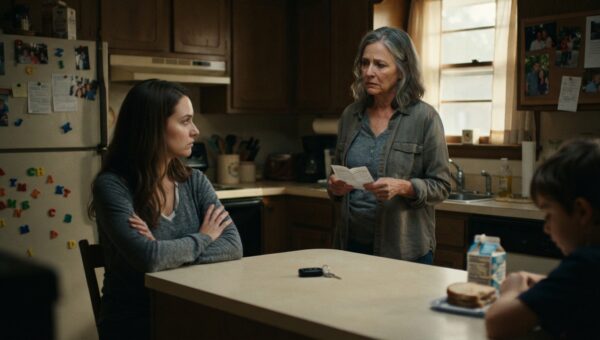
When I got home, I didn’t turn on the kitchen lights. I sat at the white laminate table and waited. At 3:15, his truck crunched down the gravel driveway. The engine died.
The heavy thud of the truck door shut echoed across the yard. Wilford walked through the back door carrying a small brown paper bag from the hardware store, but when he saw me sitting at the dark table with the florist receipt laid out flat between the salt and pepper shakers, he stopped dead in his tracks.
“Ruth,” he said. His voice was just a dry croak.
“Who are they, Wilford?” I asked. I didn’t scream. I didn’t throw anything. I was too tired for drama. “Thirty-one years. Who are they?”
He dropped the paper bag on the counter. It slid an inch across the formica. He pulled out the wooden kitchen chair across from me and sat down very slowly, like his joints were made of glass. He looked older than seventy-one right then. He looked eighty.
“It started after the accident,” he began, his eyes fixed on the grain of the table. “Spring of 2014. You remember young Jimmy Miller from the machine shop?”
“The boy who worked for you,” I whispered. I remembered the funeral. I remembered Wilford coming home that night covered in oil and staring at the wall until three in the morning without saying a word.
“He was twenty-four,” Wilford said, his voice cracking slightly. “Left behind Chloe and twin boys who didn’t even know what happened. The driver was drunk, Ruth. Just wiped them out on Route 4. Jimmy didn’t have life insurance. Nothing. Chloe was working twenty hours a week at the diner and drowning in bills.”
He reached out a heavy, grease-stained hand and touched the corner of the florist receipt.
“I went over there to help fix her back steps so the kids wouldn’t trip,” he continued, staring at the paper. “And I just… I saw the way she was trying to hold it all together. And I thought about us. I thought about how we never had kids, how quiet this house has been for decades. I didn’t want to tell you because I was scared. Scared you’d think I was looking for what we couldn’t have. Scared you’d think I was replacing something.”
“You’ve been paying for them,” I said. It wasn’t a question.
“I set up an account with the florist so she’d have flowers every Mother’s Day without feeling like charity,” he said, his voice dropping to a whisper. “And I pay for the boys’ shoes and their winter coats. I go over every Sunday while you’re at your book club. I fix their porch. I teach the oldest how to hold a hammer. That’s all it is, Ruth. I swear to you on my mother’s grave, that’s all it is.”
I looked at him across that table. I looked at the man I had lived with for over three decades, the man who knew how I took my coffee and how I liked my garden weeded. The anger I thought would swallow me whole just sort of… drained out, leaving behind a hollow, aching quiet. He hadn’t betrayed our marriage. He had just built an annex on it in the dark, terrified to let me inside.
“You should have told me,” I said, my voice barely carrying across the room.
“I know,” he said. “I’m sorry. I was a coward.”
We didn’t talk for the rest of the evening. The house stayed silent, save for the hum of the refrigerator. But the next Sunday, when one o’clock rolled around and he picked up his jacket from the back of the chair, I stood up from the living room sofa and grabbed my cardigan off the hook by the door.
“Well?” I said, turning to look at him as he paused with his hand on the doorknob. “Are we going to see them or are you just going to stand there holding that toolbox?”
Wilford blinked, his mouth parting slightly in surprise. For a second, he just stared at me like he couldn’t quite believe what he was hearing. Then a slow, shaky breath escaped his chest, and something tight in his shoulders finally let go.
“Come on,” he said softly.
The drive over took six minutes. When we pulled up to the yellow-trimmed bungalow, Chloe came out to the porch, looking nervous as she saw the truck she knew so well, accompanied by a stranger in the passenger seat. She froze when I stepped out of the car, clutching a large paper bag filled with leftover lemon pound cake I had baked that morning.
“Chloe,” Wilford said, his voice steadying as he walked around the hood to stand beside me. “This is my wife, Ruth.”
Chloe looked from Wilford to me, her hands gripping the hem of her cardigan. I walked up the three wooden steps, the same ones Wilford had probably fixed with his own two hands, and held out the bag of cake.
“I hear your boys like sweets,” I said, my voice sounding steadier than I felt. “And I think it’s about time I came over to help with those back steps.”
The following Sunday, and every Sunday after that, the truck stayed in our driveway a little longer before leaving, and sometimes, when the weather was nice, the red tricycle was parked right alongside our lawnmower in the garage.
Today, two coffee mugs sit side by side on our back porch railing, the steam curling up into the crisp air. Across the lawn, two small boys are chasing a red rubber ball through the tall spring grass, their high laughter carrying over the flower beds under Wilford and my watchful, shared gaze.