The red velvet ring box sat open on the white oak dresser, empty as a hollow tooth, while the morning sun slanted across our bedroom floor in that quiet way it always did around eight o’clock. My wife Martha had stopped wearing her wedding band about six months back when her knuckles started acting up with the arthritis, swelling until the gold pinched the skin too tight for comfort.
I had watched her slide it off over the kitchen sink one rainy Tuesday, rubbing the pale white indentation on her finger with a sigh that sounded like letting go of a heavy sack of grain. I understood it completely. Hands change when you get old, and metal doesn’t give an inch.
Then I went looking for the little silver cloth I use to clean my duck decoys, and my thumb brushed against the empty velvet lining of that box. I figured she had tucked it away in the cedar chest downstairs or maybe the small ceramic dish by the back door where she drops her house keys. Days passed, and the house stayed quiet the way it always does after thirty-eight years of marriage, when you know each other’s breathing well enough not to need words. But when I asked her casually where she had put it for safekeeping, Martha didn’t turn around from the stove.
She just kept stirring the oatmeal and said she had put it somewhere safe.
The phrase sat wrong in the air. Martha doesn’t hide things from me, not ever. We share a checkbook, a truck, and a history that goes back to the county fairgrounds in nineteen-eighty-four, back when my boots were new and her hair fell past her shoulders in a thick brown braid. I let it drop that morning because a man learns when to press and when to wait, but the empty box kept nagging at the back of my mind like a burr in a wool sock.
A month drifted by without another word about the ring. Then our granddaughter Chloe came over on a Saturday afternoon with her tablet tucked under her arm, eager to show us pictures from the junior high school fundraiser bake sale down at the community hall. Martha poured lemonade into tall glass tumblers while Chloe tapped the screen, scrolling past rows of frosted cupcakes and kids holding poster board signs.
I leaned over the back of the floral sofa, pointing out the boy who sold the crooked brownies, when Chloe swiped to a wide shot of the whole gymnasium crowd.
Right there in the second row, behind the table piled high with paper plates, a woman’s hand was raised to brush back her hair. On her ring finger sat a plain gold band with a distinct little jagged scratch right beside the small chip in the metal. It was Martha’s ring. I knew that scratch as well as I knew the scar on my left thumb from the old hay baler. I had dropped the ring on the concrete floor of our garage twenty years ago when we were hauling lumber, and the impact had left that exact bite in the gold.
“Chloe, stop right there,” I said, my voice dropping lower than I meant it to. “Go back one picture. Zoom in on that lady by the lemonade stand.”
Chloe tapped the screen, pinching her fingers together until the image blurred and sharpened again. There it was. The same worn gold, the same deep notch near the mounting. I looked up from the glowing screen to find Martha standing by the kitchen archway, a dish towel clutched so tight in her fists her knuckles looked like chalk. She wasn’t looking at the tablet. She was looking at the floorboards right between my boots.
“Martha,” I said, standing up slow from the couch. “Where is your ring? Because I just saw it on a stranger’s hand down at the middle school.”
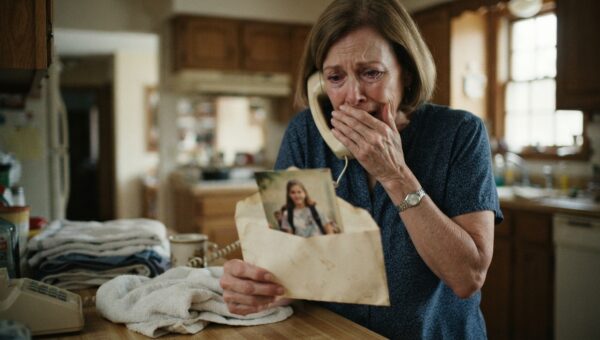
The kitchen went dead silent except for the hum of the old refrigerator in the corner. Martha didn’t answer right away, and that silence felt heavier than any storm I had ever weathered out on the back forty. Her shoulders began to shake, just a little at first, before the tears finally broke over her lower eyelids and she reached up to wipe her cheek with the corner of the dish towel.
“I didn’t loan it,” she said, her voice cracking right down the middle. “I sold it.”
The words hit the air like a dropped wrench. I just stood there by the sofa, my brain refusing to catch up with what my ears had just taken in. You don’t sell a wedding band after thirty-eight years of building a life together, not unless the bank is about to padlock your front gate or the hospital is demanding cash upfront. We weren’t rich, but we paid our bills on time, and we certainly didn’t need to hock family gold for grocery money.
“Sold it?” I asked, the words feeling thick and stupid on my tongue. “To who? Why would you sell our rings? What are you talking about, Martha?”
She wouldn’t look me in the eye. She kept her chin tucked down against her collarbone, crying harder now, the quiet kind of crying that hurts worse to watch than a full-blown shouting match. “I needed the cash for something,” she whispered, her voice trembling so bad I had to strain to catch it. “Something I was hiding. Something I didn’t want you to know about.”
Before I could take a step toward her or demand to know what kind of secret required hocking the gold off her own hand, the front screen door rattled on its hinges and banged shut. Heavy footsteps echoed down the short hallway, and our daughter Sarah walked into the kitchen with her canvas work bag slung over her shoulder, her face flushed from the autumn wind outside. She took one look at Martha standing there shaking with the dish towel and then at me standing frozen by the sofa with Chloe’s tablet still glowing in my hand.
Sarah stopped dead in her tracks, dropping her bag onto the floor with a dull thud that made the china cabinet rattle against the dining room wall. She looked between the two of us, her jaw tightening the way mine always does when I’m about to lose my temper, and she let out a long, ragged breath that told me she had been carrying this weight just as long as her mother had.
“Mom, he deserves to know who the money was for,” Sarah said, her voice ringing out hard and clear in the quiet room. “You can’t keep covering for him anymore. Dad has a right to know.”
The room seemed to shrink right down around us until the walls felt like they were pressing against my ears. I didn’t need them to say his name. The mention of a secret and a hidden need dropped like a cold stone into the bottom of my stomach, because there was only one person in this world who could tear our family apart and then come crawling back through the dark when the water got too deep.
“Nathan,” I said, and the name tasted like old rust in my mouth. I hadn’t spoken it out loud in four years, not since the night he stood in this very kitchen and told me I was a hard-headed hypocrite who didn’t care about anyone except my own stubborn pride. I had told him then that if he walked out that door, he was cutting the last tie, and I meant it. A man’s word has to stand for something, or he has nothing at all.
Sarah crossed her arms over her chest, glaring at me with the same stubborn fire her mother used to have when we were young. “His shop was three days away from being seized by the county for back taxes, Dad. He was going to lose his tools, his truck, and the little apartment above the garage where he’s been sleeping since his wife left him. He didn’t have anyone else to call. He was too ashamed to call you because of the things you said when he left, so he called Mom.”
Martha finally looked up then, her eyes red-rimmed and fierce behind her glasses, daring me to be angry, daring me to start shouting about boundaries and broken promises. “What was I supposed to do, Walter?” she asked, her voice rising with a sudden, desperate strength that caught me off guard. “Let my only boy lose the last shred of what he has left in this world? You can sit there and hold your grudges until your dying day, but I am his mother. A mother doesn’t get to stop keeping score because her husband’s pride is too big to bend.”
The words stung because they were true, every last one of them, but they also cut right to the bone of everything I thought I stood for. I had built my whole life on the idea that actions have consequences, that when a grown man makes his bed he has to lie in it, and that bailing out failure only teaches a person how to fail again. That was the code I lived by, the code my own father handed down to me on a cold Nebraska morning fifty years ago. But looking at Martha’s bare, swollen finger and hearing about our son sleeping above a drafty garage while his life fell apart, that old code felt less like strength and more like a stone wall built around a very empty house.
“How much did you get for it?” I asked, and my voice sounded hollow, like it was coming from the bottom of an empty well.
Martha swallowed hard, wiping her nose with her sleeve. “Fourteen hundred dollars. It was enough to clear the county lien and give him two weeks of breathing room to find another welding contract.”
Fourteen hundred dollars for thirty-eight years of vows melted down into a furnace in the back of some pawn shop on the edge of town. I looked down at the tablet in my hand, at the blurry little photo of a stranger wearing the symbol of my marriage, and then over at my wife, who looked older and more tired than I had ever seen her. The silence came back, but this time it wasn’t the comfortable silence of old age. It was the heavy, clearing-the-air silence that comes right before you have to decide whether you’re going to rebuild something or let it rot.
I reached out and laid the tablet down on the kitchen counter beside the cold oatmeal pot. I didn’t yell, and I didn’t start pacing the floor like I usually do when I’m riled up. Something inside me just settled, heavy and slow, like silt dropping to the bottom of a pond after a tractor crosses the creek.
“Get your light jacket, Martha,” I said quietly, reaching for my old canvas cap hanging by the back door.
She blinked at me, her eyes suspicious and tired. “Where are we going, Walter?”
“We’re going into town,” I said, sliding my truck keys off the brass hook. “We’re going to drive down to that jewelry buyer by the railroad tracks, and we’re going to see if he still has that gold band in his display case. And after that, I suppose we’re going to drive over to Nathan’s garage and see what kind of mess our boy has gotten himself into this time.”
Sarah let out a short, sharp breath that sounded almost like a laugh, though her eyes were still wet, and Martha just stood there by the stove for a long second before reaching over to grab her cardigan from the back of the chair. We didn’t fix everything that afternoon, and we didn’t magically erase four years of bitter silence with a single truck ride down the highway. Some things get broken so deep they always leave a scar, no matter how good the glue is.
By the time we got to the pawn shop, the owner told us the ring had already been melted down into bullion two weeks prior, just like he does with all the scrap gold that comes across his counter. Martha didn’t cry when she heard it; she just nodded once, her hand slipping into mine with a quiet, rough grip that felt like sandpaper against my palm. We didn’t buy a replacement that day either, because you can’t buy back thirty-eight years of history in a strip mall storefront.
Instead, we drove out to the edge of the industrial park where Nathan’s garage sat with its peeling gray paint and oil-stained gravel drive. When he saw my truck pull up beside his old rusted Ford, he came out of the side door wiping grease off his forearms with a dirty rag, looking smaller and thinner than he had the last time I saw him shouting at me across this very kitchen. He didn’t run, and he didn’t put up his fists or start making excuses. He just stopped by the fender of my truck, looking down at his boots the exact same way his mother had looked at the kitchen floor earlier that morning.
We didn’t shake hands, and we certainly didn’t hug, but I told him he could pack his tools and bring his truck over to our property by the weekend to set up in the old tractor shed where there was proper heat and room to work. I told him he’d be paying us rent, and I told him we’d sit down every Sunday night to look at his ledger books so he didn’t end up in a hole like this again. It wasn’t a bailout, and it wasn’t forgiveness handed out on a silver platter. It was just a place to start over, built on the hard, messy truth instead of family pride.
That evening, after the sun had dipped below the ridge and the kitchen had gone dark, I sat at the white oak table with a small piece of scrap pine and a pocketknife, carving out a simple, flat band to measure the size of Martha’s swollen knuckle. I didn’t have gold, and I didn’t have a jeweler’s bench, but I had hands that knew how to work wood until it fit smooth against the skin. When I finished sanding it down under the single overhead light, I placed the plain wooden ring right beside her teacup on the table, not to replace what she had given away, but to mark the place where we finally stopped pretending we could carry our burdens all by ourselves.