The blue construction paper card in Benjamin’s pocket had three jagged layers of cotton glued on to look like snowdrifts, and he had spent two hours coloring the little stick figures on the front with his box of fifty-pack Crayola markers.
He was six years old, and he believed with his whole heart that if you drew someone holding hands with you on a piece of heavy cardstock, it meant they loved you back.
We had driven two hours through the slush on Route 9 to get to the rented mountain lodge where my family spent every December. The air up in the hills always smelled like woodsmoke and old pine needles, but tonight the sharp bite of the freeze was sitting right behind my teeth.
My mother opened the lodge door just four inches and told us to leave.
I remember the exact way her hand looked gripping the edge of that heavy oak door, her knuckles pale under her gold rings, keeping the gap narrow enough that we couldn’t push our way past. Benjamin pulled his handmade Christmas card halfway out of his pocket and then shoved it back in like it had embarrassed him. Behind her, I could smell roast beef and vanilla candles. Laughter rolled from inside, high and clear, belonging to my sisters and their kids. Everyone was there but us.
She said there wasn’t enough room. That we missed an RSVP that never existed.
The lie was so smooth it sounded rehearsed, the kind of neat little fence she had been building around our family for as long as I could remember. Benjamin looked up at me with snow in his eyelashes and whispered, Mommy, did I do something wrong?
I almost broke right there. My chest went tight, the kind of heavy squeeze that makes it hard to pull air all the way down into your lungs.
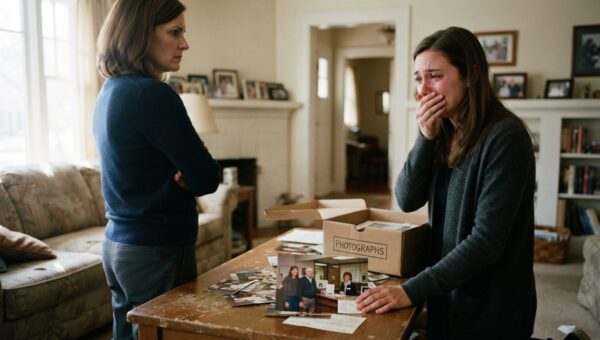
Mark stepped up beside me, his boots crunching loud in the packed powder on the porch, holding the glass pie dish steady against his chest. He didn’t yell at her because Mark knew how my mother operated, how she liked to leave you standing on the wrong side of the glass so she could play the victim of an unorganized daughter later.
I picked Benjamin up and carried him to the car while my husband followed with the untouched apple pie, the cinnamon crust starting to grow cold under its foil tent.
The Honda started with that familiar dry crank in the sub-freezing air, the heater blowing cold grey wind for the first three miles before the engine finally caught up. I kept my hands locked at ten and two on the steering wheel, watching the wipers sweep away the heavy wet flakes that kept piling up on the windshield. Mark didn’t say anything from the passenger seat, just reached across the console and let the back of his hand rest against my knee to keep me from shaking.
Ten minutes down the road, my phone rang.
It was sitting in the cup holder, vibrating with that sharp, short-burst rhythm that always meant trouble. I glanced down at the screen and saw Grandma Mary’s name blinking against the dark glass.
Mary was eighty-four, half-blind in one eye, and the only person in our family tree who had ever looked straight through my mother’s little games without blinking.
I hit speaker and pushed it back into the holder. Jessica, turn around right now, Grandma Mary’s voice rasped through the dashboard speakers, sharp as dry twigs. And bring Benjamin’s card inside. I want everyone to see it.
Before I could answer, the line went dead with a hard click.
Mark turned and looked at me, his eyes wide in the dim glow of the dashboard lights. What did she say?
She said turn around, I whispered, my foot already finding the brake before my brain had even caught up to the steering wheel.
The drive back up the winding gravel road took twice as long because the slush was starting to turn into black ice under the tires. My palms were sweating against the steering wheel, leaving damp patches on the worn vinyl. I kept thinking about what we were walking back into, about the way my mother’s face would tighten up when she realized her little perimeter had been breached from the inside out.
When we pulled back into the lodge driveway, the other cars were parked crooked in the dark, their roofs dusted with white.
I didn’t wait for Mark this time. I unbuckled my belt, reached back to help Benjamin out of his booster seat, and took his small, cold hand in mine. He didn’t want to get out at first. He kept his chin tucked down into the collar of his blue winter coat, staring at the slush on the ground.
My boots made a hard, rhythmic crunch as we walked back up the wooden steps of the porch. The same roast beef smell was drifting through the screen, thick and heavy, but this time it didn’t feel inviting. It felt like smoke trapped in a box.
I didn’t bother knocking. I just reached out, gripped the brass handle, and pushed the heavy oak door all the way open.
The wall of sound inside the main room stopped dead in less than two seconds.
The laughter died out from the kitchen counter where my sister Clara was pouring ginger ale into plastic cups. Twenty heads turned toward the entryway at once. The room was warm, smelling of pine and melting candle wax, lit by a string of yellow fairy lights woven through the cedar beams. My mother was standing by the stone fireplace holding a silver platter of deviled eggs, her smile frozen halfway across her face like a glass mask that had just been dropped on a tile floor.
Grandma Mary was sitting straight up in the high-backed wing chair by the window, a wool blanket folded neatly over her knees, her cane propped against the armrest like a judge’s gavel.
Well, Mary said, her voice carrying clear and dry across the quiet room. Look who finally made it through the snowstorm.
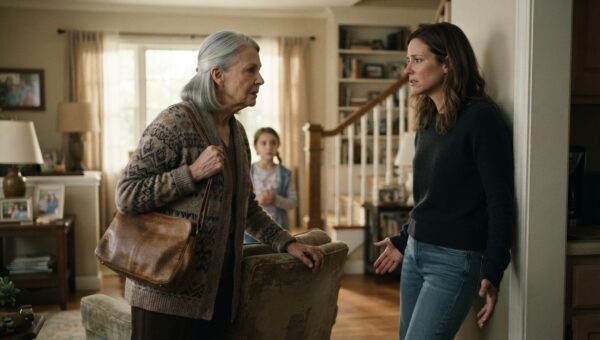
My mother set the silver platter down so hard a deviled egg slid sideways into the parsley. Helen, Mary continued, turning her head slowly toward my mother. You told me Jessica had the flu and couldn’t make the three-hour drive. You told me she called you herself this morning to say they were staying home.
The silence in the room got so thick you could hear the logs shifting in the fireplace.
My mother’s mouth opened, but nothing came out for a second. Her face flushed a dark, mottled red right up to the roots of her frosted blonde hair. Mother, that isn’t, I mean, they didn’t send the RSVP card back by the tenth like I asked, and with the roads being this bad, Don’t lie to me in front of the whole family, Mary snapped, her hand coming down flat on the arm of the chair with a dry wooden smack. I talked to Jessica’s husband on Wednesday about the turkey. I know damn well they were coming. You locked the front door on a six-year-old child because you didn’t want people asking why you never invited them last year either.
My sisters wouldn’t look at my mother. Clara looked down at her red plastic cup, her fingers turning white around the rim.
Benjamin stayed close to my leg, his small fingers hooking into the denim of my jeans. He didn’t understand the words, but he understood the sudden drop in the air, the way adults get stiff and small when they’re caught doing something they shouldn’t.
Show her the card, Benjamin, Mary said, her sharp old eyes softening just a fraction as she looked down at my boy. Go on. Pull it right out of your pocket.
Benjamin looked up at me, his lower lip giving a tiny, nervous quiver, and then he reached down. He pulled the blue construction paper out of his coat pocket. The cotton snowdrifts were a little smudged from his damp mittens, and the green marker tree in the corner was slightly bent at the top, but he held it out with both hands like it was something fragile and important.
He walked it right over to Grandma Mary’s chair.
Mary took it in her spotted, trembling hands, adjusted her reading glasses with one finger, and stared down at it for a long, quiet minute. There were three stick figures drawn in thick black marker near a yellow circle sun: a tall one with a dress, a tall one with trousers, and a very small one in the middle holding a blue balloon.
She looked up at my mother, her gaze hard enough to cut glass.
Helen, you are going to walk over there right now, Mary said, her voice dropping into that steady, commanding tone she used when running the county Grange board back in the seventies. You are going to look that boy in the eye, and you are going to tell him he belongs at this table just as much as anyone else in this room.
My mother stood by the stone hearth, her arms crossed tight over her chest, her shoulders pulled up toward her ears. She looked smaller now than she had out on the porch, stripped of her four-inch barrier and her neat little stories.
I’m sorry, she muttered to the floorboards near the fringe of the area rug.
Speak up, Mary barked. The boy has ears.
I’m sorry, Benjamin, my mother said, the words coming out tight and dry like paper being torn in half. I made a mistake about the date.
Benjamin didn’t say anything back to her. He just looked up at me, waiting for the signal, and then he let out a long breath that sounded like he was finally putting down a heavy bag he’d been carrying all the way from the car.
Mark stepped through the doorway then, carrying the foil-covered apple pie like it was an offering, and set it down right on the edge of the long dining table next to the heavy roast beef platter.
Mary didn’t wait for anyone else to move. She reached out, picked up Benjamin’s handmade blue card, and propped it up proudly against the silver gravy boat right in the center of the table, where the yellow candle light hit the cotton snowdrifts and made them look almost real.