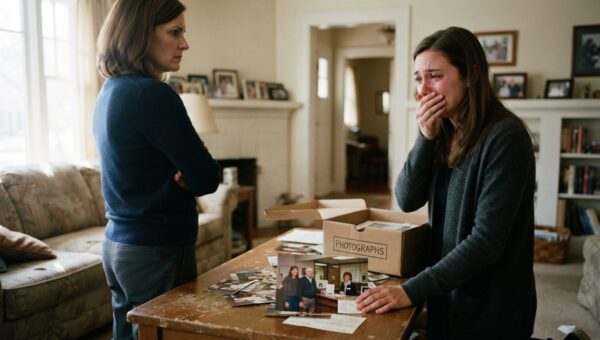
Forty-two thousand dollars. That was the exact number Julian decided to shout across the oak guest book while people were still folding their black umbrellas outside the chapel doors. He held up an old manila envelope like it was a magistrate’s warrant, his voice shaking just enough to sound like a grieving brother instead of a man who had spent two years draining an old woman’s accounts dry.
Nobody stepped forward. Aunt Clara adjusted her shawl and stared straight at the linoleum, and Cousin Ray cleared his throat and looked out the stained glass window. I just stood there with my coat over my arm because my brain kind of stopped working for a second.
Six months before that afternoon, Mom had called me over to her house on a Tuesday morning under the pretense of canning green tomatoes. The kitchen smelled like vinegar and hot paraffin, and her hands were trembling as she slid a heavy, cold metal cash box across the oilcloth table. She didn’t look at me when she spoke, keeping her eyes fixed on the rim of her enamel pot. She told me to take it home and shove it in the back of my closet, and above all, she told me not to let Julian know it was under my roof. She didn’t explain why, but I had seen the way Julian hovered around her kitchen whenever bank statements arrived in the mail. I just nodded and tucked the box under my arm.
The trouble started long before Mom took to her bed with that cough that wouldn’t clear. Two years back, Julian had talked her into letting him handle her auxiliary investments so she wouldn’t have to worry about the quarterly forms. At first it was just a signature here and a phone call there, but by the time I noticed the bills piling up on her sideboard, Mom was apologizing for spending five dollars on groceries at the Piggly Wiggly. Julian drove a new pickup truck every eighteen months, and every time someone asked about it, he talked about his commission structure at the tile warehouse. Mom stopped going to her bridge club on Thursdays because she said the gasoline cost too much.
Julian had everything planned down to the minute for the funeral. He arranged the flowers, he picked out the hymns, and he made sure he stood right beside the book where everyone had to sign their names and drop their sympathy cards.
When I walked up to pay my respects, he didn’t hand me a pen. He pulled that manila envelope from beneath the registry stand and shook it in my face. He told the room that Mom’s safe-deposit box was missing forty-two thousand dollars in bearer bonds, and that I was the only one who had visited her house alone the week before she went into the hospital. He smiled when he said it, a quick, small twitch of the lip that told me he had practiced the lines in his bathroom mirror.
I handed him the heavy metal box right then and there without saying a word, because at that exact moment I didn’t have the energy to fight him in front of the floral arrangements. I set it on the corner of the table, and he reached out and snatched it up like a dog grabbing a bone. His fingers went straight for the latch, and when it popped open to reveal three empty folders and a spare set of lawnmower keys, his face went dark and blotchy.
He thought he had trapped me, but he hadn’t realized that Mom was a whole lot smarter than either of us ever gave her credit for.
As the crowd started drifting out toward the parking lot to get away from the awkwardness, a heavy hand caught my elbow. It was Marcus, the fellow who ran the front office at the funeral home and had known our family since we were kids playing in the drainage ditch behind the feed store. He looked around to make sure Julian was busy cornering the pastor by the water fountain, and then he pressed a small, cold piece of metal and a folded slip of paper into my palm. He didn’t look at me when he whispered his warning. “Your mother left something under a different name,” he told me, his voice barely louder than the hum of the ceiling fan. “You need to see this before your brother does.”
The slip of paper was a receipt from a self-storage facility out on the old highway past the livestock barns, dated three days before Mom drew her last breath. I didn’t go back to the family dinner at the VFW hall where everyone was whispering behind my back. I got straight into my sedan, tossed my coat onto the passenger seat, and drove out through the gray afternoon drizzle with the heater blowing lukewarm air against my ankles. The highway was mostly empty except for a few gravel trucks kicking up spray against the guardrails.
The storage facility was just a long row of green corrugated metal sheds behind a barbed-wire fence with an electronic gate that hummed when you punched in the code. Unit 104 was halfway down the third aisle, right where the gravel turned to deep mud from the runoff. My thumb was shaking so hard it took me three tries to get the small brass key into the padlock, but it turned with a clean, dry snap that echoed off the metal walls. When I pulled the heavy roll-up door halfway, the smell of cardboard and dry dust hit me right in the chest.
Inside, sitting on a gray plastic milk crate, was a single cardboard file box with my name written across the flap in Mom’s shaky, looping cursive. I dragged it out into the pale afternoon light and pulled the lid off right there on the wet gravel. Inside wasn’t a stash of stolen cash or old jewelry, but an entire paper trail of every single dime Julian had pulled out of Mom’s accounts over the previous twenty-four months. She had printed out the bank statements, highlighted every fraudulent wire transfer in yellow highlighter, and attached carbon copies of the withdrawal slips bearing Julian’s forged signatures.
Underneath the folders lay a handwritten ledger that broke my heart into a dozen pieces. Mom had spent her final months sitting at her kitchen table with a ruler and a black ballpoint pen, logging every time Julian came over and bullied her into signing a check for his truck payments. She had even written down the exact dates and the excuses he used, like a schoolteacher keeping track of unruly students. At the very bottom of the box was a sealed envelope addressed to me with a note that explained everything. She knew what Julian was doing, but she didn’t want to involve the authorities while she was still living under his thumb, so she built an airtight case and hid it where he would never look.
The decoy metal box she had given me six months ago wasn’t meant to hold anything at all, because she knew Julian would eventually tear her house apart looking for her savings. She used me as a decoy to draw his fire, trusting that I would keep the empty box safe while she secured the real evidence out here in the county. She even used her maiden name on the rental agreement so the online registry wouldn’t show up on her standard mail delivery. Sitting there in the gravel with the rain starting to soak through the knees of my slacks, I realized she had protected me right up until the end.
I put the folders back into the box, slid it onto the floor of my car, and drove straight back to the VFW hall. The parking lot was still choked with family cars, and I could see Julian standing near the buffet table accepting condolences from folks who probably didn’t even like him. When I walked through the double doors, the room went quiet the way it always does when someone shows up who isn’t supposed to be there. I didn’t yell or make a scene, because anger isn’t my way, but I walked right up to the head table where Julian was holding a paper plate of ham sandwiches.
I didn’t say a word about forty-two thousand dollars. I just set Mom’s cardboard box right on top of the ham rolls, popped the lid off, and pulled out the top bank statement with Julian’s signature scrawled across the bottom in blue ink. I laid it out flat against the white tablecloth right in front of his coffee cup. He looked down at the paper, and the color drained right out of his face until he looked like skim milk. He tried to laugh it off, but his mouth wouldn’t cooperate, and his hands started twitching against the edge of the table.
“You might want to take a look at the rest of these before you talk to the sheriff about missing bonds,” I told him, keeping my voice low enough that only the people right around us could hear every word. “Mom kept very good records. Better records than you thought.”
Julian didn’t argue. He didn’t yell about me being a thief anymore, and he didn’t try to wave his manila envelope around to impress Aunt Clara. He dropped his paper plate into the trash can by the door, grabbed his jacket off the back of the folding chair, and walked out without looking at a single person in the room. Nobody tried to stop him, and nobody asked where he was going.
The house is quiet now that the estate has been settled according to Mom’s actual wishes, and the lawyers took care of the rest without needing another funeral. I keep that little brass key from the funeral home right on the kitchen counter beside Mom’s worn-out gardening shears where the morning sun hits the wood grain. It doesn’t open anything important anymore since the storage unit is cleared out, but every time I walk past it to make my coffee, I touch the cold metal just to remind myself that she had the last word after all.