Thirty-one thousand dollars and eighteen months of paying her rent when the divorce took the ground right out from under her. That was the tally I kept in my head, though I never said it out loud to a single soul.
At my sister Elena’s retirement dinner at the church hall, she stood up by the punch bowl with a glass of sparkling cider and thanked everyone who had carried her through thirty years of teaching third grade.
She named her coworkers, the neighbors who shoveled her driveway twice, and even the woman who watered her ferns while she was laid up.
She never once looked at my table near the back door.
I had driven her to forty-two radiation appointments in my rusted Honda Civic, sitting in the waiting room with a crossword puzzle while she vomited in the clinic bathroom. I had taken Marcus into my spare bedroom for an entire school year when she couldn’t get out of bed without weeping from the pain. I told myself to stay quiet and let her have her moment in the sun.
Then she raised her glass higher and told the room, “The best thing I ever did was learn not to depend on family.”
People applauded. Plates rattled against tables. I smiled, set my napkin down beside my half-eaten chicken breast, went out to my car, and cried where nobody could see me.
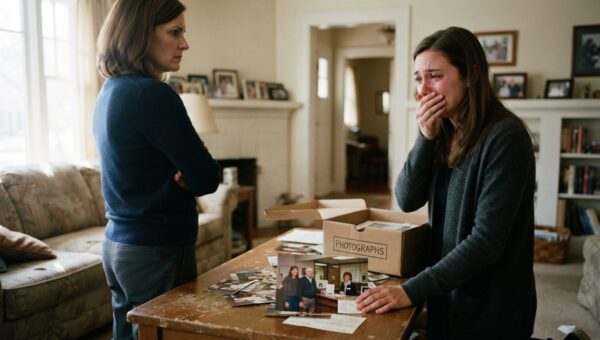
Two days later, Marcus showed up at my kitchen table with a taped-up cardboard box from his mother’s attic and soot smeared across his knuckles.
He didn’t take off his sneakers. He just sat down on the wooden chair by the back door, dropped the box between us with a heavy thud, and looked straight at me.
“Aunt Jo,” he said, his voice shaking just a little bit. “I think you need to know why she never mailed these.”
I looked down at the cardboard. The flaps were held together with yellowed masking tape, and my name was written across the top in Elena’s sharp, precise teacher handwriting.
“Where did you find these?” I asked.
“Behind the old cedar chest,” Marcus said. “She told me to clear out some junk before the retirement party guests came over. I opened the box thinking it was old grade books. It’s not. It’s just you. Every single one of them is addressed to you, Jo.”
I reached out and hooked my fingernail under the brittle tape. The glue gave way with a dry tear. Inside lay thirty-one envelopes, stacked in neat, chronological bundles separated by rubber bands that had rotted and snapped into orange dust.
I picked up the first one. The postmark read October 14, nine years back, right after the divorce papers were finalized and Elena lost the house.
“Read it,” Marcus whispered.
I pulled out the folded sheet of lined notebook paper. The ink was smeared near the bottom where a tear had hit it.
“Jo,” I read out loud, my voice sounding thin in the quiet kitchen. “I don’t know how to look at you today without feeling like I’m drowning. You handed me the check for the landlord before I even had to ask. I hate that I need you.
I hate how small it makes me feel to watch you walk into this house with groceries while I’m still in my pajamas at two in the afternoon. But thank you. God help me, thank you.”
I folded the paper back up and set it on the oilcloth table. My hands felt clumsy.
“She never sent that?” Marcus asked.
“Obviously not,” I said. “She told me she was handling the rent herself through her savings.”
We spent the next two hours going through the stack. It was like watching someone slowly build a wall out of bricks made of pride. The letters from the chemotherapy months were the thickest. In November, she wrote about how I sat beside her holding an emesis basin while she shook so hard the metal rattled.
“I threw up on her shoes,” I remembered out loud, staring out the window at the neighbor’s hedge. “Brand new loafers I bought her for parent-teacher conferences. She didn’t say a word about the shoes. Just cried.”
In the letters from that winter, Elena wrote that she wanted to give me a key to her safety deposit box just in case things went sideways. She wrote that I was the only person on earth who knew her real ribs were showing, the only one who saw her without her wig or her temper.
Then the tone shifted. It happened right around the time she went back to work part-time.
By the third year, the letters grew shorter. The handwriting got sharper, pressed harder into the blue lines until the paper nearly tore. One letter from a Tuesday in April caught my eye.
“Jo brought over lasagna again,” I read, the words sticking in my throat. “She asked if I needed help with the gutters. I told her no. I am tired of her looking at me like I’m a project she’s keeping score on. If she brings up the hospital bills one more time, I think I’m going to scream.”
I looked up at Marcus. He was staring at his sneakers, his jaw tight.
“She never brought up the hospital bills,” I said. “I paid them out of my own savings and shredded the statements so she wouldn’t have to look at them.”
“I know,” Marcus said quietly. “That’s why she hated you. You were too good to her, Aunt Jo. She couldn’t figure out how to pay you back with anything other than her pride, and pride doesn’t buy groceries.”
We reached the bottom of the box. The last envelope was dated just two weeks before the retirement dinner. There was no letter inside this one, only a printed-out guest list for the church hall with my name crossed out in thick black marker. Next to my name, she had written a single sentence in the margin.
“I survived because I am strong,” she wrote. “Not because of her.”
The kitchen was so quiet I could hear the refrigerator compressor clicking on down the hall. I picked up the empty envelope and turned it over in my hands. Thirty-one letters. Thirty-one times she sat at her desk, poured her heart out in secret, and then locked the truth away in the dark so she could pretend to the world that she owed nobody anything.
“She’s having a small dinner at her house tonight,” Marcus said, breaking the silence. “Just a few of her teacher friends from the district. She thinks I’m out buying more folding chairs.”
I stood up from the table. My knees popped, and my back ached from leaning over the box for hours.
“Get your jacket, Marcus,” I said.
“Where are we going?”
“We’re going to give her mail back.”
The drive over took twelve minutes. Neither of us said a word. When we pulled into Elena’s gravel driveway, her Honda was parked right by the front porch, and soft classical music was drifting out through the open living room window.
I didn’t knock. I just turned the brass knob, pushed the front door open, and walked straight into the dining room where Elena was lighting the candles on the table.
She turned around with a box of matches in her hand, her face dropping the second she saw me standing there with the cardboard box in my arms.
“Jo,” she said, her voice instantly defensive. “What are you doing here? I didn’t invite anyone over tonight. This is just for the department heads.”
I walked over to her polished mahogany dining table, the one I had helped her finance back when Marcus was in middle school, and set the box right down in the middle of the white lace runner. The cardboard hit the wood with a dry slap.
Elena looked at the box, then up at me, her eyes darting to Marcus standing in the doorway behind me.
“What is this?” she asked, though her throat tightened up before the words even came out.
“Your mail,” I said. “You forgot to put stamps on them.”
She reached out, her fingers trembling slightly as she brushed the flap of the top envelope. “Where did you get these?”
“Marcus found them behind the cedar chest,” I said, keeping my voice entirely even. “He thought I should read them. And you know what, El? He was right. I learned a lot about how much you hated me for saving your life.”
Elena’s face went tight, her skin flushing a dull, angry red. “You always had to be the savior, didn’t you? Every time you handed me a check or drove me to that clinic, you were just building a monument to how useless I was.”
“I was paying your rent so your kid wouldn’t end up in foster care,” I snapped back, taking one step closer to her across the table. “I was driving you to chemo because you couldn’t walk across the room without fainting. If that makes me a savior in your head, I’m sorry, but someone had to do it while you were busy feeling sorry for yourself.”
“I wanted to do it on my own!” she shouted, her voice cracking as the carefully built facade finally split wide open. “Is that so hard for you to understand? Thirty years in that classroom telling kids they can do anything, and then I couldn’t even pay my own light bill without my little sister writing the check. I hated myself for needing you, Jo. Every time you looked at me, I saw myself failing.”
“Then you should have told me,” I said quietly. “You could have just said thank you instead of standing up in front of a room full of strangers and acting like I never existed.”
She didn’t answer. She just looked down at the box of letters, her shoulders slumping as the fight went right out of her. She looked smaller suddenly, stripped of the schoolteacher authority and the stubborn pride that had kept her warm for so many years.
“I can’t fix this for you, El,” I told her, stepping back toward the door. “I’m done keeping score, and I’m done pretending I wasn’t there. You can keep your independence. You can keep the letters, too. I don’t need them anymore.”
I turned around and walked out of the house, Marcus right behind me. We didn’t look back at the porch light or the open windows.
Two days later, Sunday morning sunshine was hitting the pine floor of my kitchen just right. Marcus was sitting at the worn wooden table with an open textbook propped up against a ceramic bowl of cereal, working through his college algebra homework.
I set two mugs of steaming black coffee down on the wood, right beside his elbow. Outside the back window, the trash truck was grinding its way down the alley, hauling away the flattened cardboard pieces of a box that didn’t matter anymore.