The salt air out here in Bandon always gets heavy right around ten in the evening, rolling off the Pacific and settling into the cedar siding like a wet wool blanket. I was standing at my kitchen counter, wiping down the laminate with a damp sponge for the second time, listening to the small ticking of the brass wall clock that belonged to my mother.
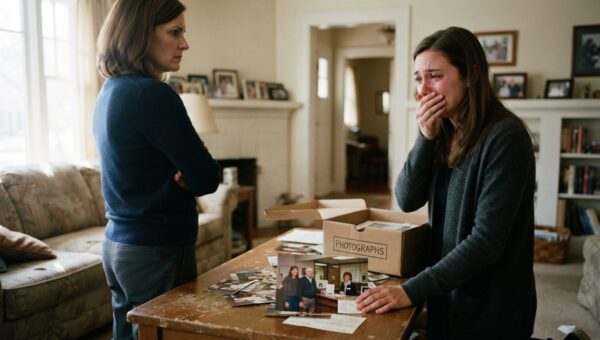
It was Sunday night, July fourteenth, and the house was entirely too quiet. For nearly three hundred and sixty days, that quiet had been the hardest thing to carry. Chloe hadn’t called since last August, not since the afternoon she stood right where I was standing and told me I was a selfish, cold-hearted woman who loved her savings account more than her own flesh and blood.
The argument had started over a stupid piece of paper. Chloe wanted me to put my name down as a cosigner on a three-hundred-and-ten-thousand-dollar construction loan for her boyfriend, Derek. Derek was thirty-eight, wore expensive leather shoes that always looked out of place on our gravel drive, and talked in circles about real estate flips and market timing. I had looked at the bank disclosures he brought over, looked right through his smooth smiles, and told him no. I told Chloe that a house built on borrowed credit and high-risk lending usually comes crashing down the second the wind changes.
She called me bitter. She said Derek was going to give her and my grandson Noah the life they deserved, and that my caution was just a coward’s way of holding them back.
When I refused to sign, she grabbed her car keys, scooped up Noah from the braided rug by the sofa, and walked out without looking back. For almost a year, my only window into my grandson’s life was a blurry text message every few weeks from an old neighbor who still ran into Chloe at the grocery store, sending me a snapshot of Noah blowing out three candles on a supermarket cupcake.
Then the headlights cut across my living room wall at 11:20 PM.
They didn’t belong to Chloe’s sedan. They belonged to a battered gray pickup truck that idled rough in the gravel before backing away down the lane before the tires even stopped rolling. I dropped the sponge into the sink and hurried to the front door, throwing it open before the latch could even click.
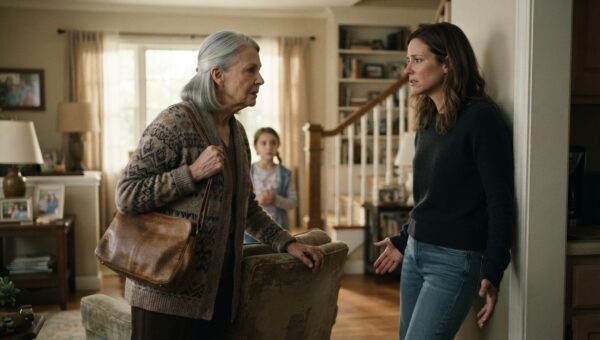
Chloe stood on the top step under the porch light. She wasn’t wearing shoes. Her bare feet were gray with dust from the gravel drive, and her hair was pulled back into a messy knot that looked like she had twisted it in her sleep. In her right hand, she clutched Noah’s blue canvas backpack with the cartoon dinosaur patch on the front. Noah was sound asleep against her shoulder, his little arm hanging limp, his knuckles smudged with dried chocolate.
“Chloe?” I said, my chest tightening so fast I couldn’t get the air past my throat. “What is going on? Is Derek in the truck?”
Chloe didn’t look at my face. She kept her eyes fixed on the welcome mat between her bare feet. “Mom, can you come get Noah?”
“Of course I can, honey, come inside, “
“No,” she said, and her voice had that thin, brittle sound that meant she was holding herself together by a single thread.
She shoved the backpack straps into my hands and transferred the heavy weight of the sleeping boy into my arms. Noah stirred, muttered something about his toy truck, and settled his warm cheek against my collarbone. “Just take him inside.”
“Chloe, where are you going? Where is Derek?”
She took two steps backward off the porch, her bare heel catching on the edge of the board. “He had to go out of town for work. Things got complicated with the build. I’ll explain tomorrow.”
“Tomorrow isn’t good enough, Chloe. Look at you, you don’t even have your shoes on, “
“I’ll call you in the morning,” she whispered, turning around before I could grab her wrist. She walked down the gravel drive into the dark, her bare feet making a soft, scraping sound against the crushed rock until the sound of her footsteps faded into the roar of the ocean down the bluff.
I carried Noah inside, laid him gently across my spare bed, and pulled a quilt over his shoulders. He didn’t wake up. I sat on the edge of the mattress for a long time, watching the steady rise and fall of his small back, listening to the old refrigerator hum in the kitchen, and wondering how many miles Chloe had walked in her bare feet before she finally turned the wheel toward my house.
The next morning, the house smelled of bacon and warm corn muffins. Noah sat at the small pine kitchen table with a box of Crayola markers, coloring a green dinosaur on the back of a grocery receipt with fierce concentration. He asked about his mother once, right around eight o’clock, looking up with big brown eyes that looked so much like his grandfather’s.
“Mommy had to go help Derek with his truck,” I told him, keeping my voice steady while I poured milk into his cereal bowl. “She’ll call us soon.”
I spent the entire morning staring at my landline and my cell phone. At 9:00 AM, I dialed Chloe’s number. It went straight to voicemail. I tried again at 10:15. Still voicemail. By 11:45, the quiet in the house had turned into that heavy, suffocating kind that usually comes right before a storm hits the coast.
Then came the heavy rap against the front door. Three sharp knocks, the kind delivered by someone who has a clipboard and a quota to fill.
I walked down the hall, opened the door half an inch past the chain, and found a tall man in a tan windbreaker standing on the porch. He had a thick leather folder tucked under one arm and a clipboard in his hand.
“Chloe Miller?” he asked, looking down at a yellow slip of paper.
“No,” I said, my hand tightening on the edge of the wood. “I’m her mother. She isn’t here right now.”
The man frowned, tapping a ballpoint pen against his teeth. “Well, she’s listed as the primary resident at this address on the county assessor’s rolls, or at least she was until three months ago. You need to sign for this summons. It’s civil litigation out of Lincoln County.”
“Summons for what?” I asked.
“Foreclosure proceedings and declaratory judgment regarding unauthorized secondary liens,” he said, rattling off the legal terms like he was reading the grocery list. “Property parcel number four-zero-two dash eight. Sign right here on line four.”
He shoved the clipboard forward. I looked down at the top sheet of heavy white bond paper. The printer had smeared a tiny bit of blue ink near the top margin. My eyes scanned past the legal header, past the name of the mortgage company in bold black letters, down to the property description.
It was my house. The legal description matched the five acres my husband and I cleared back in 1982, the house where I raised Chloe, the house that had been paid off in full fifteen years ago when my husband passed.
And right there at the bottom of the page, under the section marked *Guarantor / Property Owner Acknowledgement*, was my signature.
My name, spelled out in my careful, upright cursive, right down to the little loop on the tail of the ‘M’ that I had practiced in middle school. Except I had never signed that paper. I had never walked into a title office in Newport. I had never laid eyes on the lender named on the letterhead.
“Ma’am?” the process server said, shifting his weight from one foot to the other. “You need to sign the receipt of service.”
“I didn’t sign this,” I whispered. My fingers went cold against the clipboard. The world didn’t spin, and my heart didn’t shatter; it just felt like someone had reached inside my ribs and turned off the heat.
“Well, somebody signed it,” the man said, his voice dropping into that flat, bored register of people who deliver bad news for a living. “Right there in front of the notary public in Lincoln City back in February. Now, are you taking the papers or do I file an affidavit of refusal?”
I took the thick envelope from his hand because my fingers seemed to move on their own command. “Leave them,” I said.
He marked his clipboard, mumbled something about a court date in three weeks, and turned back down the gravel drive toward his sedan.
I closed the door, locked the deadbolt twice, and carried the heavy manila envelope back to the kitchen table. Noah didn’t look up from his crayons. He was coloring the dinosaur’s tail bright red now, humming a little tune he must have picked up at daycare.
I laid the papers flat on the oilcloth table cover. There were twelve pages in total. I flipped through them one by one, my thumb leaving faint smudges on the white sheets. Page four was the mortgage note for three hundred and ten thousand dollars, dated February twelfth. Page seven was the notary stamp from a small office down near the bay. Page nine was the asset transfer agreement, listing Derek as the primary beneficiary of the construction loan, with my property listed as collateral to secure the debt after the primary bank application stalled.
And there, right beside the red wax seal of the notary, was the forgery. It was a good forgery. Anyone who had ever seen my signature on a birthday card or a tax form could have traced it if they had enough practice. But they missed the way I cross my ‘t’s just a fraction too low.
The kitchen was so still I could hear the refrigerator compressor clicking on. I picked up my phone and dialed Chloe’s number again.
This time, it didn’t go to voicemail. It rang twice before a sharp, ragged click sounded on the other end.
“Chloe?” I said, and my voice sounded thin, like dry paper tearing.
“Mom,” she gasped. She was crying now, hard and ugly, the way she used to cry when she was six years old and scraped her knee down to the bone on the gravel behind the old cannery. “Mom, I didn’t know. I swear to God I didn’t know until yesterday afternoon.”
“What didn’t you know, Chloe?” I asked, looking down at the forged signature on page four.
“Derek said we just needed a local address to get the contractor’s license approved,” she sobbed, her words tumbling over each other so fast I could barely catch them. “He brought home some papers in January. He told me you had already talked to him on the phone, that you said it was okay to use your name for the preliminary paperwork so we could get the loan moving. He said you didn’t want to talk to him directly because you were stubborn, but that you wanted to help Noah.”
The room seemed to tilt just an inch to the left. I reached out and caught the edge of the pine table with my free hand.
“You let him sign my name?” I asked, and the words didn’t sound like mine. They sounded small and hollow, coming from somewhere across the room.
“I didn’t think he was forging anything!” she screamed into the phone, her voice cracking into a high, jagged wail. “He had a notary come right to the kitchen table while I was making lunch. He told me you signed things like that all the time for family. And then yesterday… yesterday a man came to our apartment with an eviction notice and said the loan defaulted because Derek took the first draw of three hundred thousand dollars and wired it to an account in Reno, and he’s gone, Mom. Derek is gone. He cleaned out our joint checking account and his truck isn’t at the yard and his phone is disconnected.”
I looked over at Noah. He had finished his green dinosaur and was carefully peeling a blue crayon wrapper off with his small fingernails, humming quietly to himself.
“Get your shoes on,” I told Chloe.
“What?”
“Get your shoes on, get in whatever car you can find, and come back here right now.”
“Mom, I can’t. The bank, “
“I didn’t say anything about the bank, Chloe. I said get over here. We have to go see a lawyer before the county recorder’s office opens tomorrow morning.”
There was a long silence on the line, broken only by the wet, ragged sound of her breathing. Then she let out a small, broken sob.
“I’m sorry,” she whispered. “I’m so sorry, Mom.”
“I know,” I said, and my hand stopped trembling against the wood. “Just get home.”
I hung up the phone, placed it face down on the table next to Noah’s box of crayons, and walked over to the window to watch the fog roll in off the water, thick and gray and heavy enough to hide anything.