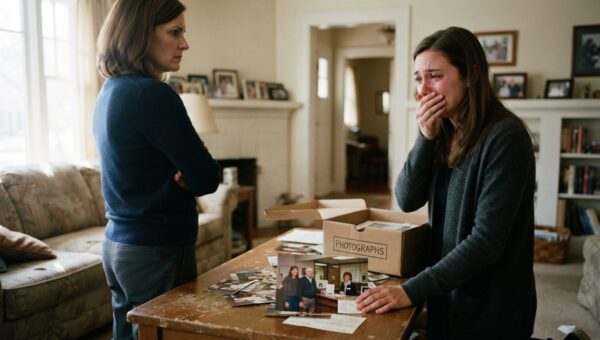
“I wish you’d never been my daughter.”
My mother said it across a table covered with Mother’s Day flowers and an expensive brunch I’d paid for. Nobody at the table defended me. My brother, Russell, just looked down at his eggs Benedict like he was studying a map. Aunt Clara cleared her throat and reached for the mimosa pitcher. I stood up and said, “Then live as if you never had one.” I walked straight out to my car, backed out of the gravel lot, and blocked her number before I even hit the highway. That night, I slept better than I had in months.
At 6:17 the next morning my phone started ringing. It didn’t buzz; it just kept vibrating against the pine nightstand in a steady, angry rhythm. By the time I actually checked the screen while waiting for the coffee maker to finish sputtering, there were twenty-three missed calls. Most of them were from my mother, but the last three were from Russell. His text message sat right at the top of the preview: “Mom’s bank says her mortgage payment failed. What did you do?”
I poured my coffee into a heavy ceramic mug and sat down at the kitchen table. The morning sun was just starting to crest over the foothills, casting a pale, quiet light across the linoleum. For five years, nobody had ever asked me what happened to a mortgage payment because, as far as the rest of the family was concerned, those payments just happened.
They were like the weather or the turning of the leaves. Magic.
The truth was far less scenic. Ever since my father passed away and left the family farm with a mountain of back taxes and a balloon note, my mother had operated under a very specific set of assumptions. She assumed that daughters were born to be shock absorbers for bad financial planning. She assumed that my quiet bookkeeping job in town came with an endless well of spare cash. And she assumed that no matter how many times she called me bitter, ungrateful, or heavy-handed behind my back, I would always show up with a checkbook in my purse.
The phone vibrated again, rattling against the wooden tabletop. It was Russell. I let it ring out until it went to voicemail. Then I opened my laptop and pulled up the secondary checking account I had kept secret for nearly a decade.
There it was, clear as day on the monthly ledger. An automatic debit of nine hundred and forty-two dollars, pulled on the twelfth of every month, routed straight to the local savings and loan where my mother’s mortgage had lived since 1994. Nine hundred and forty-two dollars. Month after month, year after year, deducted cleanly from the account where I saved my holiday bonuses and overtime pay. I hadn’t looked at the ledger in two months because I had been too busy working double shifts to pay for my own dental work.
Russell didn’t wait long before trying a different tactic. At 8:05, my doorbell rang. It wasn’t a friendly knock; it was that heavy, two-knuckle thud that only my brother used when he was annoyed that someone wasn’t falling in line. I walked to the front door, unlocked the deadbolt, and pulled it open just enough to block the threshold.
Russell stood on the porch in his gray work jacket, smelling faintly of stale cigarette smoke and damp pine. He didn’t look at my face; he looked past my shoulder into the hallway. “Open your phone, Clara,” he said, skipping any kind of greeting. “Mom’s sitting at her kitchen table in hysterics. The bank called her fifteen minutes ago about the escrow account. She thinks they’re going to foreclose by Friday.”
“Let them call,” I said. My voice sounded remarkably steady, even to me.
Russell blinked, finally lifting his eyes to meet mine. “What are you talking about? You set up that auto-pay back when the bank threatened to take the south pasture. You’re the one who handles the transfers.”
“I was the one who handled them,” I corrected. “Past tense.”
“Don’t play games with me this early,” Russell said, taking a half-step forward as if he could physically nudge me out of the doorway. “She’s eighty-one years old. You want her put out on the highway over a fight about brunch?”
“She made her feelings about me very clear yesterday,” I said, leaning my weight against the doorframe. “In front of twenty people. She said she wished she never had a daughter. Since I’m officially out of the family business, I figured I’d save her the embarrassment of taking money from a stranger.”
“She didn’t mean that,” Russell scoffed, waving a calloused hand in the air. “You know how Mom gets when she gets worked up about the grandchildren or the church committee. You’ve got a thick skin. Why are you punishing her over a bad afternoon?”
“It wasn’t a bad afternoon, Russell. It was thirty years of inventory,” I said. “And I’m done stocking the shelves.”
He stared at me then, really stared, as if he were trying to calculate the exact moment I had stopped being useful. “She needs that money today, Clara. The grace period ends at noon.”
“Then I suggest you and Aunt Clara start pooling your resources,” I said. “You’ve been living in her carriage house rent-free for four years while you work on your supposed contracting business. Why don’t you pay the nine-hundred-and-forty-two dollars?”
The color drained right out of his cheeks, leaving him looking mottled and small beneath the porch light. “You know I don’t have that kind of cash sitting around. Jobs have been slow.”
“Then I guess you’ll find out what it feels like to figure it out,” I said, and closed the door right in his face. I heard him mutter something foul through the wood, followed by a heavy kick against the bottom panel that left a scuff mark on the white paint. Then his truck doors slammed in the driveway, and the gravel sprayed as he tore out of the lane.
By noon, my phone had turned into a digital hornets’ nest. Aunt Clara texted me a Bible verse about honoring your mother, followed closely by a cousin I hadn’t spoken to since Thanksgiving asking if I had lost my mind. I didn’t open a single message. I simply went into the settings of my phone and muted every last one of them, leaving only the work line active in case my supervisor needed to reach me about the Tuesday inventory audit.
The rest of the week settled into an unnatural, beautiful quiet. Nobody came by the house. No more angry voicemails dropped into my inbox. I spent Tuesday evening sitting on the back porch with a pair of pruning shears, trimming back the dead growth on my hydrangea bushes. For the first time in as long as I could remember, my shoulders didn’t feel like they were hitched up around my ears. Every time I thought about the bank account and the missing transfer, a strange, light feeling washed over me, like stepping out of a heavy winter coat into a warm room.
On Thursday afternoon, my mother finally tried a different number. She used the landline from the local pharmacy, knowing I wouldn’t recognize the local exchange. I picked up on the third ring, thinking it was the hardware store calling about my special-order screen door.
“Clara Marie,” her voice came across the line, sharp and thin as a dry twig. “You’ve made your point. Now unlock that account before the sheriff serves notice.”
“There’s nothing to unlock, Mother,” I said, keeping my voice even. “The account is closed.”
“Closed?” A sharp intake of breath whistled through the receiver. “You can’t just close an account that pays for my roof. Your father built this house.”
“My father built this house, and then you spent twenty years letting Russell treat it like a storage locker while you spent my grocery money on floral arrangements and county club dues,” I said. “You told everyone yesterday morning that you didn’t have a daughter. A woman living by herself in a four-bedroom house doesn’t need a daughter’s charity.”
“You are my flesh and blood,” she hissed, her voice rising in pitch. “You owe me until the day I go into the ground.”
“No,” I told her, looking out across the yard where the evening shadows were stretching long and blue across the grass. “I paid my debt off years ago. From here on out, you’re on your own. Ask Russell to help you with the mortgage. He’s very good at standing around while other people work.”
I didn’t wait for her reply. I pressed the red button on the handset, walked over to the kitchen counter, and unplugged the landline base entirely.
The silence that followed in the house was absolute. It wasn’t the heavy, suffocating silence of an argument waiting to happen; it was just empty space, clean and entirely my own.
Two weeks later, I drove past my mother’s place on my way back from the feed store. A modest blue-and-white sign had been driven into the front lawn near the mailbox, right where the old hydrangea bushes used to grow. *For Sale By Owner.* The front windows were dark, and Russell’s beat-up Ford was parked out on the grass with its hood up, looking like it had finally given up the ghost for good.
I didn’t slow down. I tapped my fingers twice against the steering wheel, hit the gas, and kept right on driving toward home.