How long can you carry someone else’s burden before your shoulders forget what it feels like to stand up straight? That is the question I kept asking myself while staring at the grease spot on my kitchen ceiling, wondering if I had another four hundred dollars to spare for a plumber who would tell me the pipes were simply old and tired.
Five years ago, my father’s heart started giving out in earnest, and with it went whatever savings my parents had managed to scratch together in that small brick house on Maple Street. Dad was sixty-nine then, working part-time at the hardware store just for the health insurance, and when the strokes began, the insurance company found every possible excuse to deny coverage. I remember Evelyn, my mother, calling me at work on a Tuesday morning with that thin, trembling edge in her voice that always meant she needed a checkbook more than a conversation.
“Clara,” she had said, her breathing shallow over the line. “The county sent the final notice for the winter property taxes. If we don’t clear the balance by Friday, they start the foreclosure filings.”
I was thirty-three at the time, renting a duplex across town and trying to pay down my own student loans while managing a commercial loan portfolio at the regional bank.
I did not have extra money lying around in shoe boxes. But I had credit, and I had a savings account that was supposed to go toward a down payment on a place of my own someday. So I wrote the check for the taxes. Then came the winter the old oil furnace finally cracked right down the heat exchanger, filling the basement with a smell like burning hair and leaving my parents shivering in thermal underwear under three heavy quilts. That bill was eight thousand four hundred dollars, and since Kevin, my younger brother, was between jobs and dealing with his own financial scrapes, I signed the financing paperwork myself so the old folks wouldn’t freeze.
Over the next sixty months, the pattern became as predictable as the changing leaves. Whenever a bill grew too large for their fixed social security income, my phone would buzz against the nightstand.
I sent money for roof repairs, for specialist co-pays, for backdoor ramp installations, and for three separate mortgage adjustments that kept the bank from knocking on their door. By the time my ledger finally stopped growing last spring, the direct transfers and out-of-pocket checks totaled exactly thirty-one thousand dollars. Every time I hesitated, Mom would place a soft hand over mine, look into my eyes with that old churchgoing gentleness, and say, “Don’t you worry, Clara. When we finally sell this place and move into something smaller, you get that money back first before a single penny touches anything else.”
I believed her because mothers are supposed to be the one place in the world where a promise means more than a signature. I never asked for interest, and I never asked for a promissory note, because family was supposed to keep score in heaven, not on legal paper.
The shift came on a rainy Tuesday afternoon last month. Mom called to invite me over for pot roast, her voice unusually bright, humming with a nervous energy that sounded remarkably like relief.
She told me they had finally made up their minds. They were packing up fifty years of memories and moving into a ground-floor senior apartment two miles away, a clean, quiet place where nobody had to shovel snow or clean out gutters. I sat at my desk, genuinely relieved for them, feeling the five-year knot in my stomach finally loosen just a fraction.
“That is wonderful, Mom,” I said, genuinely meaning it. “It’s about time you guys didn’t have to worry about a roof leaking or property assessments going up. When is the closing on the house?”
There was a tiny, unnatural pause on the other end of the line, just long enough for a grandfather clock to tick twice in the background.
“Well, about that,” Mom said, clearing her throat. “We aren’t putting it on the open market, honey. It’s too much fuss with realtors and open houses. We decided to keep it in the family.”
That was when Kevin walked into my office twenty minutes later to drop off some paperwork for our upcoming family reunion. Kevin is thirty-two, blessed with the kind of breezy charm that lets him skate through life while everyone else clears the path ahead of him. He tossed his keys onto my side table, dropped down onto my sofa with a contented sigh, and started complaining about the cost of moving boxes.
“Wild how it all worked out,” Kevin said, shaking his head while checking his phone for text messages. “Dad and Mom basically handing me the keys like that.”
I looked up from my computer monitor, my fingers resting on the home row. “Handing you the keys? Are they renting it to you?”
Kevin laughed, a short, dismissive sound that made the hair on the back of my neck stand up. “Renting? No, Clara. They’re signing the deed over to me. I’m just taking over the remaining mortgage balance. Ninety-six thousand dollars, and the whole place is mine.”
I stared at him. The market value of that brick house on Maple Street, with the mature oak trees in the front yard and the finished basement Dad spent three summers tiling, sat comfortably around four hundred and ten thousand dollars.
“Kevin,” I said, my voice dropping an octave into that flat, dangerous register I usually reserved delinquent commercial borrowers. “What are you talking about? What about the market sale? What about paying off the debts?”
“What debts?” Kevin asked, suddenly looking defensive, his thumb hovering over his screen. “Dad’s medical bills are wrapped up in the estate or whatever. Look, I’ve got a baby on the way with Sarah, and housing prices are insane right now. Mom and Dad wanted to help us get our foot in the door. It’s called family helping family, sis.”
The silence in the room grew very heavy, the kind of silence where you can hear the hum of the refrigerator down the hall. I didn’t yell. I didn’t throw my coffee mug. I just felt a strange, cold clarity wash over me, washing away every ounce of residual childhood loyalty I had been carrying around like dead weight for thirty-eight years.
That evening, I drove over to Maple Street before dinner. The house looked smaller than I remembered, the white paint on the trim peeling just a little near the porch rail where I had painted it myself during my summer vacation three years ago. Mom was standing at the kitchen counter stirring gravy in a chipped ceramic bowl, while Dad sat in his plaid armchair by the radiator, staring blankly at the evening news with his hands folded over his walking cane.
“Kevin told me about the deed transfer,” I said, walking past the entryway without taking off my coat. “He said he’s taking over the ninety-six thousand dollar balance and that’s it.”
Mom didn’t turn around. She kept her back to me, her wooden spoon scraping rhythmically against the bottom of the pot. “Oh, good. You talked to him. We were going to tell you at Sunday dinner, but since you know, we can just clear the air now. It’s a blessing, Clara. Kevin needs this break. Sarah is already nesting, and that baby room needs painting.”
“Mom,” I said, stepping closer to the counter. “What about the thirty-one thousand dollars I put into this house over the last five years? What about the furnace, the property taxes, the mortgage payments you promised to repay first when the house sold?”
Mom finally set the spoon down, turned around, and wiped her hands on a floral dish towel with an expression of profound, martyred exhaustion. “Here we go again with the ledger,” she whispered, her voice tightening. “Always keeping score, Clara. Ever since you got that job at the bank, everything is dollars and cents with you.”
“You promised me,” I said, my voice barely above a murmur. “You looked right at me in this exact kitchen and swore I would get my money back first.”
Mom crossed her arms, her chin lifting in that familiar, stubborn tilt that had won every argument in our house for decades. “You didn’t loan that money to strangers, you gave it to your own parents to keep a roof over our heads. You’re doing well; you make a good salary, and you don’t have dependents. Kevin needs a start. We aren’t selling the house, we’re keeping it in the family, so there’s no profit to pay you back from. You didn’t expect us to charge your brother market value, did you?”
I looked past her at Dad. He didn’t look up from the television, but I saw the white-knuckle grip he had on the wooden handle of his cane, his shoulders sinking another inch into the upholstery. He knew. He knew the whole time. He knew and he ate dinner with us anyway.
“There is three hundred and fourteen thousand dollars in equity in this house,” I said, every word coming out cold and level. “Equity that exists only because I paid your taxes when the county was going to padlock the front door. You aren’t keeping it in the family, Mom. You’re robbing me to pay Kevin.”
“That is an ugly, ungrateful thing to say,” Mom snapped, her face flushing a mottled pink. “Go home, Clara. Come back when you’ve decided to be a sister instead of a collection agency.”
I turned around and walked out of the house. The front door clicked shut behind me with a dry, hollow sound that felt like the final period at the end of a very long, very stupid book.
I didn’t go home. I drove straight to my office, unlocked the glass doors under the amber security lights, and spent the next four hours pulling every bank statement, every canceled check, every wire confirmation, and every saved text message from my cloud archives. I laid them out across the large oak conference table. There were thirty-one thousand dollars in direct, traceable payments, each one carrying memos like *Property Tax Q3*, *Furnace Replacement*, and *Mortgage Help*. And right there in my text history from eighteen months ago was Mom’s exact typed promise: *When we sell this place, you get that money back first.*
The next morning at 8:30, I sat across the desk from a real estate attorney named Jonathan Vance, a man whose office smelled of old parchment and expensive leather. I slid my thick manila folder across his blotter. He didn’t smile; he just put on his half-moon reading glasses and began turning the pages one by one, his index finger tracing the dates and amounts.
“They’re executing a quitclaim deed and a mortgage assumption through First Meridian Title next Tuesday,” Vance said after about twenty minutes of quiet reading. “Your brother is taking the title subject to the existing mortgage, bypassing the open market entirely to dodge capital gains and brokerage fees.”
“Can they do that while owing me thirty-one thousand dollars that was explicitly tied to preserving the asset?” I asked.
Vance looked up over his frames, a faint, dry smile touching the corners of his mouth. “Technically, verbal promises about real estate are slippery. But you have bank transfers with specific memos, text messages acknowledging the debt as a priority against the home’s sale proceeds, and invoices proving your money directly prevented a tax foreclosure and replaced a capital-improvement fixture that added verifiable value to the parcel.”
He pulled a blank legal pad toward him and uncapped a heavy silver fountain pen. “Under state law, you have standing to record a Notice of Equitable Lien and an Affidavit of Claim directly against the property title before the deed is recorded at the county courthouse. If I file this on Monday morning, the title company’s insurance underwriter will freeze the transfer instantly. Kevin’s bank will not fund his assumption loan with an un-discharged creditor claim clouding the title.”
“Do it,” I said.
By Friday afternoon, the paperwork was drafted, notarized, and ready for county recording. But instead of dropping it straight into the clerk’s basket, I decided to give them one final chance to behave like adults.
I called a family meeting for Saturday morning at ten o’clock. I didn’t invite Kevin. This was between the people who made the promise and the person who paid the price.
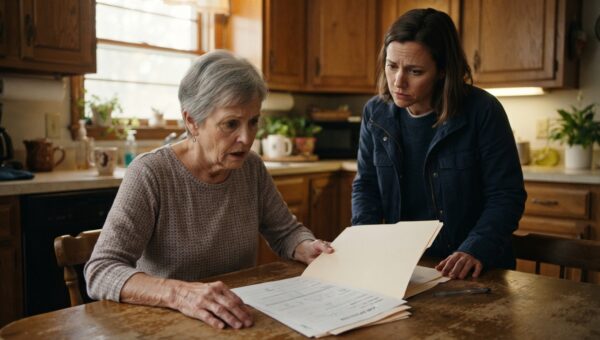
When I unlocked the front door with my spare key, a key I knew they would probably change by Monday anyway, Mom was sitting at the dining room table with a cup of instant coffee, and Dad was back in his chair. They looked up as I pulled a manila folder from my tote bag and laid it squarely in the center of the floral tablecloth, right on top of the lace runner.
“What is this?” Mom asked, her voice dropping into a defensive defensive tremor.
“That,” I said, pulling out a copy of the two-page Notice of Equitable Lien and the corresponding bank printouts, “is a legal claim against the title of this house. It’s signed, notarized, and ready to be filed at the county courthouse at 8:01 on Monday morning.”
Mom reached out a trembling hand, her fingers brushing the corner of the paper as if it were contaminated. “You wouldn’t. That’s your own family. You’re going to stop your brother from getting his home over money?”
“You had five years to treat me like family, Mom,” I said, my voice steady, unshakeable, and completely devoid of the anger I expected to feel. “You chose to treat me like an ATM machine with a heartbeat. Here are your two choices. Option one: Kevin amends his mortgage application at the title office on Tuesday to include an additional thirty-one thousand dollars, and that money is wired directly to my account at closing as a formal lien payout. Option two: I record this lien on Monday morning, the title transfer collapses, the house goes on the open market for four hundred thousand dollars, and whatever is left after the mortgage and capital gains tax get split down the middle goes wherever the court says it goes.”
Mom stared at me, her mouth opening and closing like a fish out of water, searching the empty air for a guilt trip that no longer worked. For the first time in my life, she looked old, small, and terribly ordinary.
Dad leaned forward, his knuckles white against his walking cane, his voice cracking like dry winter twigs. “Evelyn,” he rasped, looking up at his wife with tired, watery eyes. “Evelyn, stop it. Just stop it now. She paid the taxes. She paid for the heat. Sign the damn paper.”
Mom burst into ragged, wet tears, slamming her palms against the table, but the fury had gone out of her sails. She knew as well as I did that if the house hit the open market, Kevin would lose his free windfall entirely, and the neighborhood gossips would find out how they tried to cheat their older daughter out of her savings.
The closing took place on a cold, gray Thursday morning in a sterile conference room at First Meridian Title. The room smelled of fresh toner and commercial carpet cleaner. A young closing agent named Miller pushed papers back and forth across the mahogany table with quiet, mechanical efficiency.
Kevin sat across from me, his jaw clamped so tight a muscle ticked furiously in his cheek. He wouldn’t look me in the eye. He had been forced to go back to his lender on Monday afternoon, swallow his pride, and increase his mortgage assumption from ninety-six thousand to one hundred and twenty-seven thousand dollars to cover the lien payout. The bank approved it in three hours because the equity cushion was so massive it made the loan officer laugh.
Mom and Dad signed the warranty deed with shaky hands, their pens scratching against the heavy legal paper like dry grass in the wind.
Finally, Mr. Miller slid a bright green, computer-generated cashier’s check across the laminate surface toward my side of the table. I picked it up, my thumb resting on the raised seal. Exactly thirty-one thousand dollars, drawn on First Meridian’s escrow account, funded by my brother’s new mortgage.
I signed the final release of lien, handed the document back to the attorney without a word, and stood up from my chair. I buttoned my wool coat, picked up my leather bag, and turned toward the frosted glass exit.
“Clara,” Mom whispered from her chair, her voice small and broken. “Are you even going to call us for the holidays?”
I stopped with my hand on the brushed-metal door handle, looking back at them one last time. The golden-child dynamic was shattered, the illusion of unconditional family loyalty burned down to cold ash, and for the first time in five years, my lungs felt entirely clear.
“Take care of yourselves,” I said quietly, and walked out the door.
I walked out into the crisp autumn parking lot, the asphalt damp from a morning mist that was beginning to burn off under a pale, stubborn sun. My car sat three rows away, a dark blue sedan with a dent in the rear bumper that I hadn’t yet saved enough to fix. I opened the door, slid behind the steering wheel, and locked the doors against the chill.
For a long moment, I didn’t turn the key. I just sat there in the quiet interior of my own car, looking down at the green cashier’s check resting against the dark grain of the steering wheel. I let out one long, deep, unburdened breath, the kind of breath I hadn’t taken since the day my father’s heart first started failing five long years ago. Then I dropped my keys into the ignition, put the car in drive, and turned the wheel toward a life where my kindness was no longer for sale.