PART 1
My mother called on a Tuesday morning with that sharp, breathless tone she only used when she needed something from me immediately. She did not ask how my week was going or whether I was still swamped with my graphic design freelance projects. She got straight to the point.
“Your sister’s wedding dress is ruined,” she said, her voice tight with panic. “The dry cleaner on Maple Street scorched the silk along the hem.
Sarah is beside herself. You know how particular she is about everything being perfect for the ceremony.”
I sat at my kitchen counter, holding a mug of lukewarm coffee, feeling that familiar, heavy drop in my stomach. Sarah was getting married in three weeks. Everything in our family revolved around Sarah’s happiness, Sarah’s timeline, and Sarah’s demands.
“How is it ruined?” I asked, looking out the window at the gray autumn drizzle. “Can’t they fix it or order a replacement?”
“There is no time to order a new one, and nobody else can match this specific ivory silk on short notice,” my mother said, her voice rising. “You have the exact same gown. You bought yours from the same bridal boutique last year when you married David, before things went south. Yours is hanging in your spare room closet right now, completely unworn since the divorce.”
I closed my eyes for a second. My wedding dress. The dress I bought with money I saved myself, before David packed his bags and left me with a stack of bills and a quiet, empty apartment.
That dress felt like a relic of a mistake I was still trying to recover from, but it was also mine.
“Mom, that dress cost two thousand dollars,” I said slowly. “And it’s mine.”
“It’s sitting in a garment bag collecting dust while your sister is crying her eyes out over a scorched hem,” my mother snapped. “Be generous for once in your life. Lend it to her for the day. She’ll have it cleaned afterward, and you’ll get it right back. Do you really want to ruin your own sister’s wedding out of petty bitterness?”
That word always did its job. Petty. Whenever I tried to draw a boundary, my mother handed me that word like a weapon until I felt too small to hold my ground.
“Fine,” I said, the word tasting like ash. “She can borrow it. But she has to bring it back personally the day after the wedding.”
An hour later, I drove the garment bag over to my mother’s house, where Sarah was waiting with swollen eyes and an attitude of aggrieved entitlement. My mother didn’t even offer me coffee. She unzipped the bag immediately, running her manicured fingers over the silk bodice as if inspecting livestock.
Two days later, I went back to the bridal alterations shop downtown where Sarah and my mother had taken the dress to have the hem adjusted to Sarah’s height. The seamstress, an older woman named Clara who had fitted my own dress a year ago, greeted me with a polite nod when I walked in.
“Just picking up the garment bag,” I said, looking around the cluttered, warm-smelling shop filled with pins, lace, and rolls of tulle.
Clara frowned, stepping out from behind the cutting table holding a small pair of curved scissors. She looked at me, then over at the fitting room curtain. “Your mother isn’t with you?”
“No, I just need to grab the dress.”
Clara wiped her hands on her apron and crossed her arms. “I need to ask you something, honey. Why did you ask me to remove that little hidden pocket from the inside lining of the bodice? The one on the left side, right over the heart?”
I stopped walking. My hand hovered over the zipper of the garment bag lying across a chair. “What hidden pocket?”
Clara tilted her head, her expression shifting from curious to cautious. “The little satin pocket stitched inside the lining. You had me put it there last year when we fitted it for you. You said you wanted to tuck something small and special inside it for your wedding day.”
I stared at her, my pulse quickening. I had never asked for a hidden pocket. On my wedding day, I wore my dress straight off the rack with no alterations except the hem.
“Clara, I never asked for a pocket,” I whispered.
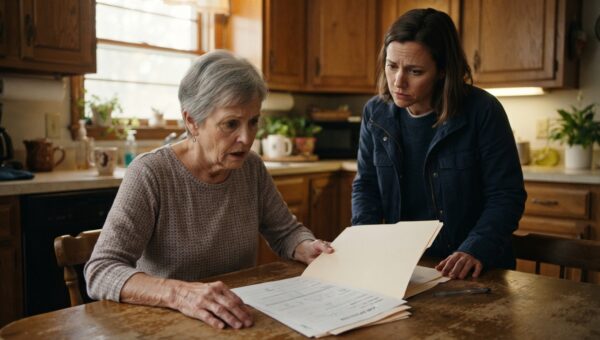
Clara walked over to a wooden desk against the back wall and picked up a manila folder stuffed with paper order forms. She flipped through a few yellowed sheets before pulling one out and sliding it across the counter toward me.
“Well, somebody brought this dress back here three days after your father’s funeral six months ago,” Clara said firmly. “And she specifically paid me cash to rip out the original lining seam, sew in a secret pocket, and slide something inside before sealing it back up. She told me it was your idea. She said you were too upset to come in yourself.”
I looked down at the paper. At the bottom, in my mother’s sharp, looping handwriting, was a signature authorizing the alteration. And the date on the work order was three days after we buried my father.
PART 2
The print on the work order blurred for a second as the small room felt suddenly airless. My father had passed away suddenly from a massive stroke six months ago, and the grief had left all of us hollowed out, or so I had thought. My mother had wept the hardest at the graveside, leaning on my shoulder so heavily that my arm went numb.
“Why would my mother alter my dress?” I asked, my voice barely carrying over the hum of the overhead fluorescent lights.
Clara shook her head, looking genuinely unsettled. “I don’t know, honey. I just do the sewing. But she was very specific. She didn’t want a single stitch visible on the outside. She wanted whatever she put in there to stay completely hidden from whoever wore the dress next. When she brought the dress back last week because Sarah needed it altered for the wedding, she acted like it was brand new off the rack. She didn’t say a word about the pocket.”
I reached out and touched the ivory silk of the garment bag. My fingers brushed against the left side of the bodice, right where Clara had pointed. Sure enough, beneath the smooth exterior fabric, there was a faint, rigid rectangle pressed against the lining. Something was still sewn inside my dress.
“Clara,” I said, my throat tightening. “Did you look at what she put in there?”
“Of course not,” Clara said, pulling back slightly. “That’s professional ethics. I mind my own business. But whatever it was, it was flat and wrapped in plastic. It felt like an old photograph or a folded document.”
I didn’t answer. I unzipped the bag, reached my hand inside the lining, and felt along the interior seam. My fingers found the small, unpicked thread where Clara had hastily re-stitched the opening after Sarah’s fitting. With a trembling finger, I hooked the thread and pulled. The stitches gave way easily, revealing a small slit in the silk lining.
I slid two fingers inside the dark cavity. My fingertips brushed against something cold and smooth. I drew it out into the light of the sewing shop.
It was a heavy, old-fashioned Polaroid photograph, yellowing around the edges and sealed inside a clear plastic sleeve.
I looked down at it, and the floor beneath my boots seemed to tilt.
The photograph showed a younger version of my father, smiling a wide, relaxed smile I hadn’t seen in decades, standing on the porch of a small house I didn’t recognize. In his arms, he was holding a newborn baby wrapped in a yellow blanket. Standing beside him, looking up at him with an expression of fierce, adoring tenderness that I had never once seen directed at my mother, was a woman who was not my mother. On the back of the Polaroid, written in my father’s familiar, hurried handwriting, were three words and a date: *Our new beginning. May 14, 1988.*
May 14, 1988. That was four years before I was born.
I stared at the image until the edges of the room went gray. My mother hadn’t just used my dress as a hiding place. She had used my wedding dress, the garment I wore on the most sacred day of my life, as a secret vault to bury my father’s deepest betrayal, knowing I would likely never wear it again, keeping his ghost locked against my heart while pretending to mourn him as the perfect husband.
Clara was watching me, her eyes wide with sympathy. “You okay, honey? You look like you’re going to faint.”
“I need to go,” I managed to say, my voice sounding like it belonged to a stranger.
I shoved the photograph into my coat pocket, zipped the garment bag, and walked out of the shop without another word, leaving the dress hanging on the back of Clara’s chair.
PART 3
I didn’t go home. I drove straight to my mother’s house, the photograph burning against my ribs like a hot coal.
When I pulled into her driveway, her sedan was parked in its usual spot. The front porch light was on, casting a warm, deceptive glow over the autumn mums in their ceramic pots. I walked up the steps and knocked once, hard and loud, before turning the brass handle myself. It was unlocked, just as it had been every day of my childhood.
“Mom?” I called out, stepping into the foyer.
My mother emerged from the kitchen holding a stack of cloth napkins, her face smoothing into its practiced mask of maternal busyness. “Oh, you’re back early. Did Clara finish the hem properly? Sarah is stressing out again about the shoes—”
I pulled the Polaroid from my pocket and laid it flat on the mahogany entry table between us.
The words on Sarah’s wedding prep stopped dead in her throat. She stared down at the small square of glossy plastic, and the color drained from her face so fast it looked like someone had turned off a light inside her skin. Her hands began to tremble, the cloth napkins slipping from her fingers and fluttering down onto the hardwood floor.
“Where did you get that?” she whispered, her voice losing all its usual authority.
“Clara,” I said, my voice terrifyingly calm. “Clara told me about the alteration you asked for three days after Dad’s funeral. She told me you used my wedding dress as a hiding place because you couldn’t bear to throw it away, but you couldn’t bear to look at it in your own house either.”
My mother opened her mouth, but no sound came out. She reached out a shaking hand toward the table, then pulled it back as if the photograph were burning hot.
“Who is she?” I asked, stepping closer. “Who is the baby?”
My mother sank slowly onto the wooden bench beside the door, her shoulders caving inward. For the first time in my life, she looked old. Not dignified, not in control, just an aging woman whose carefully constructed world had finally cracked down the middle.
“Her name was Laura,” my mother said, her voice barely a rattle. “She lived two towns over. Before we got married, before you were even a thought, your father tried to leave. He packed his car. He was gone for six months. I begged him to come back. I swallowed my pride, I tracked him down, and I made him choose.”
“And he chose you,” I said bitterly.
“He chose the life we had built,” she corrected softly. “He came back. He promised it was over. He swore on his life that he never wanted to see her or the child again. But he kept that picture. He kept it hidden in his desk drawer for thirty years. When he died, I was cleaning out his office, and I found it.”
“So you hid it inside my wedding dress,” I said, the horror of it settling into my bones. “You slipped it into the lining of the dress I wore when I promised to trust a man with my life. You turned my wedding into a lie.”
“I didn’t want to destroy our family’s memory of him,” she cried, her voice cracking as tears finally spilled over her cheeks. “He was a good father to you. He was a respected man in this town. If I burned it, the truth would have won. I just wanted it somewhere safe where nobody would ever find it.”
“Except you didn’t think about who owned the dress,” I said. “You didn’t care that you were using me to bury your secrets.”
Sarah appeared at the end of the hallway, frozen in her silk robe, looking between the two of us with wide, uncomprehending eyes. “Mom? What’s going on? What is that?”
Neither of us answered her.
ENDING
I left the photograph lying on the entry table where my mother had left it.
I didn’t scream, and I didn’t demand an apology. Some betrayals are too deep for words to fix, and some apologies are just another way of asking to be forgiven for the damage you refuse to repair. I walked back out through the front door, pulling my coat tight against the cold evening wind, and got into my car.
Two days later, a courier dropped a large cardboard box on my front porch. Inside was my wedding dress, neatly folded in tissue paper, along with a check from my mother for two thousand dollars and a brief, unsigned note written in her shaky handwriting.
I didn’t cash the check. I took the dress down to the local consignment boutique on Saturday morning and sold it for a fraction of what I paid, watching the clerk box it up for a stranger who would wear it with a clean slate.
When I got back to my apartment, the silence was quiet and heavy, but for the first time in a very long time, it belonged entirely to me. I walked over to my desk, picked up my sketching pencils, and went back to work.