PART 1
I climbed into the attic in July for the box fan and found Christmas instead. A whole corner of wrapped presents, tagged in my husband’s block letters. Names I didn’t know. To Cade. To Sela. There is no Cade or Sela in this family. Forty years married, no children between us, and that was our quiet grief.
Under the biggest box was a letter to Santa in crayon, giving an address clear on the other side of Sallisaw.
Every December he would pull $1,100 for what he called the office toy drive. Just the little ones downtown, hon. He always said it with that soft smile, wearing his old wool coat while he drove into town alone. I lowered myself onto the plywood in the heat and counted the tags. Eleven Christmases of them. Then I read the last line off that child’s letter, where she’d written who to thank for the bicycle and the winter boots, and my stomach dropped through the floorboards.
I sat there in the dusty heat for a long time, the galvanized metal roof baking right above my head. Sweat ran down my temples, but my hands felt like ice. Forty years of marriage. Forty years of sitting across from Arthur at our small kitchen table, drinking black coffee, talking about the weather and the garden and the way our knees ached when the humidity climbed. When we learned back in our thirties that we couldn’t have children, we held each other in the dark of our little bedroom and agreed that we only needed each other. We built our life around that quiet emptiness. We filled it with quiet routines and Sunday drives and a mutual understanding that we carried that loss together.
Or so I thought.
I looked at the tags again. Arthur’s handwriting was unmistakable. He always printed in thick, square block letters, pressing down so hard on the pen that you could feel the words on the back of the paper. Cade. Sela. Eleven years of boxes meant these children had grown up while I sat downstairs folding laundry, washing his shirts, and saving coupons for groceries.
The address on the crayon letter was on Elm Street, over on the east side of Sallisaw, past the old grain elevator where the houses get smaller and the yards are full of old truck parts and tall Johnson grass. I knew that part of town. Not well, but I knew it.
I didn’t call him. Arthur was down at the hardware store picking up a new valve for the kitchen sink. He always took his time when he went out, tinkering with things, stopping to talk to people. He was sixty-eight years old, with graying hair combed flat and a mild, gentle way about him that made every neighbor trust him instantly. Nobody in Sequoyah County would ever suspect Arthur of a double life. He was the man who helped widows carry groceries and showed up at church every Sunday without fail.
I climbed back down the pull-down ladder, my knees clicking in protest, and walked straight to his small oak desk in the corner of the den. Arthur kept his personal files in the bottom drawer, locked with a little brass key he usually kept on his key ring. But Arthur had a terrible habit of leaving his keys on top of the microwave when he came in from the garage.
I walked into the kitchen. Sure enough, there they were, resting right beside the coffee canister.
My hands shook as I picked them up. I walked back to the desk, slid the key into the small brass lock, and turned it. It clicked open with a soft, final sound that felt entirely too loud in the quiet house.
PART 2
Inside the drawer were tax forms, old insurance papers, and a thick manila folder tied with a piece of twine. I untied it and spread the contents across the blotter. Bank statements. Savings accounts I had never seen. Receipts from the credit union in town.
Every November for eleven years, right before the holidays, a withdrawal of exactly $1,100. But that was only the toy money. Further down were monthly deposits. Automatic transfers from our joint checking account into a separate account held in Arthur’s name alone. Three hundred dollars a month. Four hundred. Over the years, as he picked up extra work consulting for the county, it went up to six hundred a month.
I did the mental math, and the numbers made my head swim. It wasn’t just toy money. It was a second household.
I kept digging through the folder until I found a photograph tucked inside a folded medical bill from the Sallisaw clinic. It showed a woman with dark hair standing on the steps of a small white frame house on Elm Street, holding a little boy who couldn’t have been more than four years old. Beside her stood a girl with long braids, maybe eight or nine, wearing a bright red coat.
The girl was Sela. The boy was Cade. And the man standing half out of the frame, smiling down at the little girl while holding her hand, was Arthur.
The date stamp on the back of the photo was from three months ago.
I sat back in the chair, the photograph clutched in my hand, staring at the wall. He hadn’t just hidden them. He had lived two entirely separate lives under my nose. While I was taking care of my mother during her final year, while I was sitting by her bed in Fort Smith watching her fade away, Arthur had been driving over to Elm Street. While I was grieving my mother’s passing and crying at the kitchen table, Arthur had been playing catch in a yard six blocks away.
The betrayal didn’t arrive with a dramatic scream or a thrown dish. It came as a cold, heavy silence that filled every corner of the house. I put the papers back exactly where I found them, locked the drawer, and put the keys back on the microwave. Then I sat at the kitchen table and waited for him to come home.
Arthur walked in around two o’clock. He carried a small brown paper bag from the hardware store and smelled faintly of copper pipe and hot sunshine.
“Hey, hon,” he said, hanging his cap on the rack by the back door. “The valve was a little trickier than I thought, but I got the gasket seated right. Should hold for another ten years.”
He turned around, expecting me to nod and ask him how his morning went, the way I had done every day for four decades. Instead, I just looked at him.
“Arthur,” I said. My voice sounded remarkably steady, which surprised me. “Tell me about Elm Street.”
Arthur froze. The small bag in his hand slipped an inch, then he caught it. The mild, gentle look on his face didn’t shatter all at once; it dissolved slowly, like salt in warm water, until nothing was left behind those pale blue eyes.
PART 3
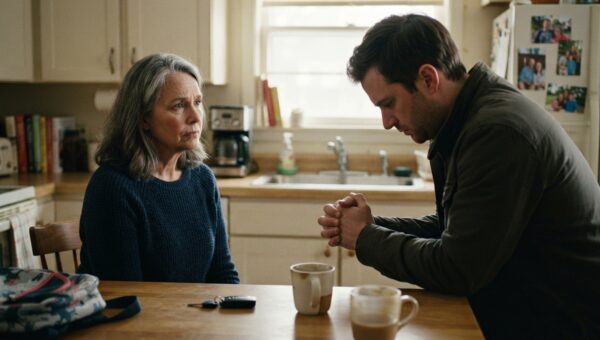
He didn’t try to lie. That was the first thing he did, or didn’t do. He just walked over to the kitchen counter, set the bag down, and pulled out a kitchen chair. He sat down heavily, resting his elbows on the oilcloth tablecloth.
“How long do you know?” he asked. His voice was lower than usual, flat and tired.
“I went up to the attic for the fan,” I said. “Found the boxes. Found the letters. And then I opened your desk drawer.”
Arthur rubbed his face with both hands. He looked old suddenly. Not the dignified, well-kept sixty-eight-year-old man everyone in town knew, but a tired, shrunken man who had finally run out of explanations.
“Her name is Martha,” he said quietly. “Back when we found out… when the doctor told us we couldn’t have children, it broke something in me. I know it broke you too, Helen, but I couldn’t accept it. Ten years later, I met Martha. She was young, she was struggling, and… things happened. It started as a mistake, Helen. But then Cade came along. And Sela.”
“You built another family,” I said. Every word felt like swallowing glass. “With our money. With the savings we built together.”
“Not our retirement,” he was quick to say, his voice defensive for a split second. “I kept that separate. I worked extra hours for them. The toy drive money… I told you about that because I needed a cover to buy the kids what they needed for Christmas without you asking questions.”
“Eleven years,” I whispered. “Every single December, you stood there in your coat and kissed my cheek and told me you were helping the little ones downtown. While you were taking another family Christmas shopping.”
“I love you, Helen,” he said, reaching across the table.
I pulled my hand back before his fingers could touch mine. The movement was sharp and final.
“Don’t,” I said. “Don’t you ever say that word to me again. If you loved me, you wouldn’t have split my life in half and lied to me every single day we drew breath together.”
He sat there, staring at his hands on the table. He didn’t yell. He didn’t beg. He just accepted it because he knew there was nowhere left to hide.
I didn’t pack his bags that afternoon. I didn’t scream or break the kitchen window. I did something much quieter. I called our lawyer, Robert Vance, who had handled my mother’s estate. I told him I needed to come into his office first thing Monday morning to discuss an immediate separation, a complete financial audit of our joint accounts, and a transfer of the deed to my name alone, since the house had belonged to my parents before we were even married.
Arthur listened to me make the phone call from the living room couch. He didn’t interrupt. When I hung up the phone, he looked at me from across the room.
“Where am I supposed to go?” he asked.
“You know the address,” I said. “Elm Street is just on the other side of town.”
ENDING
The moving van came on a Tuesday morning in August. The neighbors stood across the street, watching quietly from their porches, whispering behind their hands the way people in small towns always do when a marriage older than most of their mortgages quietly falls apart in broad daylight. Arthur didn’t look at them. He loaded his clothes into the back of his sedan, climbed behind the wheel, and drove away without looking back at the porch where I stood watching.
I stayed in the house. It felt enormous at first, echoing with forty years of silence that was no longer a quiet grief, but an empty space I finally owned.
A week after he left, I went back up to the attic to put the fan away. The corner where the Christmas boxes had been was completely empty. Arthur had come back while I was at the grocery store and taken every last tag, every wrapped box, every crayon letter to Santa.
Only one thing was left behind on the bare plywood floor. A single, small wooden toy truck, painted red, with one wheel missing. It must have rolled out from under a box and stayed behind in the dust.
I picked it up, turned it over in my palm, and carried it downstairs. I set it on the kitchen windowsill above the sink, right beside the small potted geraniums, and left it there where the morning sun could catch the faded paint. Then I poured myself a cup of coffee, sat down at the table by myself, and listened to the quiet hum of the refrigerator.