PART 1
For seven months, my husband took $180 in cash from our kitchen jar every single Thursday morning.
The jar was an old blue glass pickle crock sitting on the wooden shelf beside the flour canister. We used it for household incidentals: milk runs, the boy who raked our pine needles, church raffle tickets, and small cash repairs around the house.
My husband, Martin, had rotator cuff surgery back in October, and starting the first week of November, he began reaching into that jar before breakfast.
He always took the exact same bills: nine crisp twenty-dollar bills, folded once down the middle.
“It’s for the private mobility tech after the clinic session,” Martin told me when I asked about it before Thanksgiving. “Insurance covers the basic therapy on Tuesdays, but the shoulder specialist on Thursdays works cash-only for deep scar work. You know how stiff that joint gets.”
I had spent thirty-four years of marriage being the person who smoothed things over. When Martin got quiet or stubborn, I stayed busy in the garden. When bills got tight, I made casseroles last three nights instead of picking a fight. Martin was sixty-eight, a retired supervisor from the municipal water authority, and he had always been particular about his routines. I didn’t want one awkward conversation over kitchen cash to turn into a bitter family war, so my first instinct was to swallow it down.
Yet as winter turned into spring, his shoulder looked fine. He could reach the top pantry shelf without wincing. He could pull the cord on the lawnmower on the first yank. But every Thursday at eight-thirty in the morning, the nine twenty-dollar bills still disappeared, and Martin would drive off in his pickup truck, gone until nearly two in the afternoon.
I am not proud of how long I waited. When you suspect something is wrong in a long marriage, fear has a way of dressing up as patience. I was scared the truth would hurt more than the wondering, so I kept my head down, washed the towels, and told myself he was just lonely for routine after retiring.
Then came a rainy Tuesday in May.
Martin had dropped his denim jacket over the back of the entryway bench before going out back to check the downspouts. As I picked it up to hang it on the brass peg, his keychain swung loose from the right pocket, catching the lining.
Something fell out onto the floor runner.
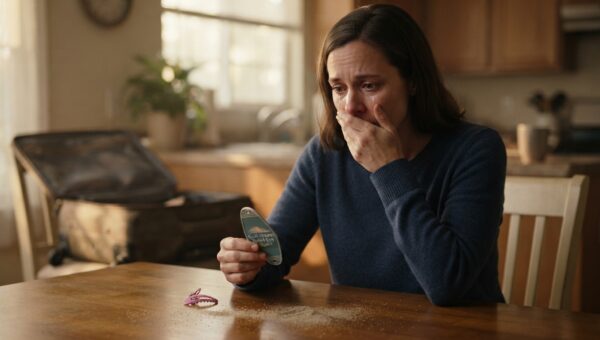
It wasn’t a clinic receipt or a physical therapy card. It was a white plastic-coated visitor badge, folded down the center to fit into a coin pocket.
Printed across the top in dark green letters was *Shady Pines Memory Care Community*, located forty minutes south in Carrollton.
Beneath the logo was the visitor date from the previous Thursday, stamped with a blue electronic barcode: *Authorized Family Guest: Room 114.*
I stood by the coat hooks with the plastic badge pressed between my thumb and forefinger. My throat felt like sand. Martin had never mentioned Carrollton. Both of his parents had passed away before we turned fifty, and his only brother lived in Arizona. We had no family in memory care.
When Martin came inside through the back mudroom, wiping his wet boots on the mat, I was still holding the badge in my palm.
“Martin,” I said, holding it out so the green lettering caught the kitchen light. “What is this?”
He stopped right in the doorway. He looked at the badge, then looked at my face.
He didn’t raise his voice, and he didn’t reach to grab it.
“Please don’t make this ugly, Clara,” Martin said softly, his voice tired and flat. “Some things are better left quiet.”
He walked right past me into the den and shut the door.
That night, after dinner had been eaten in complete silence, Martin went out to the garage around seven o’clock to grease the fittings on his utility trailer.
I took my purse from the counter, walked out to my sedan, and told him through the open bay door that I was going to the supermarket on Route 6 to pick up flour and laundry detergent.
He nodded without looking up from his grease gun.
I backed down the driveway, turned away from the grocery plaza, and drove straight south into the rain toward Carrollton.
The memory-care center sat behind a grove of wet pin oaks off County Road 12. It was a single-story brick building with tall windows and a circular drive.
I pushed the glass doors open at a quarter past eight. The lobby was warm and smelled of wax, brewed coffee, and disinfectant.
An older receptionist with silver curls and reading glasses looked up from behind the curved desk. She saw my face, smiled with total familiarity, and said, “Back so soon, Evelyn? Your brother just left twenty minutes ago.”
The name hit my ears like cold water.
I hadn’t heard anyone call me Evelyn in thirty-two years.
PART 2
I stood rooted to the carpet in front of the desk, my car keys digging into the meat of my palm.
“Excuse me?” I asked.
The receptionist adjusted her glasses, leaning forward slightly over her computer monitor. She looked at my damp trench coat, then studied my eyes, her warm expression faltering into sudden embarrassment.
“Oh, forgive me,” the woman said, shaking her head. “From the doorway, with your hair wet like that, you looked just like the photographs in Room 114. I am so sorry. How can I help you, ma’am? Visiting hours ended at eight, but if you’re family, I can check the register.”
“Who is in Room 114?” I asked. My voice came out barely above a whisper, rough around the edges.
“That’s Mrs. Vance’s room,” the clerk answered. “Martha Vance. She was admitted in October.”
Martha Vance.
The room seemed to tilt slightly under my feet.
Martha Vance had been my stepmother. She had married my father when I was nineteen, two years after my own mother died of breast cancer. Martha was thirty years younger than my father, cold-eyed, and convinced from the first month that I was waiting for my father to die so I could claim the family lumber parcel.
When my father suffered a massive stroke in the winter of 1994, Martha had shut me out of the hospital room. She had changed the locks on the farmhouse, produced a revised will drafted three weeks before his death, and told the probate judge that I had abandoned the family years earlier.
The last time I saw Martha Vance was across a mahogany table in a Mercer County courtroom thirty-two years ago, where she looked me dead in the eye and said my father never wanted to see my face again.
I was twenty-four years old then. My given name was Evelyn Clara Vance.
After the estate was signed over to Martha and the court clerk stamped the file closed, I walked out of that building, went to the county seat, and legally changed my first name to Clara, my middle name. I met Martin eighteen months later in Columbus. When we married, I buried that courthouse memory deep in the dirt. I told Martin that my father had died, that my stepmother had taken what was left, and that the family was closed to me for good. Martin had nodded, held my hand, and promised we would build our own life from scratch.
Now, thirty-two years later, my husband was taking $180 every Thursday to visit her in a locked memory-care unit forty miles from our house.
“How often does Martin Miller come here?” I asked the clerk.
The woman looked uneasy now. She glanced down at the visitor log binder beside her keyboard. “Every Thursday morning, ma’am. He’s been her primary sponsor contact since she transferred from the county annex in the fall. He comes at ten, sits with her through lunch, and brings her fresh peppermint drops and her laundry.”
“Does she know who he is?”
“Some days,” the receptionist replied gently, her voice dropping into professional sympathy. “She has advanced vascular dementia. Most afternoons she thinks it’s 1985. She talks about the timber mill and she asks where her daughter Evelyn is. Mr. Miller always sits by the window and tells her Evelyn is doing just fine.”
A cold ache spread through my chest.
Martin hadn’t just visited her. He had been paying for her.
One hundred and eighty dollars a week. That was seven hundred and twenty dollars every month. Multiplied across seven months, that was over five thousand dollars pulled from our kitchen jar, fifty dollars at a time, behind my back.
“Can I see her?” I asked.
The receptionist hesitated, looking at the wall clock that showed twenty-five minutes past eight. Then she took a plastic visitor badge from the drawer, tapped a temporary guest code into the pad, and handed it across the counter.
“Room 114 is at the end of the north corridor,” she said softly. “She’s usually awake until nine.”
PART 3
The hallway was wide, lit by soft yellow wall sconces, with handrails running along both sides of the baseboards.
Room 114 stood at the very end, right before the fire exit doors. The door was cracked open three inches, letting out the faint sound of a radio playing old big-band music.
I pushed the door open.
Sitting in a blue vinyl armchair by the radiator was a tiny, frail woman in a pink quilted housecoat. Her hair was thin and white as spider silk, pinned back with two plastic barrettes. Her hands, resting on a floral lap blanket, were spotted with age and crooked at the knuckles.
This was the woman who had stood in the county courthouse thirty-two years ago in a sharp black dress, telling the probate commissioner that my father had forbidden my name from being spoken in his house.
She looked up when the floorboards creaked.
Her pale blue eyes were clouded with cataracts, wandering across my coat before settling on my face. She didn’t flinch. She didn’t scowl.
“Evelyn?” she whispered. Her voice was cracked and thin as dried parchment. “Did you bring the cedar chest from the shed? Your father said it was going to freeze tonight.”
The anger that had carried me forty miles down the highway caught in my throat.
There was no malice in that face. There was only the hollow, drifting confusion of a mind that had untethered from time.
I looked at the small oak dresser beside her bed.
Resting on the lace runner was a framed photograph from 1982. It showed my father standing by his timber truck, with me at sixteen leaning against the front fender in my high school jacket. Tucked into the corner of the frame was a small cardboard receipt from our local pharmacy in town, with Martin’s handwriting on the back: *Cardigan washed. Peppermint drops in top drawer.*
Beside the frame was a blue legal binder.
I opened the front cover.
Inside was a state guardianship accounting ledger, filed under the Perry County Probate Division.
The primary court-appointed conservator listed on the document was Martin Miller.
I turned to the financial schedules in the middle of the binder.
In October of last year, the county adult protective services division had found Martha Vance living alone in a deteriorating mobile home near the old quarry, without heat or running water. Her timber money had been drained years earlier by an unlicensed caregiver who had fled the state. The county was preparing to place her in an unaccredited state warehouse facility sixty miles away.
Because my father’s original 1994 probate decree had listed Martin and me as surviving secondary parties of record, the county clerk had contacted our house while I was at my sister-in-law’s house in Dayton for three days.
Martin had answered the phone.
He had driven down to the county seat alone. When the social worker showed him the conditions in that trailer, Martin had agreed to serve as her private sponsor to keep her in a clean regional facility.
The $180 a week from our jar was not for a therapist’s cash rate.
It was the exact weekly gap between Martha’s meager nine-hundred-dollar Social Security check and the Medicaid co-pay requirement for a semi-private room at Shady Pines.
Martin had taken the money from our grocery fund, nine twenties at a time, because our primary retirement account was locked in a certificate of deposit that carried an early withdrawal penalty, and he knew that if he asked me for five thousand dollars to save the woman who had stolen my father’s estate, I would have told him to let the county take her.
I closed the binder.
Martha was looking at me from her chair, her head tilted slightly, waiting for an answer about the cedar chest.
“The shed is locked, Martha,” I said, my voice shaking so hard the words felt foreign in my mouth. “The chest is safe inside.”
She smiled, a small, childlike tuck of her lips, and nodded. “Good. Your father worries about the rain.”
I stepped out of the room, closed the door behind me, and walked out into the cold night air.
The drive back to our house was completely silent. The rain had stopped, leaving the asphalt shiny under the moon.
When I pulled into our gravel driveway at ten o’clock, the lights in the garage were still on.
I walked into the bright, concrete-floored workspace. Martin was sitting on an overturned five-gallon bucket beside his workbench, wiping down a socket wrench with an oily rag. He heard my footsteps, set the tool down on the metal tray, and looked up at me.
His face was drawn, the deep lines around his eyes looking heavier than I had ever seen them.
“You went down there,” Martin said. It wasn’t a question.
“I went down there,” I answered.
I pulled the white plastic visitor badge from my pocket and laid it on the wooden workbench between two oil cans.
“Why, Martin?” I asked, looking right at him. “Why didn’t you tell me?”
Martin rubbed his face with his calloused hands.
“Because thirty-two years ago, you cried for three months in that apartment in Columbus,” he said, his voice dropping low and rough. “You couldn’t sleep without the hall light on. You changed your own name so you wouldn’t have to carry the weight of what that woman did to you.”
He looked up at the rafters, his jaw set in a hard, stubborn line.
“When that county worker called in October, she told me Martha was sitting on an unheated floor with no food in the fridge,” Martin said. “She was eighty-one years old, Clara. She didn’t know what month it was. If I told you, I would have forced you to make a choice between your decency and your grief. You would have either said no and felt guilty for the rest of your life, or you would have said yes and reopened every wound you spent thirty years trying to heal.”
“So you decided to steal from our jar instead?” I said, the words sharp despite the tears spilling down my cheeks.
“I didn’t steal from you,” Martin said quietly, standing up from his bucket. “I took cash out of my own pension allowance so the bank statements wouldn’t show the transfers. I went down there every Thursday because she kept asking if Evelyn was coming. I couldn’t bring you, so I sat in that chair and made sure she didn’t die alone in a state ward.”
He stepped closer, his boots scraping on the concrete floor, but he didn’t reach for my hands. He stood there with his shoulders bent, waiting for whatever judgment I was going to hand down.
“I’m sorry about the money, Clara,” he whispered. “I’ll take extra shifts at the township water plant this summer to put every dime back in that jar.”
ENDING
I stood in the cold garage looking at my husband.
For seven months, I had imagined the worst kinds of betrayal. I had imagined secret debts, hidden vices, and another woman. I had let suspicion eat away at thirty-four years of shared meals and quiet evenings, all because I had been too terrified to ask a simple question over breakfast.
And Martin had carried a ghost on his back for seven months because he thought he was protecting me from the woman who had broken my youth into pieces.
“Martin,” I said, wiping my cheeks with the back of my hand. “You’re sixty-eight years old. You are not working extra shifts at the water plant.”
He looked at me, uncertain.
“Tomorrow morning, we’re going down to the credit union,” I told him. “We are going to set up an automatic debit from our secondary savings account for the memory-care copay. It will be accounted for, and it will be transparent.”
Martin swallowed hard, his throat clicking in the quiet garage. “You don’t have to pay for her, Clara.”
“I am not paying for her,” I said, pointing at the workbench. “I am paying so my husband doesn’t have to sneak twenty-dollar bills out of a pickle jar like a thief in his own house.”
He let out a ragged, uneven breath that sounded like twenty years of tension breaking at once. He reached out, pulled me against his work shirt, and held me tightly with both arms, his chin resting against the top of my head.
He smelled of rain, motor oil, and the cedar soap he had used since we were thirty.
We walked into the house together, locked the back door, and turned off the kitchen light.
The next morning was Thursday.
At eight-fifteen, Martin came down the stairs wearing his clean denim jacket and his work boots.
I was standing by the stove with two travel mugs of black coffee and a small white paper sack from the bakery in town.
I picked up the blue glass pickle jar from the shelf. Inside were three loose ten-dollar bills and a handful of silver change. I didn’t touch the money. I set the jar back beside the flour, picked up my car keys from the hook, and handed Martin one of the coffee mugs.
He looked at the keys in my hand, then at the bakery sack. “Clara?”
“Drink your coffee, Martin,” I said, pulling my wool cardigan around my shoulders. “It takes forty minutes to get to Carrollton, and we don’t want to hit the school buses on Route 12.”
We walked out to the truck together under a clear, pale morning sky.
The air was cool, carrying the sweet smell of damp earth and blooming lilacs from the fence line. Martin opened the passenger door for me, just like he had on our first date thirty-four years ago, and I climbed up onto the bench seat.
We drove south along the highway, the miles rolling quietly beneath the tires, heading toward the room at the end of the hall where an old woman was waiting to hear that Evelyn was doing just fine.