PART 1
My daughter-in-law banned me from seeing my seven-year-old grandson after I questioned a dark, thumb-sized bruise on his upper arm.
It happened on a Sunday afternoon in early October at her kitchen island. My grandson, Leo, was reaching across the counter for a juice box when his sleeve slid back. The mark was yellow and purple, pressed deep into the soft skin near his triceps.
I didn’t yell. I just touched his elbow and asked, “Leo, honey, what happened to your arm?”
Before the boy could take a breath, my daughter-in-law, Vanessa, snatched his wrist, yanked his sleeve down, and shoved him toward the hallway. Her face went tight and blotchy red. She told me I was accusing her of child abuse in her own home, said I was poisoned with suspicion, and ordered me to get off her porch.
By nine that evening, my son, Brian, called me.
He didn’t ask how my arthritis was, and he didn’t ask what I had seen. He sounded exhausted and stressed, using words that clearly came from Vanessa’s mouth. He told me I was dangerous to their family stability, said I was overstepping boundaries, and told me they needed complete space from me until I learned my place.
I backed off. I am sixty-four years old, living alone on my pension since my husband died five years back, and I know how easily an adult son can slip out of reach when his wife draws a line in the sand. I didn’t want to make things worse for Brian, and I didn’t want Leo caught in a family war. For two months, I stayed in my house, swallowed the loneliness, and stared at Leo’s school picture on my refrigerator.
Then came a freezing Tuesday afternoon in December.
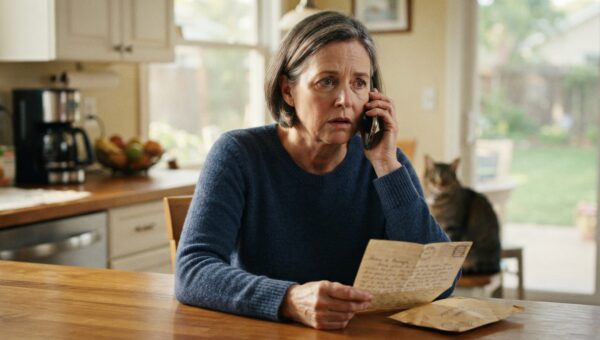
My phone rang while I was folding laundry. The caller ID showed Oak Creek Youth Soccer.
I picked it up, thinking it was an automated announcement about field closures. Instead, a man’s voice came through the line.
“Mrs. Albright? This is Coach Miller from Leo’s league. Are you nearby the municipal complex?”
My chest tightened up instantly. “I’m five miles away, Coach. Is Leo hurt?”
“He isn’t hurt, ma’am,” the coach said, keeping his voice low and deliberate. “His practice ended fifteen minutes ago. His mother isn’t here, and Brian’s phone goes straight to voicemail. But Leo had you listed on his emergency roster card in his gym bag. He asked me to call you directly.”
I threw on my coat, left the dryer running, and drove straight to the park.
The gravel parking lot was nearly empty under the gray winter sky. The other parents had already loaded their kids and pulled away.
Coach Miller was standing near the equipment shed with his hands in his parka pockets. Leo was sitting on a metal bench beside him, kicking his cleats against the dirt, holding his red duffel bag in his lap.
When Leo saw my sedan pull up, he jumped up and ran to my door. I knelt down on the cold gravel and wrapped my arms around him. He smelled of sweat, grass, and cold wool.
Coach Miller walked over, gave me a tight, troubled nod, and pointed across the asphalt toward the far tree line.
Parked beneath the bare willows was Brian’s gray sedan.
Standing beside the driver’s side door, leaning against the front fender with a cigarette in his mouth, was a man I had never seen before in my life. He was tall, thin, wearing a stained canvas coat, with greasy dark hair pulled back in a knot.
Leo pressed his small face into my shoulder, his voice dropping into a frightened whisper.
“Grandma, he lives in our basement now,” Leo said. “He moved in after you stopped coming over. But Dad says nobody can know.”
Before I could ask another word, the man across the lot dropped his cigarette, ground it into the gravel with his boot, saw us standing together, and started walking straight over.
PART 2
The man walked with heavy, dragging steps, his hands shoved deep into the pockets of his canvas jacket.
He stopped five feet from my car’s front bumper. His face was rough, hollow under the cheekbones, with three days of dark stubble and red-rimmed eyes. He looked at Coach Miller, then turned his gaze down on Leo, who had pulled himself completely behind my coat.
“Come on, kid,” the man said. His voice was raspy, like gravel rolling in a bucket. “Your mom told me to fetch you. Get in the car.”
Coach Miller took one solid step forward, placing his broad frame between the man and my grandson.
“I don’t know who you are, sir,” Coach Miller said, his tone flat and firm. “You aren’t on the authorized pickup sheet. Mrs. Albright is the listed emergency contact on Leo’s file, and she is taking him.”
The man’s jaw shifted sideways. He looked at me, his eyes cold and completely indifferent.
“I’m family,” the man muttered. “Ask Brian. He knows I’m here.”
“I am Brian’s mother,” I told him, keeping my voice as level as an iron bar. “And I have never laid eyes on you. You tell my son that Leo is with me at my house.”
The man stared at me for three long seconds. He didn’t argue. He gave a short, ugly chuckle, turned around, and walked back toward Brian’s sedan. The engine turned over with a rough cough, and he backed out of the gravel space without looking in his mirrors, speeding down the access road toward town.
Coach Miller looked down at me, his brow furrowed with deep concern. “Mrs. Albright, Leo came to practice three weeks ago with a split lip. He told me he fell on the bleachers, but he flinches whenever anyone raises a hand to call a play. Keep him with you tonight.”
“I will,” I said. “Thank you, Coach.”
I buckled Leo into the back seat of my sedan, turned the heater all the way up, and drove home.
Leo didn’t speak for the first three miles. He held his soccer shin guards in his lap, watching the telephone poles click past against the gray clouds.
When we got to my house, I made him a grilled cheese sandwich and poured a glass of apple juice. He sat at the kitchen table, eating with both hands, looking around my small, quiet living room as if he hadn’t seen it in years.
“Leo,” I said gently, sitting across from him on the wooden chair. “Who is that man?”
Leo looked down at his crusts. He picked at the paper napkin on the table.
“His name is Ray,” Leo whispered. “He’s Mom’s brother.”
My hands rested flat on the tabletop.
Brian and Vanessa had been married for nine years. In all nine years, Vanessa had told everyone in our family that she was an only child whose parents died in a car accident in Kentucky when she was sixteen. She had built her entire identity around being a self-made woman who pulled herself up through college without family help.
“When did he come, Leo?” I asked.
“Two weeks after you left,” the boy said, his chin beginning to quiver. “Mom picked him up at the bus station in town. He sleeps on the cot by the furnace. He smells bad, Grandma. He gets mad when Dad tries to watch TV, and Mom gives him cash from her jewelry box every Friday.”
“Did Ray hurt your arm back in October?” I asked, keeping my voice very soft.
Leo shook his head quickly. “No. That was Mom. She grabbed me real hard because I told my friend at school that somebody was living in the basement. She said if I told you or the police, the county people would take me away and put me in a cage.”
A sick, cold rage settled into my ribs.
She hadn’t banned me because she felt falsely accused. She had banned me because she was terrified I would look down the basement stairs and see the parolee brother she had kept hidden from the entire world.
PART 3
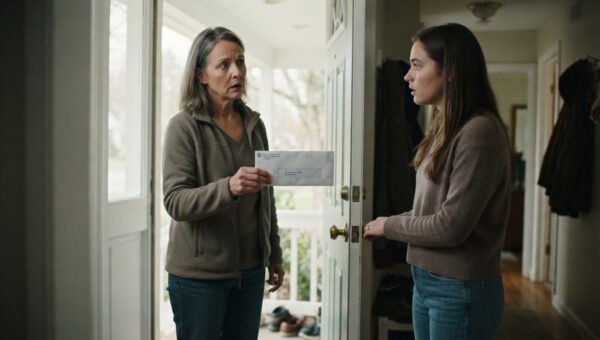
My front door banged open twenty minutes later without a knock.
Brian marched through the kitchen entryway, his winter coat open, his face flushed and sweating from the drive.
Behind him was Vanessa.
She wore a heavy down parka, but her eyes were wild, darting across the kitchen until they locked onto Leo sitting at the table.
“Get your bag, Leo,” Vanessa ordered, her voice climbing in pitch. “Get in the car right now.”
Leo froze, his small hand dropping his sandwich onto the plate.
I stood up from my chair and walked between Vanessa and the kitchen table.
“Leave the boy where he is, Vanessa,” I said.
Brian stepped forward, running a shaky hand through his hair. “Mom, please. Don’t start this. You took our kid from practice without calling us. That’s custodial interference. Vanessa has been having a panic attack since Ray called her from the park.”
“Ray,” I repeated, looking straight at my son. “You mean your brother-in-law? The brother Vanessa said never existed?”
Brian stopped moving. He glanced at Vanessa, his face turning a sickly, mottled gray.
Vanessa didn’t look down. She crossed her arms tightly over her chest, stepping right into my face.
“You don’t know anything about my family, Ruth,” Vanessa hissed, her teeth clenched. “Ray made mistakes. He served his time in state prison for armed robbery, and he was released on parole in September. He had nowhere to go. If the state found out he didn’t have an approved residential address, they were sending him back to Lucasville. I am his sister. I am keeping him off the street.”
“You are keeping a convicted felon in the basement five feet from your son’s bedroom,” I said, the words coming out low, hard, and steady. “You bruised your child’s arm because he almost mentioned it at school. And you told him the county would put him in a cage if he spoke to his own grandmother.”
Brian turned his head slowly to look at his wife. “Vanessa? You told Leo that?”
“I was protecting this house, Brian!” Vanessa yelled, rounding on him with pure fury. “Your mother has been looking for an excuse to tear us down since the day we got engaged! If the neighbors found out a felon was living in our basement, what happens to your mortgage license? What happens to my job at the clinic? We would be ruined!”
“You’re already ruined, Vanessa,” I told her.
I picked up my kitchen landline receiver from the wall.
“I took down the license plate on your sedan when Ray drove out of the soccer park,” I said. “And I called Deputy Dalton at the county sheriff’s station ten minutes ago. Ray’s parole terms require him to register his address with the county within forty-eight hours of relocation. He is not registered at your house. In fact, harboring an unregistered violent felon violates your parole conditions as a sponsor.”
Vanessa’s eyes went wide with pure terror. Her breath hitched in her throat, her hands falling to her sides.
“Ruth, don’t,” she stammered, her voice suddenly small and trembling. “If you report him, they’ll violate his parole. He’ll do five more years. And they’ll charge Brian and me with obstruction.”
“Then you should have thought about that before you put your hands on this child,” I said.
I looked at my son.
“Brian,” I said, looking him dead in the eyes. “You sat on my porch for nine years and let this woman tell you who you were allowed to love. You let her lock your own mother out of your life because she was running a private flophouse for a criminal in your basement. Look at your son’s face right now.”
Brian turned to look at Leo.
Leo was sitting with his knees pulled up to his chest on the wooden chair, shaking, tears running silently down his cheeks into his soccer jersey.
Brian looked at the boy, then down at his own trembling hands.
The spell that Vanessa had kept over him for nine years, built out of manufactured emergencies, high drama, and threats of leaving, finally shattered on my linoleum floor.
“Brian, let’s go,” Vanessa demanded, grabbing his sleeve with both hands. “We have to get Ray out of the house before the deputies show up! Move!”
Brian pulled his arm out of her grip.
He didn’t yell. He stepped two feet away from his wife, his jaw set in a hard, stubborn line I hadn’t seen since his father was alive.
“Get out of my mother’s house, Vanessa,” Brian said quietly.
Vanessa blinked, stunned. “What did you say?”
“I said get out,” Brian repeated, his voice firming up. “Take your car. Go get your brother. Take whatever you can fit in the trunk and get off our property. Because if Dalton’s deputies don’t find you there, I will tell them where to look myself.”
ENDING
Vanessa stared at Brian for five seconds, realized the floor had given way beneath her feet, turned on her heel, and ran out the front door.
Her tires spun in the gravel, throwing stones against my wooden porch railing, and then the road fell quiet.
Brian stood in the center of my kitchen for a long time, his shoulders hunched, his chest heaving with silent, ragged breaths.
He didn’t make an excuse. He didn’t offer an apology, because he knew that nine years of enabling a liar could not be wiped away with three words.
He walked over to the table, dropped to his knees on the floor beside Leo’s chair, and pulled his son into his arms.
Leo buried his face in his father’s coat, and the two of them held each other while the afternoon turned into cold blue dusk outside the windows.
The county deputies intercepted Brian’s sedan three miles outside town an hour later.
Ray was in the passenger seat with two duffel bags, violating his regional travel perimeter. He was taken back into custody without incident and remanded to the state reception center in Orient to serve out the remainder of his original sentence.
Vanessa was cited for misdemeanor obstruction and moved into an extended-stay motel near the highway. Brian filed for legal separation and temporary physical custody of Leo the following morning, using Coach Miller’s incident report and the sheriff’s intake log as supporting evidence.
The court granted Brian exclusive possession of the marital home, and Vanessa is currently permitted only supervised visitation through the county family court facility.
Last night was another cold Tuesday.
Leo sat at my kitchen table with his third-grade math workbook, his colored pencils lined up neatly beside his juice glass.
Brian was in the living room, helping me change the air filter on my furnace, his hands black with dust, whistling an old tune his father used to play on the radio.
Around seven o’clock, Leo closed his book, walked over to the counter, and leaned against my side while I stirred a pot of chicken dumplings on the stove.
He pulled back his sweater sleeve.
The skin on his arm was completely clear. The purple mark was gone, replaced by the pale, healthy skin of a little boy who slept through the night without listening for footsteps on the basement stairs.
I reached down, wiped a speck of flour from his cheek, and handed him a spoon to taste the broth.
He smiled, blew on the steam, and told me it tasted just right.
The house was warm, the locks on the doors were solid, and out on the gravel drive, the only cars parked under the trees belonged to people who knew how to tell the truth.