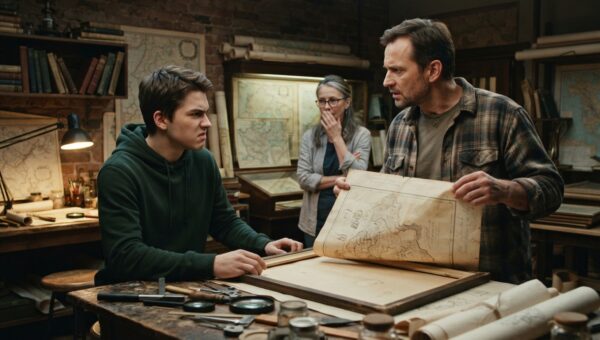
My brother crossed out two lines from the eulogy I had written about our father.
“He wasn’t cruel,” George said. “He was complicated.”
We were standing in the church office with the funeral program between us. Outside, a line of cars had begun to form along the road. My father’s neighbors were coming to say goodbye.
“I didn’t call him cruel,” I said.
“You wrote that he made you feel like a stranger in your own family.”
“Because he did.”
George lowered his voice. “Do you have to say that today?”
I looked at the sentence he had crossed out. My hand had been shaking when I wrote it, but I had meant every word.
My father died on a Tuesday morning in the apartment above the garage he had built behind his house. He was seventy-nine. He had been a plumber for forty-six years, and even after retirement he kept a wrench in the pocket of his coat in case a neighbor called. He could repair anything in a house except the conversations he had broken.
George had lived close to him. He took him to appointments, brought him groceries, and sat through the long evenings when Dad could no longer hear the television well. I lived three hours away. I called every Sunday and visited when I could. I had not taken care of Dad in the same way. I knew that, and I did not want my grief to pretend otherwise.
But I had also spent twenty years waiting for him to say he was glad I had married Laura.
Dad did not come to our wedding. He told me he was not ready to “make a show of it.” He did not use the word gay. He did not have to.
For a long time, I stayed away. When my daughter was born, I mailed him a picture. He sent back a card with a note about the baby’s strong hands. It was the first time he had written to me without making a point.
Over the years, he came closer in small steps. He attended a school concert. He fixed our back steps. When Laura had surgery, he drove across the state to bring a casserole and stayed long enough to tighten the loose railing.
He never apologized for the wedding. He never said he had been wrong. He began showing up, and I accepted the effort without calling it a repair.
George had seen a different father. Dad was strict with both of us, but with George he was also proud. They had worked side by side for years. My brother had inherited his way of speaking with his hands and the habit of saying “I’ll handle it” before anyone asked.
I had inherited the habit of waiting for him to finish.
The first time Dad met Laura after we married, he shook her hand in our kitchen and said he hoped I wasn’t making her life difficult. It was not the greeting I had wanted. Laura answered, “We’re learning each other,” and Dad nodded as if she had said something he could respect.
For years, I thought of that sentence as another way to avoid saying he was glad we were together. Maybe it was. He was clumsy with warmth, especially when warmth required him to admit that I had been right to choose a life he had not chosen for me.
Things changed slowly. When Maya was five, Dad came to her school concert. He sat in the back row because he said his ears were better there. Afterward, he bought her a hot chocolate and asked which song had been hers.
She told him she had not been the one with the red scarf. He listened as she explained the whole performance anyway.
The year Laura had surgery, Dad came to our house without calling first. He had a casserole in one hand and a toolbox in the other. He tightened the bathroom rail, checked the porch step, and then stood by the kitchen door.
“How is she?” he asked.
“Recovering.”
“Good.”
He looked at the casserole. “I don’t know what you’re supposed to bring.”
“Food is good.”
He nodded. “All right, then.”
He did not stay for dinner. He did not ask how I was doing. But he left the casserole, fixed the rail, and called the next morning to ask whether it was holding.
When he started missing pieces of conversation because of his hearing, I bought him a small speaker for the television. He called me twice to say he could not get it to work. The third time, Laura showed him how to connect it. He was embarrassed, but he kept the speaker. A week later, he told her she had a good way of explaining things.
At Maya’s high school graduation, he asked Laura whether she would save him a seat. He sat between her and me. When Maya came down from the stage, he clapped until his hands hurt.
Those moments did not erase the wedding. They helped me understand what the last years had been: not a full repair, but a man attempting to remain part of a family he had once held at arm’s length.
That was why I could not stand at his funeral and describe him as only one thing. It was also why I could not pretend the old hurt had never happened.
“George,” I said, “I’m not trying to punish him. I’m trying to tell the truth about what he was like to me.”
“He did better later.”
“He did. I wrote that, too.”
George rubbed his forehead. “People are coming to remember him. They don’t need to hear about the worst part.”
“I’m not giving them the worst part. I’m giving them the whole person.”
He picked up the page. “Can’t you say he was a man of his time?”
“That makes it sound like he had no choices.”
“He didn’t know how to talk about it.”
“That was a choice, too.”
George set the paper down. He looked tired. I knew he had slept badly since Dad died. He had been the one who found him. He had made the calls and met the funeral director. I could see the weight he was carrying. It did not make my answer change.
“I’ll say what I think is honest,” I told him. “You can give your own eulogy.”
He looked at me for a long moment. “Fine.”
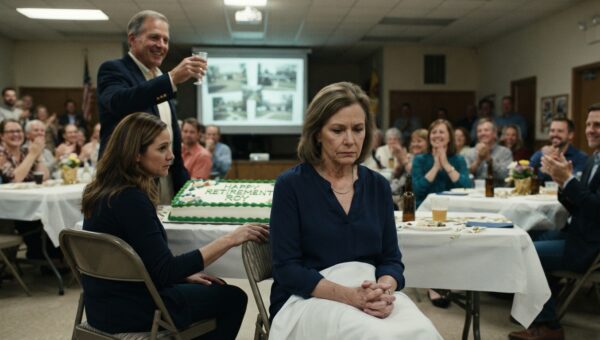
The service was small. Dad’s old coworkers sat near the front. A neighbor brought a framed photograph of the two of them standing beside a pipe they had repaired after a flood. My daughter, Maya, sat beside Laura and held my hand.
George spoke first. He told a story about Dad teaching him to replace a water heater, then making him redo the work after he had skipped a step. People laughed. George described their fishing trips and the years Dad had spent helping neighbors who could not afford a plumber.
He spoke well. He spoke truly.
Then it was my turn.
I stood at the lectern and unfolded my page. I could hear the air conditioner and the quiet movement of people shifting in their seats.
“My father was not an easy man to know,” I began. “He loved through tasks. He showed up with tools, groceries, and a casserole. He could not always say what he felt, and when I married the person I loved, he chose not to be there.”
I saw George look down.
“I spent a long time thinking that meant he did not love me. I don’t believe that now. But I also know love that stays silent can still hurt the person waiting to hear it.”
The room was still.
“In the years after, Dad made small changes. He came to our daughter’s concert. He repaired our steps. He showed up when Laura was ill. He never gave me the apology I wanted, but he gave me time, and I learned to recognize that he was trying.”
I looked at my brother.
“George cared for him in ways I could not. I am grateful for that. We each knew a different version of our father. Today, I want to remember all of them.”
I folded the paper and stepped away.
The people came to the fellowship hall afterward. There were sandwiches, coffee, and a bowl of peppermints that Dad used to keep in his truck. George stood by the window, looking out at the parking lot.
I walked over. He did not turn around.
“You said what you wanted,” he said.
“I did.”
“I still don’t like it.”
“I know.”
He looked at me. “I guess I wanted him to leave this world without anyone saying he failed you.”
“I didn’t say he failed me. I said he hurt me.”
He nodded, as if he was trying to hear the difference. “I’m sorry I asked you to change it.”
“Thank you.”
“I don’t know what he would have said if you asked him about the wedding.”
“I don’t either.”
“I keep thinking I should have made him call you.”
“You couldn’t make him say something he wasn’t ready to say.”
“But I could have told him it mattered.”
I thought about that. “Maybe.”
He looked down at the coffee cup in his hand. “I did tell him, once. After Laura’s surgery. I said he should have come to your wedding.”
“What did he say?”
“He said, ‘I know.’ That was it.”
I closed my eyes for a second. It was not an apology. It was not nothing.
“Why didn’t you tell me?” I asked.
“I thought it would make you feel worse. And I thought if I told you, you’d ask whether I said more.”
“I might have.”
He gave a tired half-smile. “I didn’t have more.”
We stood without talking. Then George asked if Laura and Maya were ready to leave.
“I’ll find them.”
Outside, the sky had turned gray. George walked with me to the car. We had been speaking carefully all day, afraid every sentence would make the loss sharper.
“Can you come next weekend?” he asked. “I could use help sorting Dad’s workshop.”
“I can come Saturday.”
“You don’t have to take anything.”
“I know.”
“I wasn’t implying—”
“I know,” I said again. “I’ll come because he was my father, and because you’re my brother.”
He nodded. “Good.”
The following Saturday, I drove back to Dad’s house. George had made coffee and set two pairs of work gloves on the bench. We sorted the tools slowly. Some went to his neighbors. Some went into a box for the local trade school.
The tools were arranged in drawers with labels written in Dad’s block letters. George knew where every wrench belonged. He could tell which ones Dad used for which kind of job just by the wear on the handle.
“You did this with him all the time,” I said.
“Most Saturdays.”
“I didn’t know how much of the workshop was yours together.”
“He liked showing me things.”
I ran my finger over a box of drill bits. “He showed me how to change a tire once.”
George looked surprised. “I thought you already knew.”
“I learned from Laura’s father.”
He frowned. “Dad told me you didn’t want to do the work.”
“I did want to. I was twelve. He said it was easier if he did it.”
George shook his head. “He told me you didn’t want to get your hands dirty.”
“I was a kid.”
We stood there, both looking at the same shelf, seeing different rooms.
“I’m sorry,” he said.
“You didn’t know.”
“I could have asked.”
“Yes,” I said. “You could have.”
He took that in. He did not argue. He set the drill bits aside and handed me the worn wrench. We each held one end for a moment before I put it in my bag.
It was not an apology from our father. It was my brother learning that the story he had been told was not the only one.
The following month, George called to ask whether I would come to the trade school when they dedicated the tool donation. I brought Laura and Maya. George spoke for a few minutes about Dad’s work and the neighbors he had helped. He did not call him perfect. He did not describe the wedding. He said Dad had been a skilled plumber who believed a good repair should last longer than the person who made it.
Then he handed the microphone to a student who had received one of Dad’s toolboxes. The student said he had never owned a full set before. He thanked the family for making the donation.
In the car afterward, George asked if I thought Dad would have liked it.
“I think he would have pretended not to care,” I said.
George laughed. “That sounds right.”
We were not finished grieving. We were not suddenly in agreement about everything Dad had done. But we had found a way to honor his skill without editing our memories to make him easier to praise.
I found the wrench Dad had carried in his coat. The handle was worn smooth where his palm had held it.
George saw me holding it. “You want that?”
“I think I do.”
He placed it in my hand. “He would have wanted you to have something.”
I almost said he could have told me that himself. I did not. I put the wrench in my bag.
Before I left, George stood on the back step with me.
“I don’t want us to become strangers over who Dad was,” he said.
“Neither do I.”
“He was better with me.”
“He was.”
“And I know he made it hard for you.”
“Yes.”
He looked at the yard. “I don’t know how to hold both.”
“You don’t have to make them match.”
He let out a breath. “That might be the first useful thing either of us has said this week.”
I laughed. He did too.
Dad had not been a good man in every room. He had not been a bad man in every room, either. My brother and I could keep our own memories without forcing them into one story. That did not make the hurt disappear. It gave us something honest to build on.
I still wish my father had stood beside me at my wedding. I still wish he had said he was glad I had married Laura. I also remember him carrying the casserole up our porch steps after her surgery, then refusing to leave until the railing stopped wobbling.
Both memories belong to me.
George called the next morning to ask whether I had made it home safely. We did not discuss the eulogy. We talked about Maya’s school and his leaky kitchen faucet. It sounded ordinary, which was a comfort. He had been my brother before our father died, and he would be my brother afterward.