The hallway in Aunt Nora’s house always smelled like old peppermint and damp cedar wood, even in the middle of July when the air turned thick enough to chew. Leo was already standing by the front door with a black plastic trash bag in his hand when I walked down the stairs, his car keys jingling against his knuckles like a small, impatient metronome.
He looked at the framed map hanging near the coat rack and blew out a long breath through his nose.
“It is literally just water-stained paper,” Leo said, his voice bouncing off the bare plaster walls. “Nobody wants a faded drawing of county roads from forty years ago. Let me just toss it in the bin so we can finish clearing this place out before dark.”
He reached up with one hand, his fingers already brushing the scarred wooden frame that Nora had polished every Sunday for as long as I could remember. I caught his wrist before he could lift it off the brass hook, feeling the hard, steady pulse under his skin. Nora had lived in this house for eighty-two years, and she did not leave things behind by accident, no matter how much Leo wanted to treat her estate like a storage unit he was paying to empty.
“Leave the frame alone, Leo,” I told him, pulling my hand back and wiping my palm against my jeans. “I want to take it to town first. Just give me one afternoon.”
He rolled his eyes and dropped the trash bag onto the floor with a hollow thud, muttering something about wasting gas and chasing ghosts. He did not understand the weight of Nora’s silence, because he had only known her as an aging aunt who gave terrible Christmas sweaters and forgot to turn off her oven. He did not know the way she used to sit by the kitchen window during a spring downpour, staring out toward the northern ridge where the county road ended in a rusted chain-link gate and a row of overgrown sumac trees.
An hour later, I was standing in the back of Master Mercer’s map shop on Elm Street, listening to the muffled rumble of traffic outside while an old ceiling fan clicked overhead in a slow, uneven rhythm.
Master Mercer was seventy if he was a day, with ink permanently stained under his fingernails and thick bifocals that slid halfway down his nose whenever he leaned over his workbench. He had spent forty years authenticating land grants and property surveys for half the state, and he did not suffer fools or sentimental amateurs gladly.
He laid Nora’s map flat on his green felt table and shone a heavy brass-hooded lamp directly across the surface, squinting through his lenses until his chin almost touched the paper. For a long time, the only sound in the small shop was the scratching of his magnifying glass against the glass of the frame.
“Where did you pull this from?” Mercer asked, his voice dry as old parchment.
“My aunt’s hallway,” I said, shifting my weight from one foot to the other. “It has hung there since I was seven years old. Leo thought it was just a cheap reproduction someone bought at a gift shop in town.”
Mercer let out a short, humorless bark of laughter that sounded like dry leaves scraping across a sidewalk. “Reproductions don’t bleed iron gall ink into the rag cotton, and they certainly don’t have two layers of sizing.” He reached for a small silver scalpel resting near his inkwells. “Your nephew has a lot of confidence for someone who cannot tell twenty-first-century wood pulp from nineteen-fifties rag paper. Mind if I lift the corner of the top sheet?”
“Go ahead,” I whispered, my mouth suddenly feeling dry.
The tiny blade made a soft, rasping hiss as it sliced through the ancient wheat-paste adhesive holding the perimeter of the map to its backing board. Mercer peeled back the top layer of faded green and brown ink, revealing a second, older surface underneath that looked entirely different. The lines were sharper, drawn by a steadier hand with dark, heavy strokes that seemed almost angry in their precision.
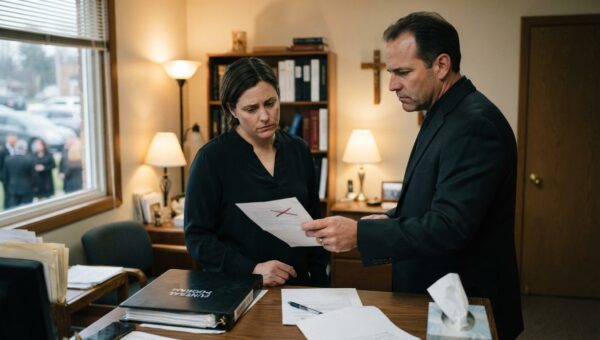
There was a road drawn on the lower layer that did not exist on any modern county survey, winding up through the steep ravine behind the old quarry before ending abruptly at a sharp, red-inked cross. Right over the spot where my childhood home had burned to the foundation back in ninety-four, someone had pressed the quill so hard the paper had actually torn and mended again with tiny cross-stitches of linen thread from the back.
Mercer adjusted his glasses and tapped the red mark with the blunt end of his scalpel. “That ink isn’t standard iron gall,” he murmured, leaning closer until his nose was nearly touching the tear in the paper. “Smell it.”
I leaned over the table, inhaling cautiously. Beneath the expected scent of old cellar dust and dried glue, there was a sharp, mineral tang of wood ash and rendered animal fat, the kind of crude mixture homesteaders used when store-bought ink was too scarce to waste on mere sketching.
“It is mixed with hearth ash,” Mercer said, straightening up and wiping his hands on a greasy rag. “Someone painted this over the original map to hide what was underneath. They didn’t just tuck it away in a drawer. They mounted a fake scene right on top of it, framed it, and hung it in a busy hallway where nobody would ever think to look behind the glass.”
My phone buzzed in my jacket pocket, a short, sharp vibration from Leo demanding to know if I was coming back to help load the truck, but I ignored it and let the screen go dark against my palm. The realization settled into my chest like a cold stone, heavy and unmovable. Nora had spent her entire life telling me that nothing of importance had ever happened on that north ridge, that our family history was nothing more than quiet cornfields and forgotten property taxes.
I carried the disassembled frame back out to my truck, my hands shaking slightly against the cold wood of the backing board as I drove back to the estate. Leo was leaning against the tailgate of his pickup when I pulled into the gravel drive, his arms crossed over his chest and a scowl carved deep into his forehead.
“Took you long enough,” he snapped, walking over as I stepped out with the map under my arm. “The donation truck is coming by at four, and I am not hauling this junk to the dump by myself tomorrow.”
“It’s not junk, Leo,” I said, holding the frame out so he could see the torn edge where Mercer’s scalpel had exposed the dark, ash-streaked lines beneath. “There’s a whole second map under here. Someone went to a lot of trouble to cover it up.”
Leo took one look at the exposed paper and his face went tight, all the color draining right out from under his sun-browned skin in a way that made my stomach drop. He didn’t look surprised. He looked caught.
“You shouldn’t have done that,” he said, his voice dropping into a low, harsh register that didn’t sound like him at all. “Aunt Nora told me specifically before she went into the care home. She said if you ever found out about what was behind that frame, you wouldn’t let the property go. She told me to burn the whole thing if you ever started asking questions about the old north road.”
I stared at him, my fingers tightening around the wooden edges until my knuckles ached. “Burn it? Why would she want to burn family history?”
Before Leo could answer, the screen door of the front porch swung open with a familiar squeak, and Mrs. Clara Holloway stepped out onto the top step, holding a plastic pitcher of iced tea she had brought over for the movers. Clara was eighty-six years old, and she had lived three houses down from Nora since the Eisenhower administration, her memory sharper than a meat cleaver even if her knees gave her trouble on the stairs. She stopped dead when she saw the open frame in my hands, her cloudy blue eyes widening behind her wire-rimmed glasses.
She didn’t say hello. She didn’t ask how we were doing. She just walked right down the gravel path, her orthopedic shoes crunching loudly in the quiet afternoon air, until she was standing two feet away from us.
“Is that the road ledger?” she asked, her voice trembling slightly as she reached out a liver-spotted hand and touched the edge of the exposed paper.
“Mrs. Holloway,” Leo stammered, stepping forward like he wanted to block her view. “We were just, my aunt had a lot of old papers, we’re just sorting through, “
Clara ignored him completely, her gaze fixed entirely on the dark, ash-streaked ink of the hidden map. She looked up at me, her eyes shining with sudden, bright tears that didn’t match her stern mouth.
“Your aunt promised to explain why that road was closed,” Clara said, her voice dropping to a harsh, steady whisper that cut right through the hum of the truck engine. “She promised every single person whose name is written on the back of that board that the truth would come out when you were old enough to understand why she had to lie.”
Leo let out a sharp breath and turned away, kicking a loose piece of gravel across the driveway. “There is no truth,” he muttered to the side of the truck. “It’s just old history from a night everyone else forgot about.”
“It wasn’t a night anyone forgot, Leo,” Clara said, her voice turning cold as winter iron. “That road didn’t wash out from a normal spring flood. Nora stayed behind on the ridge with the ledger while the bridge went down, making sure every family on the north side got across the ravine before the dynamite went off.”
I looked down at the wooden backing board in my hands, finally noticing the tiny brass tacks holding the center seam together. With my thumb, I pried the first tack loose, letting it drop into the dirt. I pulled the backing away from the frame entirely, and there it was, written in neat, fading pencil strokes across the raw pine: a column of thirty-two names, every single family from the northern ridge, with my own birth date marked at the very bottom in Nora’s own hand, right beside the word *Survivor*.
Leo stood beside the truck with his hands shoved deep into his pockets, his shoulders slumped as he looked at the list of names he had tried so hard to throw away.
“She just wanted you to have a normal life,” Leo said quietly, his voice finally losing its angry edge. “She didn’t want you carrying the weight of what happened on that bridge every time you walked down this hallway.”
The autumn wind came up off the river then, rattling the dry corn stalks along the fence line and carrying that faint, familiar smell of wood smoke and old cedar. I ran my thumb over the pencil date at the bottom of the board, feeling the slight indentation where the lead had pressed deep into the wood on the night I was born. Nora hadn’t hidden the map to keep a secret from me. She had hidden it to keep me safe from a debt she spent eighty years paying off alone.