“It’s furniture, not a person.”
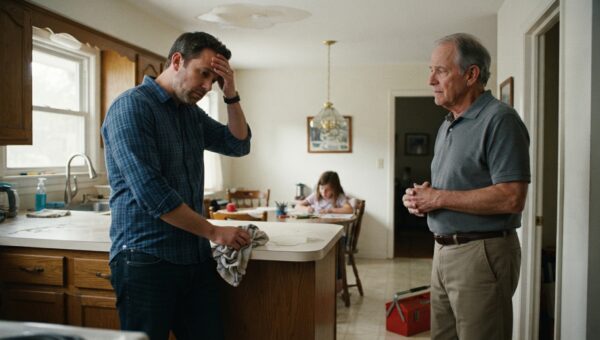
Clara said that into the kitchen phone at 4:14 on a Tuesday afternoon, and the way her voice clipped off at the end told me she was already done talking about it. She had just moved Mom out of the three-bedroom house on Maple Street and into Oakridge Assisted Living, which was a job big enough to break anyone down.
But she had also listed Mom’s heavy oak dining set on an online marketplace and sold it for $450 before I even knew the house was empty.
The strange thing is, I nearly ignored it. That is just what we do in our family when things get messy. I did not want one bad moment to become a family war, so I kept doing little chores and normal things around my own kitchen because normal felt safer than admitting something was off. I wiped the counters. I loaded the dishwasher. I told myself Clara was just overwhelmed with the paperwork and the facility deposits.
The detail I kept coming back to was that marketplace message showing it sold in four minutes flat to someone named Mark across town.
I stopped arguing with myself and checked for myself. I tracked down the buyer, a local woodworker with a shop down by the river, and drove out there with four hundred and fifty cash in my glove box.
Mark was leaning over a workbench when I walked in, rubbing mineral oil into the edge of a pine board. He looked up, wiped his hands on a blue shop rag, and listened while I explained that the table had belonged to my mother and my sister had no right to clear it out.
He didn’t give me any trouble about it. “Take it back,” Mark said, leaning against his saw. “I don’t need another project anyway.”
We walked over to the corner of his crowded shop where the oak table sat under a string of bare bulbs. It was a sturdy thing, built back when furniture was meant to last three generations, with thick turned legs and a center leaf that always stuck if you pulled it too fast. My hand went straight to the edge, feeling for the old familiar groove.
There was still one detail left. When Mark and I flipped the table over to carry it out to my wagon, a heavy, yellowed envelope taped securely beneath the center leaf fell out and hit the concrete floor with a dull slap.
I picked it up before Mark could lean down. The tape was dry and yellow like old cellophane, brittle at the corners where time had chewed it away. My maiden name was written across the front in Mom’s careful, looping cursive from twenty years ago, but the ink had faded to a bruised purple.
I drove straight to Clara’s house with the table loaded in the back and that envelope sitting on the passenger seat like a live wire. Clara answered her front door with a dish towel in her hands and dark circles under her eyes that looked like bruises. She took one look at my face and the tailgate of my wagon, and her shoulders just dropped six inches.
“You went and got it,” she said, her voice small and flat.
“I did,” I said, holding up the envelope. “And I found this taped to the bottom of the center leaf. Clara, what is this?”
She stared at the paper in my hand, and for a second I thought she was going to slam the screen door in my face. Instead, she pushed it open and walked back into her kitchen without another word, leaving me to follow her into the room that always smelled faintly of burnt toast and instant coffee.
“I didn’t know it was there,” Clara whispered, sinking into one of her Windsor chairs. “I swear to God I didn’t. I just needed the money for the facility intake fee, okay? Oakridge wanted four thousand upfront that wasn’t covered by the bridge loan, and I didn’t know who else to ask. You were working double shifts at the clinic. I was drowning.”
“You could have called me,” I said, sitting down across from her. “We could have split it.”
“With what?” she snapped, a sudden flash of heat rising in her voice. “Your roof repairs? Your car transmission? I couldn’t ask you for another cent.”
We sat there in the quiet for a long minute while the refrigerator hummed in the corner. I laid the envelope on the laminate table between us. The paper felt thick, heavier than a normal letter.
“Open it,” Clara muttered, looking down at her hands.
I slipped my thumb under the brittle tape and pulled out two things. The first was a hospital birth record from St. Jude’s in Peoria, dated November fourteenth, 1968, six years before Clara was born. The second was a letter written on lined notebook paper, folded twice and written in the same purple ink.
I read the first few lines out loud before my voice caught. “To whoever finds this after I’m gone. If it’s Clara or the little one, don’t hate me. Her name was Miriam. She was born before your father and I had the farm, and we signed the papers because we didn’t have a crust of bread to feed ourselves.”
Clara leaned forward, her eyes wide and fixed on the paper. “A sister?” she whispered. “Mom had another baby?”
“She kept her birth certificate right here,” I said, turning the paper over. “For fifty years, right under our noses while we sat eating meatloaf and doing homework on top of it.”
The room felt entirely still. I looked down at the edge of the table we had dragged back from Mark’s shop, running my thumb along the underside where the old pencil marks were carved into the grain. There was Clara’s name at age seven, and mine at age five, right beside a set of earlier notches we never understood, written in a hand that was taller and straighter than ours.
“She was terrified we’d find out,” Clara said, and I could hear the crack in her voice now. “That’s why she never wanted anyone touching that table. She told me once it was the only thing she owned that mattered, and I thought she just meant because Dad built the leaves.”
“She meant it was her archive,” I said.
We didn’t yell anymore after that. Clara cried hard for about ten minutes, leaning her forehead against the edge of the counter, and I went over and put my hand on her back the way she used to do for me when we were kids. We weren’t hiding behind polite phone calls or pretending everything was fine anymore. The debt was out in the open, and so was the ghost that Mom had carried around in her head for half a century.
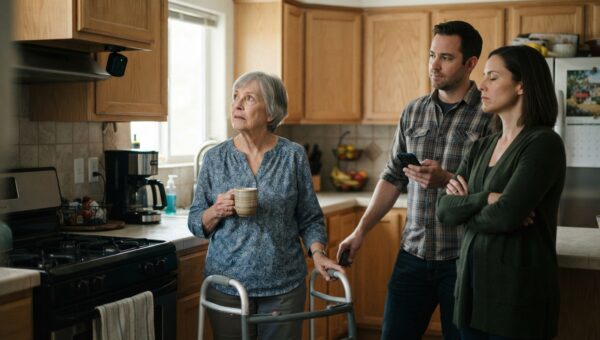
The next morning, we drove out to Oakridge together. We didn’t bring the whole table into the common room, but we brought the center leaf wrapped in an old quilt. Mom was sitting by the window in her blue cardigan, staring out at the parking lot with that blank, lost look she got most days before the afternoon medication kicked in.
We laid the leaf across her lap, resting our hands on either side of it. Mom didn’t say much, just reached out with her shaky left hand and touched the notched wood near the edge where the old initials were scratched into the pine.
“She’s okay,” Clara said softly, her voice shaking just a little. “We found her, Mom.”
Mom blinked once, slow and heavy, and her fingers found the notch that belonged to the baby born in sixty-eight. A small, tired sigh slipped out of her, and for a second her eyes cleared up. “Took you girls long enough,” she muttered.
That was all she said. We sat with her until the nurse brought around the little paper cups of juice at two o’clock, neither of us rushing to leave.
Back at my place, the restored oak dining table sits right where it always belonged, pushed against the dining room wall beneath the window. The underside is wiped clean of dust now, but the old pencil heights are still there, deep and dark in the grain. Clara came over on Sunday with a small pocket knife and carved one tiny, fresh notch right beside the rest, marking the day we finally stopped keeping secrets from each other.