The spare brass key always lived in the hollow of the rusted cast-iron frog beside the back porch steps, where my father put it the summer he built the deck.
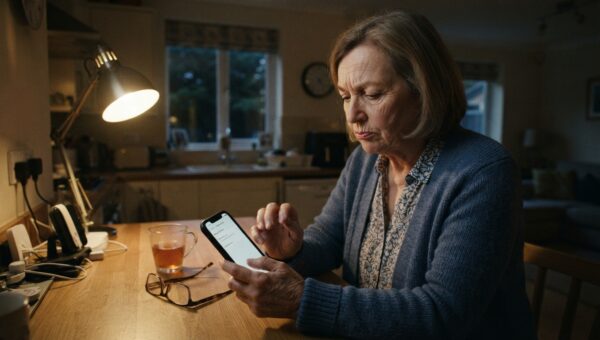
Mom had kept it there for twelve years after he died. I never thought much about it until she started locking the screen door before dark and telling me on the phone that she was too tired for evening visits.
Leo was the one who mentioned the man in the jacket first, sitting at my kitchen island and chewing on a straw from his iced tea while I wiped down the counter. He said he went by around dinner to drop off the library books Mom wanted, but the front screen was bolted and some guy in a blue windbreaker came out the side exit.
I did not think it was a big deal at first because Mom’s hip bothered her and sometimes the neighborhood kids mowed her strip of lawn for twenty bucks. But Leo frowned, swirling the melted ice in his cup, and said the guy looked thirty-something and walked like he owned the place.
“He didn’t look like a helper, Aunt Faye,” Leo had said, his voice dropping that teenage register for something sharper. “He had a key on a ring. He unlocked the side door right in front of me.”
That was Tuesday. By Thursday evening, my car was parked three houses down under the dripping branches of an overgrown maple, my headlights off and the dashboard clock glowing a cold digital 7:12.
The rain had stopped around sunset, leaving that heavy Nebraska damp that smells like wet asphalt and old corn husks. My hands felt clumsy on the steering wheel, stiff from gripping the vinyl too hard while I watched the yellow porch light of my childhood home cut a clean square across the wet sidewalk.
I kept telling myself I was being ridiculous, a classic overanxious daughter inventing drama because an old woman wanted some peace and quiet after seventy-nine years of cooking meals for men.
Then a silver sedan turned the corner without its blinker and pulled right into Mom’s gravel drive.
The man who got out was tall, moving with an easy, loose-jointed stride that did not belong to any cousin or neighbor I knew.
He wore a dark blue jacket with reflective tape across the shoulders, the kind delivery drivers or utility contractors wear when they want you to look away instead of asking questions.
He did not knock. He walked straight to the side porch, his hand dipping into his pocket with practiced familiarity before the brass click of the lock carried over the quiet street.
The digital clock on my dash flickered to 7:15.
I sat there in the dark of my sedan with my chest tight, watching the single lit window of the front parlor throw a blurred shadow of my mother moving across the lace curtains. Forty minutes crawled past in total silence, the kind of heavy, dragging time where every tick of the engine cooling down sounds like a hammer blow.
When the front door clicked shut again and the silver sedan backed out without its lights until it hit the corner, I was out of my car before the tail-lights even faded.
The porch wood felt spongy under my sneakers. I didn’t knock twice; I just hammered my knuckles against the screen until the inner door creaked open and Mom stood there in her faded blue cardigan, her fingers instantly going to work twisting the edge of the hem until her knuckles went gray.
“Faye,” she said, and her voice sounded smaller than it had that morning, thin and dry like old paper. “You shouldn’t have come out in the damp. My hip is acting up anyway.”
She tried to angle her body in the doorway, blocking the narrow hall, but I could smell the faint trace of cheap peppermint and damp wool lingering in the air behind her.
“Who was that, Mom?” I asked, pushing past her before she could find her balance, the screen door swinging shut behind me with a loud metal slap that made her flinch.
She backed up into the hallway, her slippers shuffling against the linoleum runner my father laid down the year he retired.
“Nobody,” she whispered, her eyes darting toward the parlor table where a blue plastic folder sat open under the brass lamp. “Just a service man. A routine check on the foundation vents. You know how these older houses settle.”
“Mom,” I said, my voice dropping into that flat, dangerous register I usually reserved for my tenth-grade students when they tried to lie about their homework. “You don’t have a service plan. I pay the bills out of your account every month. Who was that?”
She didn’t answer right away. She just stared at the framed portrait of my father hanging by the coat rack, her jaw working as if she were trying to chew on words that wouldn’t fit in her mouth.
The silence in the narrow hallway felt thick enough to choke on, smelling of her old dusting wax and the tea she always drank at four.
“He says he’s helping me fix a mistake your father made before he died,” she finally whispered, her hand trembling as she reached out to steady herself against the side table. “About the back property line and the workshop permits. But yesterday he asked me to sign…”
She trailed off, her eyes going blank and wide as the sentence died in the air between us, leaving only the hum of the old refrigerator in the kitchen down the hall.
That was the moment the floor dropped out from under the whole evening.
I didn’t yell. I didn’t cry. I just walked past her into the warm, cluttered parlor while she stood frozen by the coat rack, her fingers still clawing at her cardigan.
The blue folder on the table wasn’t from a city office or a contractor. It was a standard legal packet from an online template site, filled with pre-printed quitclaim forms and corporate assignment deeds naming an LLC I had never heard of registered out of an office park in Grand Island.
The parcel description was already filled out in a neat, professional hand, transferring clear title of my parents’ debt-free home to a holding company with no phone number and a registered agent whose name I didn’t recognize.
At the bottom of the signature page, right where my mother’s shaky cursive usually sat on birthday cards, there was a faint pencil line showing her where to press.
I didn’t sleep that night. I sat at my own kitchen island with the stolen papers spread out under the glare of my overhead fluorescent light, drinking cold tap water and watching the numbers on the microwave clock tick from 2:00 to 3:00 to 4:15.
The next morning, I called the regional home care company whose logo I vaguely remembered seeing on a calendar magnet at the senior center, only to be told by a bored dispatcher that nobody named Greg worked for them and they didn’t do property assessments.
Then I drove down to the county courthouse on the corner of Fourth and Walnut, where the clerk with the silver hair and the green visor pulled the property ledger for our block and showed me the active inquiry filed three weeks ago by a corporate buyer requesting duplicate parcel maps.
“Someone’s fishing for a clean title,” the clerk had muttered, sliding her glasses down her nose to peer at me over the counter. ” Older houses like these, paid off twenty years ago? People think nobody’s watching the gate.”
By 6:45 that evening, I was back on Maple Street.
I didn’t park down the block this time. I pulled my sedan right into the driveway, blocking the gravel path so no silver sedan could slide in behind the hydrangeas.
Inside, the house was dark except for the kitchen light. Mom was sitting at the enamel-topped table with a cup of chamomile she hadn’t touched, her shoulders rounded under her sweater as if she were bracing for a cold wind.
“Faye, please,” she started the second I turned the kitchen knob, her voice shaking with that sudden, terrible panic of a child who knows she broke something expensive. “He said if we didn’t sign, the county would take the house for back taxes. He said Arthur forgot to file the final release before he passed.”
“Dad didn’t forget a damn thing,” I said, walking over to pull out the chair across from her and sitting down so our knees almost touched. “Arthur built this house with his own hands, and nobody is taking it.”
She looked at me then, really looked at me, her eyes watery behind her bifocals, and for the first time in three years she didn’t try to straighten her apron or tell me she was fine.
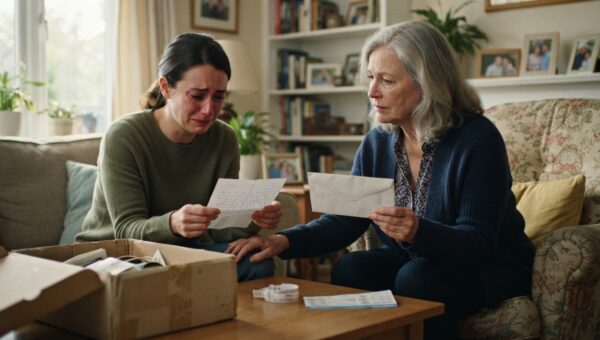
“I’m so stupid,” she whispered, and the sound of it broke something small and sharp inside my ribs. “I just… I was so scared I’d leave a mess for you and Leo to clean up.”
“You didn’t make a mess,” I said, reaching out to cover her thin, papery hand with mine. “We’re going to clean it together.”
At 7:13, the crunch of gravel sounded outside the side window.
The headlights swept across the lace curtains, painting long, yellow fingers across the kitchen wallpaper before the engine died in the drive.
Mom half-rose from her chair, her breath catching in her throat, but I squeezed her fingers once and stood up, my pulse hammering hard in my ears like a drumbeat.
The heavy brass key went into the side door lock with a familiar, mechanical click.
The door swung inward on its hinges, and Greg stepped into the narrow hallway with his blue jacket half-zipped and a smile already forming on his face.
“Evening, Clara,” he began, stepping past the coat rack before he saw me standing by the kitchen archway with my phone raised and the county deed printout clutched in my left hand.
He stopped dead, his smile flattening out into a hard, narrow line as his eyes flicked from my face to the phone screen where the local sheriff’s non-emergency dispatcher was already on speaker, the low static hum filling the quiet hall.
“You’re about forty minutes early for your paperwork,” I said, my voice shaking only a little as I stepped out into the light of the hallway. “And the county clerk already has your name on file.”
For three seconds, nobody moved. The porch light hummed softly outside the screen, casting a long shadow across the linoleum runner where my father’s footprints used to be.
Greg didn’t argue. He didn’t try the smooth, professional voice he must have used on half the widows in this county. He just looked at the phone in my hand, his eyes cold and assessing for a single beat before he took two steps backward out the door.
“Tell your mother she dropped her pen,” he muttered, his voice flat and ugly as he pulled the screen shut between us.
The gravel crunched once under his heel, then twice, and the silver sedan hit the corner without its lights before the sound of the engine even reached the trees.
We didn’t talk for a long time after he left.
I walked over to the side door, pulled the old brass cylinder out of the latch with my father’s flathead screwdriver from the hall drawer, and dropped the heavy metal into my pocket.
Later, we sat together at the kitchen table in the bright, quiet evening light, watching the front porch through clean glass without a single shadow on the step, drinking lukewarm tea while the new brass deadbolt sat right in the center of the white enamel like an anchor.