The smell of bleach always lingers in the hallway whenever I scrub the bathroom tiles after Keith uses them. It is a sharp, chemical sting that coats the back of my throat long after the bucket is emptied and the rubber gloves are put away. For three hundred and sixty-five days, that smell was just part of the background noise of our house. Keith had been living in our spare bedroom under the banner of temporary misfortune, a thirty-two-year-old man who lost his warehouse job, packed his life into twelve cardboard boxes, and showed up on our porch with a sad story and a duffel bag. My husband, Donald, welcomed him in with an open heart and a handshake that lasted a fraction too long. Back then, I felt sorry for the boy. I figured family is family, and everyone stumbles sometimes. We set him up with fresh sheets, cleared out the bottom half of the linen closet, and told him to take his time getting back on his feet.
The trouble with temporary arrangements is how quietly they turn into permanent furniture. Month twelve rolled around without a single job application printed, without a single grocery bag brought through the front door with his own money, and with the electric bill climbing forty percent higher every cycle because Keith liked to run his gaming computer twenty-four hours a day. I kept quiet for a long time, biting my tongue every time I stepped over his muddy boots in the entryway or found half-eaten takeout containers left on the coffee table. Donald kept smoothing things over with a tired smile whenever I tried to bring it up over Sunday coffee. He would pat my hand and tell me to give Keith another month, that the boy was fragile, that he was trying his best in a tough market. But patience wears thin when you are the one buying the dish soap and wiping up messes you didn’t make.
Things finally came to a head on a rainy Tuesday morning when I caught Keith in the kitchen eating my leftover pot roast straight out of the Pyrex dish with a serving spoon. I did not yell, which was probably my first mistake, but I told him plainly that things needed to change. I told him he had a full-time job at the auto parts warehouse now, he had been pulling a paycheck for four months, and it was time he started contributing to the household. I asked him for four hundred dollars a month to cover his share of utilities, internet, and groceries. Keith stopped chewing, lowered the spoon, and looked at me like I had just asked him to hand over his left arm. He didn’t say a word to my face in that moment, but by evening, the machinery of family politics was already spinning behind my back.
My phone started buzzing around dinner time with a text from Donald’s mother, Marcia, telling me that charity begins at home and greed is an ugly trait in a wife. Twenty minutes later, Donald walked through the front door looking like he had just carried the weight of the county across his shoulders. He dropped his lunchbox on the counter and told me I had really upset the apple cart. He begged me to drop the rent demand, to just let it slide for another thirty days so the family could keep the peace. I told him no. I told him my name was on the mortgage too, and I was done subsidizing a grown man who spent his entire paycheck on custom car parts. Donald sighed, rubbed the back of his neck, and finally agreed to let it go for one more month, hoping that would somehow magically solve a problem he refused to address himself.
The breaking point arrived three days later when Keith left his phone on the kitchen island and bolted back to his room to grab his charger. I saw the screen light up with an email notification from the county tax assessor, a routine reminder about property filings. When Keith rushed back out to grab his device, he left his laptop open on the kitchen desk with the printer tray half-extended. A single sheet of paper was resting right there on top, warm from the rollers. I glanced down before I even realized what I was looking at. It was a property tax statement for a two-bedroom condo on Maple Street, located just across town near the old mill. The owner’s name was printed clearly at the top. It was Keith. And right beneath the address was a line item for rental income, showing sixteen hundred dollars a month deposited into an account bearing his signature, active for the past eleven months.
I stood there by the counter for a long time, the paper shaking slightly between my fingers as the math ran through my head. Sixteen hundred dollars a month, multiplied by eleven months, while he slept in our spare room and ate our food under the guise of being broke. I did not wait for Donald to get home from his shift. I grabbed my car keys, walked out to my sedan, and drove across town to Maple Street to see for myself. The drive took twelve minutes, and every stoplight felt like a personal insult. When I pulled into the asphalt lot of the Maple Street complex, unit 4B, I did not have to guess if someone lived there. A woman in her twenties was carrying bags of groceries from a silver sedan up the concrete stairs, unlocking the front door with a brass key that jingled against a plastic lanyard. I sat in my car with the engine idling, watching her push the door open and step inside a home that my freeloader houseguest owned and rented out for a profit.
When I got back home, Keith was sitting at the kitchen table scrolling through his phone with his sneakers propped up on one of our dining chairs. I did not bother with pleasantries. I dropped the printed tax statement right onto the middle of the table, letting the corner of the paper smack against his coffee mug. He didn’t even flinch. He just looked down at the paper, then looked up at me with a slow, greasy smile that made my stomach turn over. I asked him how he had the nerve to collect sixteen hundred dollars a month while living in my house without paying a dime. Keith leaned back in the chair, crossed his arms over his chest, and laughed. He told me I was barking up the wrong tree. That was when he dropped the line that broke the floor right out from under me. He looked straight into my eyes and said, “You really don’t know? Your husband is the one who told me to do it because…”
The front door clicked open just as Keith started to speak, and Donald walked into the kitchen with his jacket slung over his shoulder. Donald stopped dead in his tracks when he saw the tax paper on the table and the look on my face. He didn’t look surprised; he looked caught. The color drained right out of his cheeks, leaving him staring at the linoleum like he wished the floor would open up and swallow him whole. Keith stood up from the chair, suddenly playing the victim again, muttering that he didn’t want any part of our domestic trouble before grabbing his jacket and heading down the hall to slam his bedroom door shut. I turned on Donald, my voice dropping into a register I didn’t even know I had, demanding to know what Keith meant. Donald stammered for a second, trying to find words that wouldn’t fit, before he finally broke down and admitted the whole miserable truth.
It turned out Donald had engineered the entire arrangement from the very beginning. When Keith hit that rough patch a year ago, Donald had panicked about what his mother would say if her favorite nephew ended up sleeping on a park bench. But instead of talking to me like a partner, Donald came up with a cowardly scheme. He told Keith to move into our spare room for free and secretly rent out his own Maple Street condo, pocketing the sixteen hundred dollars every month to rebuild his savings while I paid for the groceries, the water, the electricity, and the endless bags of garbage. Donald had kept it a secret because he knew I would never agree to subsidize a healthy, working relative who was turning a profit behind our backs. He stood there in our kitchen, making excuses about family honor and temporary help, while I looked at a man I had trusted for twelve years and realized I didn’t know him at all.
I did not scream or throw things, because anger that deep doesn’t need to make a loud noise to do its work. I walked down the hall, tapped once on the guest room door, and told Keith he had thirty minutes to pack his duffel bags and get out of my house before I called the police for trespassing. He tried to argue through the wood, his voice thin and panicked, but I told him I didn’t care where he went as long as it wasn’t under my roof. By evening, his car was packed, and the driveway was empty. When Marcia called five minutes later to scream at me about treating family like garbage, I didn’t let her finish her sentence; I told her about the sixteen hundred dollars a month her golden boy had been raking in while mooching off us, and the phone went dead silent on her end before she hung up.
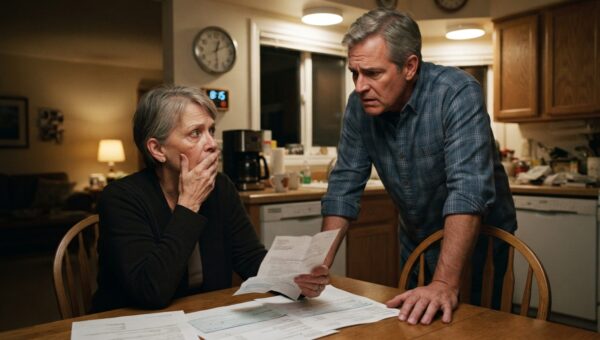
Donald is still here in the house, but the guest bedroom door stays locked tight, the brass key sitting right on top of the microwave where I can see it every time I walk past. We sat at the kitchen table last night in absolute silence, sliding a freshly printed financial disclosure document back and forth between us under the harsh light of the overhead fixture. He knows the marriage is hanging by a very thin thread, and he knows that every household bill from now on is going through an audit with my signature stamped on every line. The house feels colder now that the parasite is gone, but at least the air smells clean, and for the first time in a year, nobody is lying to me from across the kitchen counter.