The rain had been drumming against the aluminum gutters of my kitchen for three hours straight, a steady, gray sound that usually made me want to bake something or pull out a basket of mending. Instead I was staring at the small blinking red light of my desk phone, wondering why my ears felt so hot.
Julian had hung up on me forty minutes ago. Just clicked the receiver dead while I was halfway through explaining that I did not have an extra ten thousand dollars sitting in my checking account to bail out a catering contract.
I am a retired medical billing clerk from Dayton. I spent thirty-four years looking at numbers that did not add up, tracking down decimal points and transposed digits until my eyes watered, and I learned early on that when the math refuses to balance, someone is lying.
When Julian and Chloe got engaged back in January, they sat right at this very laminate table and told me they wanted a quiet life. They said big weddings were a waste of hard-earned cash. They wanted something small, just fifty people in a rented park shelter with sandwiches and a cousin playing acoustic guitar.
“We just want to keep it simple, Mom,” Julian had said, leaning across the table to pat my hand with that easy, crooked smile he had used since he was ten years old to talk his way out of broken windowpanes. “If you can manage fifteen thousand to help us cover the basics, we will not have to borrow a dime.”
I had saved that money across six years of picking up extra Saturday shifts at the clinic after Arthur passed away.
Every time I looked at those numbers in my credit union statement, I saw quiet mornings, a paid-off hot water heater, and a cushion for rainy days that I was gladly handing over so my only son could start his married life without a chain around his neck.
I wrote the check right then. I did not ask for a receipt. I did not demand to see a spreadsheet. I just handed him the blue slip of paper because he was my boy and he told me he was being sensible.
A month later, I saw the photographs on Facebook. One of Chloe’s bridesmaids had posted a carousel of pictures from a bridal tasting at the Grandview Hotel downtown, complete with crystal chandeliers, ice sculptures shaped like swans, and floor-to-ceiling windows overlooking the river.
My stomach had dropped into my shoes when I saw those pictures, but I told myself I was just being an old worrywart.
I figured they changed their minds and found a deal, or maybe the bride’s parents stepped in with their own savings to upgrade the package.
So I kept my mouth shut. I did not call to complain. I did not ask why the park shelter suddenly looked like a five-star ballroom.
Then came the phone call at 4:15 in the afternoon two days ago. Julian did not ask how my arthritis was acting up or whether I needed help bringing in the groceries. He just called to say the final vendor invoices came in higher than expected and they needed an immediate wire transfer for ten thousand dollars.
“We are short because Chloe’s parents couldn’t help us at all,” Julian had said, his voice clipped and impatient, sounding more like a bank manager than my son. “They are going through some property tax issues, so it falls on you to bridge the gap.”
“Julian, I gave you fifteen thousand already,” I said, my voice shaking a little against the kitchen counter. “I do not have ten thousand more. That is my property tax money.”
“You can pull it from your CD,” he snapped. “Do you want us to start our marriage in debt or what?”
When I said no, absolute no, he did not argue or try to reason with me. He just let out a sharp sigh and said, “Unbelievable, Mom,” before the line went dead.
That was when the doorbell rang.
It was 4:52 in the afternoon. The rain was still coming down in gray sheets against the front porch glass. I wiped my hands on my dish towel, thinking maybe the neighbor’s kid dropped something off, and pulled the inner door open.
Standing on my welcome mat was Robert, Chloe’s father. I had only met the man twice before, once at a stiff Christmas dinner where he mostly talked about his lawnmower engine, and once at the engagement party where he wore a suit that looked two sizes too big.
He did not look like a man coming to pick a fight. He looked like someone who had just walked three miles through a hailstorm without an umbrella. His hair was plastered to his forehead, and his beige windbreaker was soaked dark at the shoulders.
“May I come in, Evelyn?” he asked. His voice was hoarse, almost cracking on my name.
I didn’t even answer with words. I just stepped back and pulled the door wide, watching him track wet mud onto my hallway runner without caring enough to mention it.
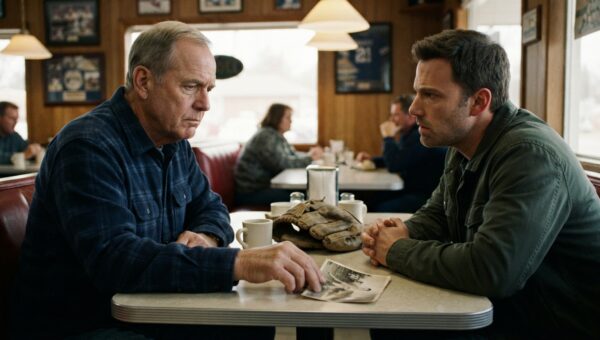
He walked into the kitchen, pulled out the very same wooden chair Julian had sat in three months ago, and sat down hard enough to make the salt shaker rattle. He did not take off his jacket. He just reached into his inner pocket, pulled out a thick manila folder held together with a rubber band, and laid it flat on the table between us.
“I need to ask you something,” Robert said, staring straight down at the wood grain instead of looking at my face. “How much have you given them?”
I blinked, the cold air from the open front door still drifting into the hallway. “I gave Julian fifteen thousand dollars back in January.”
Robert nodded slowly, like a man confirming a terminal diagnosis he had been dreading all afternoon. He reached out with a thick, calloused thumb and flicked the rubber band off the folder.
“They told us you refused to contribute,” Robert said quietly. “They told my wife and me that you said your money was for your own retirement and we were on our own if we wanted a proper wedding for our daughter. So we remortgaged our back lot. We already gave them twenty-five thousand dollars over the last two months.”
Nobody said anything for a second, and honestly that felt worse than any shouting match we could have had. The only sound in the small kitchen was the refrigerator humming in the corner and the rain hitting the windowpane.
“Twenty-five thousand?” I finally managed to whisper, the numbers rattling around in my head like dry beans in a tin can. “From you?”
“Every penny of it,” Robert said, his jaw tightening until the muscle jumped under his ear. “And today Chloe called my wife crying because Julian says they are still short ten thousand for the photographer and the open bar, and he told her to call you back to fix it. My wife was ready to sell her mother’s piano to cover it. That is when I told her I was coming over here to find out what kind of stone heart you have.”
He finally looked up, his eyes bloodshot and tired, and the anger I had felt toward him dissolved into something much colder and heavier.
“Well,” I said, my voice dropping an octave as the thirty-four years of billing clerk came roaring back to life inside my chest. “Now we know where the stone is.”
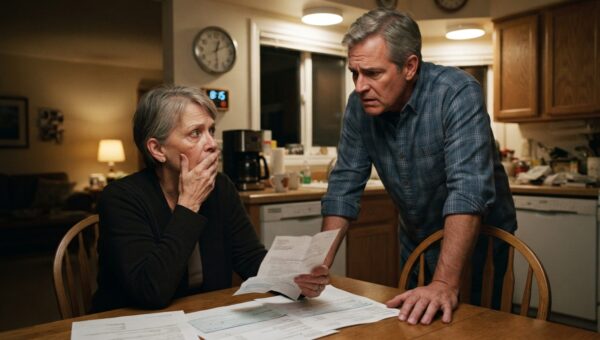
We spent the next two hours at that kitchen table doing what families should never have to do. We laid out every text message, every bank transfer receipt, and every screenshot Chloe had sent her mother over the last eight weeks.
Robert had printed out their bank statements because he was suspicious of how fast the money was disappearing into unitemized vendor fees. I went to the drawer where I kept my credit union receipts and pulled out the carbon copy of the check I handed Julian on January 14th.
The math did not just not balance. It screamed.
My fifteen thousand had cleared my account within twenty-four hours and was immediately transferred into a joint savings account Julian and Chloe opened behind our backs. Robert’s twenty-five thousand had followed the exact same path three weeks later. But when we looked at the vendor invoices Robert brought in his folder, the Grandview Hotel deposits did not match what the kids were claiming.
“Look at this line item here,” Robert said, tapping a thick finger against a catering printout. “They booked the premium prime rib package for one hundred and twenty guests, plus an open bar with top-shelf liquor, plus a midnight seafood buffet. They did not downsize. They scaled up the second they knew both of us were paying.”
“They played us,” I said, feeling a strange, hollow calm settling over my shoulders. “They took forty thousand dollars total from two retired families living on pensions and social security, told each of us the other one gave nothing, and pocketed the difference for extras.”
“And now they want ten thousand more for the photographer,” Robert muttered, staring out the window at the gray backyard where my tomato cages were slowly tipping over in the mud.
We did not yell. We did not cry. Old people who have worked for every dollar they ever owned do not waste good energy on waterworks once the ledger is balanced. We simply made a list.
I called Julian first, putting the phone on speaker right there on the table so Robert could hear every word. It rang three times before Julian picked up, his voice sharp and defensive before I even said hello.
“If this is about the ten thousand, Mom, I told you, “
“Julian,” I interrupted, keeping my voice entirely flat, the way I used to talk to insurance adjusters when they tried to deny a claim. “Your father-in-law is sitting across my kitchen table. We are looking at the deposit slips for the Grandview Hotel.”
There was a long, dead silence on the other end of the line. You could hear someone breathing softly in the background, probably Chloe.
“Mom, I don’t know what you’re, “
“Shut up, Julian,” Robert said, his voice low and steady, carrying across the speakerphone with the weight of an anvil. “You have forty-eight hours before your wedding. You are going to call the Grandview right now and scale that party back to the fifty-person park shelter package you promised us in January. You are going to return every single cent of the unspent cash to this kitchen table by noon tomorrow, or your mother and I are renting a billboard outside that hotel parking lot to explain to your guests exactly how this party was funded.”
“You wouldn’t do that,” Julian stammered, his voice cracking upward in a way I hadn’t heard since he was twelve years old and caught lying about his report card.
“Try us,” I said. “We have the bank routing numbers right here. We have your text messages telling me Robert and his wife refused to give a dime. We have your father-in-law sitting right here in my kitchen.”
The line went silent again, save for the faint sound of someone crying softly on the other end. It wasn’t my grief, and it wasn’t Robert’s. It was the sound of a scam finally running out of runway.
“We’ll call you back,” Julian whispered, and the line disconnected with a sharp click.
Robert and I sat there in the growing dusk as the streetlights flickered on down the block, throwing long, yellow beams across the wet pavement. Neither of us moved for a long time.
He reached out, pulled my ceramic coffee mug toward himself, poured himself a fresh cup from the pot I had kept warm on the burner, and took a long, slow sip.
“You take sugar?” I asked.
“Just black,” Robert said, staring out at the rain. “Quiet evening.”
“Too quiet,” I said, and for the first time all day, the corner of my mouth actually twitched toward a smile.
We didn’t talk about the wedding after that. We didn’t talk about whether we would sit in the front row or stay home with the television on. We just sat there as two parents who had finally compared their notes, drinking bitter coffee in the fading light, knowing that whatever happened next at that hotel, the ledger had finally been closed.