Twenty-four thousand, six hundred and twelve dollars and forty-eight cents. That was the exact figure sitting in my credit union statement on the Tuesday morning Lucas walked into our kitchen with a fresh haircut and a story about a three-bedroom fixer-upper down by the old wharf.
I was standing at the counter scraping leftover butter off a knife when he laid it out. He wanted twenty thousand flat for the earnest money deposit and the inspection fees. The market was moving fast, he said, and if he didn’t wire the broker by Friday, some out-of-state investor was going to snap up the yard with the old apple trees.
Mark looked across the table at his son with that soft, foolish expression he always wore when Lucas was trying to pull himself up by his bootstraps for the fourth time that year. Mark worked thirty-two years at the paper mill before they closed the third line, and he always carried this heavy guilt about the divorce, like every missed Little League game or split holiday had left some permanent hole in Lucas that only a blank check could patch.
“We have it in the municipal bond fund,” I said, keeping my voice level. “We can transfer it, but let’s just draw up a simple repayment note. Nothing fancy. Just a paper trail so we all know where we stand.”
Lucas stopped mid-sentence, his smile sliding right off his face like grease down a hot skillet. He looked at his father, his eyes widening with that practiced look of deep, wounded betrayal he used whenever anyone expected him to act like a grown man.
“You’re treating me like a stranger in my own dad’s house,” Lucas said, his voice dropping into that low, gravelly register that always made Mark flinch. “I come to you for help with my first real home, and you want to treat me like a bank? Dad, is this how it’s going to be?”
Mark turned on me then, his jaw tight, his coffee mug coming down on the laminate with a sharp crack that rattled the sugar bowl. “He’s trying to buy a house, Arlene. He’s trying to settle down. I am not going to let you turn family into some kind of business transaction.”
“It is my retirement money, Mark,” I said, my chest going tight. “It’s not a spare twenty dollar bill from the glove box.”
“It’s our money,” Mark snapped back, using that plural pronoun only when he wanted to override me. “And he’s my boy. I said we’d help him.”
I gave in. I always gave in because the alternative was spending every evening listening to Mark sigh into his newspaper, walking around the house like a ghost who blamed me for his own failures as a father. I went to the credit union on Wednesday morning, sat under those harsh fluorescent lights with Brenda at the desk, and authorized the wire transfer. I watched the numbers drop from twenty-four thousand down to four thousand, six hundred and twelve dollars and forty-eight cents. Brenda asked me if everything was all right with the purchase, and I told her yes, my stepson was buying a house. My tongue felt like sandpaper when I said it.
For the next five months, the house stayed quiet. Too quiet. Every time I asked about the closing date or whether the home inspection had turned up any issues with the foundation, Lucas had a smooth answer ready. The title company was backed up. The seller was dragging his feet on the roof repairs. The municipal office lost the permit paperwork. Mark bought every word of it, nodding along and telling me I worried too much about details.
I didn’t believe a single word, but I kept my mouth shut because the alternative was another week of silence across the dinner table where Mark wouldn’t even pass the salt without making it feel like an indictment. I watched him clear his plate every night and talk about how Lucas was finally turning a corner, how thirty was the age where boys finally grew up into men.
The phone call came on a Tuesday afternoon in late October, right when the rain was starting to turn the maple leaves outside into soggy brown paper.
The landline rang first, that shrill, old-fashioned ring that always made my shoulders jump. Mark was out in the garage trying to fix the lawnmower deck, so I picked it up on the second ring, expecting a robocall about duct cleaning or extended warranties.
“Is this Mark Miller?” a flat, professional voice asked. There was no greeting, just the dry, sandpaper scrape of someone who spent eight hours a day reading from a screen.
“He’s outside right now,” I said. “Who is calling?”
“This is Mr. Vance with Capital Recovery Solutions. I’m trying to reach Mark regarding an overdue commercial line of credit where he is listed as the primary guarantor.”
I stood there by the white laminate counter, looking out the kitchen window at Mark’s back through the screen door. He was hammering away at a rusty bolt, his shoulders rounded under his old flannel shirt.
“There’s some mistake,” I said, my voice dropping an octave. “My husband doesn’t have any commercial lines of credit. He’s retired from the mill.”
“Well, ma’am, according to the file here, an account was opened six weeks ago through our online portal, and the guarantor’s signature matches a Mark Miller with this exact address and social security number,” the voice said, entirely unmoved by my confusion. “Your son listed you as the guarantor on another account.”
“My stepson,” I corrected automatically. “Lucas?”
“The name on the debtor file is Lucas Miller. But the guarantor who signed for the fifteen thousand dollar credit line is Mark Miller. Put him on the phone, please.”
“He’s not signing anything,” I whispered, though I didn’t know why I was arguing with a debt collector. “He didn’t sign anything.”
“Then you should look at the application, because the signature matches line for line,” Vance said, and the line went dead with a sharp click.
I stood there for a long time holding the dead receiver against my ear, listening to the dial tone hum until it switched to that annoying fast busy signal. The kitchen was so quiet I could hear the refrigerator compressor clicking on and off in the corner. My skin felt cold, like someone had opened the freezer door and left it wide open behind my back.
Mark came through the back door a minute later, wiping grease off his knuckles with a dirty red rag. He smelled like WD-40 and damp earth.
“Who was that on the horn?” he asked, tossing the rag onto the counter. ” sounded like you were arguing.”
“That was a debt collector,” I said. I didn’t raise my voice. I didn’t yell. I just handed him the slip of paper where I’d scribbled the name Capital Recovery Solutions and a case number while Mr. Vance was talking.
Mark looked down at the paper, and his eyebrows drew together. “What is this? I don’t owe anybody anything. We paid off the truck three years ago.”
“He asked for you by name,” I said, and every word felt like pulling a nail out of old wood. “He said Lucas listed you as the guarantor on a fifteen thousand dollar credit line. He said you signed for it.”
Mark let out a short, dry laugh, the kind of sound a man makes when he thinks someone is playing a bad joke on him. “That’s crazy. I haven’t signed a paper for Lucas since he bought that used sedan five years ago. The kid doesn’t even know where I keep my checkbook.”
“He knows where your tax forms are, Mark,” I said. “They’re in the top drawer of the old oak desk in the study. Right under the Bible.”
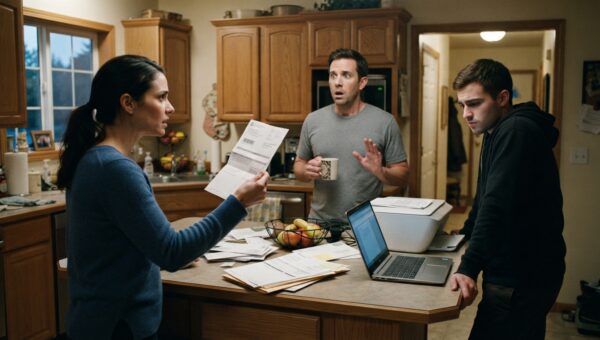
Mark stopped laughing. The color drained out of his face so fast his skin looked almost gray under the fluorescent light, not because he was pale, but because the blood had just retreated from his cheeks all at once. He walked over to the kitchen table without saying another word, pulled his old laptop out of its sleeve, and flipped the lid up.
We didn’t talk while it booted up. We both just stood there in the quiet kitchen, listening to the little fan whir inside the plastic case as it connected to our slow rural internet. Mark’s fingers were shaking slightly as he typed in his password, missing the keys twice before he got it right.
He went straight to his email, dug into the recovery portal link I had written down from memory, and logged into the financial dashboard using his social security number. It took three minutes of clicking through menus and password resets before the application PDF finally popped up on the screen in front of us.
There it was.
At the bottom of a fifteen-thousand-dollar high-interest revolving credit application, right under the bold text about legal liability and default terms, was Mark’s signature. It was traced with agonizing precision, every loop and slant copied from some old medical form or tax return Lucas must have photographed with his phone when he came over for Sunday pot roast three weeks ago.
Mark stared at the screen for a full minute without blinking. His hand came up, index finger trembling as he touched the glass of the monitor right over the forged M in his last name, as if he could rub it away with his thumb like a smudge of charcoal.
“He used my name,” Mark whispered. It wasn’t an accusation anymore. It was just a fact, heavy and flat, dropping down between us onto the wood table. “He used my name to borrow money for his gambling.”
“It wasn’t for a house, Mark,” I said, and my own voice sounded small and distant in my ears. “The twenty thousand didn’t go to a title company. It went forty-eight hours after I wired it to an offshore betting site called Meridian Sports. I checked the routing number with Brenda yesterday when I went in to see why my quarterly statement looked funny.”
Mark didn’t defend him. He didn’t say we were making family transactional. He just sat down hard on the wooden chair, his knees hitting the underside of the table with a dull thud, and buried his face in his grease-stained hands.
“I gave him my name,” he muttered into his palms. “I gave him everything I had, and he just… he just used it like a credit card.”
“Call him,” I said.
Mark looked up, his eyes red around the edges, looking older than his sixty-one years.
“Call him right now,” I repeated, reaching out and tapping the screen right over the forged signature. “Tell him to get in his car and drive over here right this minute. Because if you don’t, I’m calling the state police myself to report the identity theft, and I don’t care whose last name is on the police report.”
Mark reached for his phone on the table. His thumb slipped twice on the screen before he found Lucas’s contact card, hit the call button, and put it on speaker.
The phone rang four times. On the fifth ring, a voice answered, loud and slightly slurred, with background noise that sounded like slot machines chiming and heavy bass from some bar downtown.
“Dad? I’m kind of in the middle of something, “
“Get in your car,” Mark said. His voice didn’t shake anymore. It sounded like iron hitting stone. “Get in your car right now and drive to this house. Do not stop for gas. Do not call anybody. If you aren’t sitting at this kitchen table in twenty minutes, I am driving down to the county precinct with the printout of the loan application you forged with my name.”
There was a long silence on the line, the kind of silence where you can hear someone’s brain calculating how many doors are left to run through.
“Dad, I can explain, “
“Twenty minutes, Lucas,” Mark said, and he hung up the phone without waiting for an answer.
We sat in silence for the twenty minutes. Mark didn’t look at me, and I didn’t look at him. We just watched the digital clock on the microwave tick from 4:42 to 5:02, the little red numbers changing in the gathering dusk outside the window.
When headlights swept across the living room curtains and a car door slammed in the gravel drive, Mark stood up. He didn’t wait for the knock. He walked straight to the front door, pulled it open, and stood in the frame with his arms crossed over his chest, blocking the entryway so Lucas had to stop five feet short on the porch mat.
Lucas looked like he hadn’t slept in three days. His jacket was missing a button, and his eyes darted from Mark’s face to mine where I stood by the kitchen island.
“Dad, come on,” Lucas started, holding up his hands in that familiar, helpless gesture. “It’s a misunderstanding with the lender. The guy on the phone doesn’t know what he’s talking about, “
“Shut up, Lucas,” Mark said. He didn’t yell. He just said it so quietly that Lucas actually stopped talking mid-sentence. “Just shut your mouth for once in your life.”
He stepped aside and let Lucas stumble into the hallway, smelling of stale beer and cheap tobacco. Lucas walked into the kitchen, saw the laptop open on the table with his application still glowing on the screen, and his shoulders collapsed all at once. All the bluster went out of him like air from a punctured tire.
“I was going to pay it back,” Lucas muttered to the linoleum floor. “I had a system. I just needed one more game to cover the shortfall from the house deposit, “
“There was no house,” Mark said, his voice dropping so low it was almost hard to hear over the hum of the refrigerator. “Arlene found out where the twenty grand went. It didn’t go to a title company. It went to an online bookie.”
Lucas looked at me then, his eyes hard and small. “You’re checking up on me? You’re spying on my bank accounts?”
“I checked my own retirement fund,” I said, stepping forward until the island was the only thing between us. “The fund you stole from under a lie about a three-bedroom house with apple trees. You didn’t just take my money, Lucas. You took your father’s name and you signed it to a crime.”
Lucas looked back at Mark, expecting the usual softening, the old mill worker’s sigh about how hard things were for kids these days. He waited for Mark to say something about family loyalty or giving him another chance.
Mark didn’t say it. He walked over to the desk in the corner, pulled his checkbook out of the drawer, and laid it flat on the wood. Then he opened his wallet, took out his debit card, and dropped both items onto the center of the table next to the laptop.
“You’re going to call that collection agency tomorrow morning while I’m listening,” Mark said, looking straight at his son’s forehead. “You’re going to tell them the truth, or I am walking down to the sheriff’s office with Arlene and letting them handle the forgery charge. And as for the twenty thousand you stole from her retirement…”
Mark stopped, swallowed hard, and looked at me for the first time since the phone call started. His eyes were damp, but his jaw was set like he had finally made up his mind about something he should have done ten years ago.
“I’m selling the old boat,” Mark said to me, his voice steady. “The aluminum fish boat with the Mercury motor. It’ll bring in twelve thousand if I get what it’s worth, and I’ve got eight thousand in my separate credit union account from before we married. I’ll transfer it tomorrow morning, Arlene. Every single cent back into your bond fund. I’ll make you whole before the week is out.”
Lucas let out a sharp, choked sound. “Dad, you can’t sell the boat. We fish together on Sundays, “
“We haven’t fished on a Sunday in four years, Lucas,” Mark said, and for the first time, he sounded tired, really tired, like a man who had finally set down a heavy bag he’d been carrying up a mountain for half his life. “Get out of my house. Don’t come back until you’ve got a receipt from a debt counselor and a lawyer.”
Lucas stood there for a second, his mouth opening and closing like a fish on a dock, waiting for some crack in his father’s face to show. When he saw there wasn’t one, he turned around, pushed the screen door open into the damp evening air, and walked out to his car without another word.
We listened to him grind the gears of his sedan trying to back out of the gravel too fast, the tires throwing loose stone against the siding of the garage. Then the taillights swept across the trees and faded down the road toward the highway.
The kitchen went back to being just a kitchen. The rain was drumming a steady, gray rhythm against the aluminum gutters outside, washing the autumn leaves down the drainpipes.
Mark didn’t say anything. He walked back to the table, closed the laptop lid with a soft click, and stood there looking down at the scarred wood where his checkbook still sat.
“I’m sorry, Arlene,” he said, and his voice cracked just a little bit on the last word. “I called you transactional. I said you were making things hard.”
“You were trying to be a good father,” I said, my voice softer than I intended. “You just had the wrong son in mind.”
He nodded slowly, reaching out to touch my hand where it rested on the edge of the counter. His skin was rough and cold, smelling of grease and rain, but I didn’t pull away.
The next morning, before the sun had even cleared the ridge behind the parish church, Mark was on the phone with Brenda at the credit union, setting up the transfer to move his separate account funds back into my retirement bond. He didn’t ask me to sign anything. He didn’t complain about the paperwork. He just did it, sitting at the kitchen table with his reading glasses slipping down his nose until the confirmation number printed out on the little receipt machine by the fax.
That afternoon, after he drove down to the marina to list the aluminum boat with the broker, I went upstairs to the study.
I unlocked the bottom drawer of the oak desk where we kept the deed to the house, the insurance policies, and the spare keys to the safety deposit box at the bank. I pulled out the heavy steel lockbox with the dent in the corner from the time Mark dropped it off the truck bed back in ninety-four.
I opened it with the small brass key I keep on my key ring, tucked the new confirmation printouts from Brenda right inside next to my birth certificate, and snapped the heavy latch shut with a solid, metallic click that echoed off the bookshelves.
Then I put the key back in my pocket, walked over to the window, and watched the gray October rain fall steadily down on the empty driveway.