Arthur stood on my front porch at 4:14 in the afternoon, holding a manila folder against his chest like a shield. I knew it was him before I even opened the screen door, mostly because the mail carrier had already come and gone three hours ago. The heat coming off the asphalt out here in the Bakersfield exurbs was thick enough to chew, but Arthur looked colder than a headstone.
His gray hair was uncombed, sticking up on one side where he had probably been running his hand through it in his truck. I had only met the man twice before, once at a stiff diner lunch when our kids first announced they were getting hitched, and once across a restaurant table where Mark had done all the talking.
I didn’t invite him in right away because my brain kind of stopped working for a second. Arthur just looked at me through the screen wire, his jaw working like he was trying to swallow something sharp. Then he took a breath that rattled in his chest and said the thing that blew the whole house of cards apart. I need to ask you something. How much have you already given them?
I stared at him through the rusty wire mesh. The wind kicked up a little dust cloud from the driveway gravel.
They told us you refused to contribute anything, Arthur said, his voice dropping an octave as he let the folder sag against his belt. We already gave them $25,000. So where did the first $15,000 go?
A month before that Tuesday, Mark had sat right where Arthur was standing now, holding a lukewarm mug of instant coffee and telling me about how expensive everything had gotten. He was wearing that faded blue work shirt he knew made him look honest, the one with frayed cuffs he kept pulling at whenever he wanted sympathy. We want to keep it simple, Ma, Mark had said, leaning his elbows on my Formica kitchen table. Just something small out by the orchards with a few people who actually care about us. Chloe doesn’t want any of that high-society nonsense. She just wants to be my wife.
I had looked at my only son and remembered his father clearing our own small savings thirty years ago just to put a roof over our heads that didn’t leak when the winter rains hit.
I wanted him to start his marriage without the heavy anchor of debt around his neck. So I went down to the credit union the very next morning, bypassed the teller, and had Maria at the desk wire fifteen thousand dollars straight into Mark checking account. I didn’t even ask for a receipt because he was my boy. A mother gets stupid sometimes when she thinks she is doing right by her blood.
The first crack showed up about three weeks later when I ran into Brenda down at the Piggly Wiggly. Brenda does alterations out of her garage and knows every bride in the county before she even picks her veil. She stopped me by the canned tomatoes and asked if I was flying into Santa Barbara for the ceremony at the cliffside resort. I just stood there with a can of stewed tomatoes in each hand, wondering what on earth she was talking about.
Mark and Chloe told everyone they were keeping it simple down by the local park. Brenda patted my arm with her flour-dusted fingers and laughed. Oh, honey, that place closed down last year. They booked the grand ballroom at the Oakhaven Estate. Minimum spend is thirty grand just for the caterer.
I didn’t say anything to Mark that night. I went home, sat in my green armchair with the stuffing coming out of the left arm, and told myself kids exaggerate things. I figured they found a deal or someone chipped in extra. I told myself I was just being an old worrywart who couldn’t stand to see young people have a nice day. When Mark called me four days later asking for another ten thousand dollars because the bride family had fallen on hard times and couldn’t help with the tent rental, I told him no. I remember the exact tone of my own voice. It wasn’t angry. It was just flat. No, Mark. I gave what I had. You said it was simple.
He had gone dead silent on the other end of the line for three long seconds. Then he muttered something about me being unsupportive, told me I never cared about his happiness, and clicked the phone dead. I spent that whole night staring at the ceiling fan turning lazy circles in the dark, listening to the desert wind rattle the aluminum siding outside my bedroom window.
Now Arthur was standing on my porch with a Manila folder, asking about twenty-five thousand dollars he had handed over because his daughter told him I was a miser who would not give a red cent. Come on inside, Arthur, I said, pushing the screen door open. The air conditioning in here is at least working today.
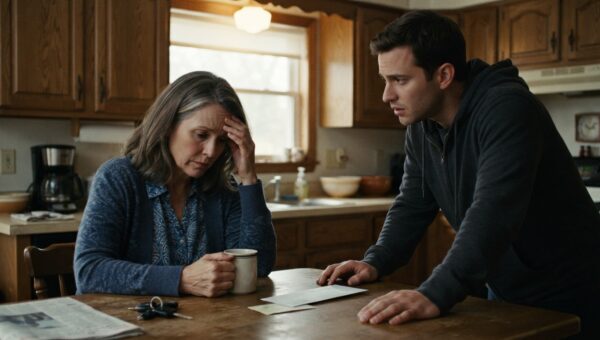
He followed me into the kitchen, his boots heavy on the linoleum. I didn’t offer him coffee because neither of us had the stomach for it. I pulled out my kitchen chair and sat down right across from him. Arthur dropped the folder onto the table, and the sound it made was heavier than it looked. He unlatched the metal clasp with shaking thumbs and pulled out three crisp sheets of paper printed from an online banking portal. Here is our check, Arthur said, sliding a paper across the table toward my coffee mug. Dated May fourteenth. Made out to Mark and Chloe joint account. Twenty-five thousand even.
I reached out and touched the corner of the paper. My fingers felt stiff, like they belonged to someone else. I didn’t say anything for a second, and honestly that felt worse than shouting. I stood up, walked over to the metal filing cabinet by the refrigerator where I keep the utility bills and the tax papers, and pulled out my own green carbon copy from the credit union wire transfer. Fifteen thousand. May second. Paid directly to Mark checking account. Total forty grand before anyone even bought a single carnation.
Arthur leaned back, his face turning that dull, heavy gray of a man who has just taken a shovel to the chest. They told us you hated Chloe, he whispered. That was why you wouldn’t give anything. They said you told you wished the wedding was off.
I let out a dry, humorless sound that didn’t have any fun in it. I love that girl well enough, but I never wished for a wedding that cost more than my first two houses combined. I sat back down and folded my hands over the table. If they got forty thousand dollars, Arthur, where is the Oakhaven ballroom money coming from? Because Brenda down at the store said they booked the whole place for three days.
Arthur pulled a crumpled receipt out of his shirt pocket and laid it flat between us. That was the other thing he found in Chloe desk drawer when he went over to help them pack up some boxes the night before. It wasn’t a venue receipt. It was a travel agency confirmation for a fourteen-day tour of the Greek islands, first-class airfare included, booked under a newly minted savings account with both their names on it. Total deposit: twelve thousand five hundred dollars, paid in full on May eighteenth. Six days after my wire cleared.
We sat there in the quiet kitchen for a long time. The only sound was the refrigerator compressor kicking on with a low, vibrating hum that made my back teeth ache. I thought about Mark when he was seven years old, scraping his knee out by the irrigation ditch and crying because he thought I wouldn’t let him have an ice pop. I had kissed his forehead and given him the red one, the one that stained his chin like cherry juice. I thought I raised him better than this. I thought he knew what an honest dollar cost a person who stood on a concrete floor for eight hours a day at the county records office.
We are going over there, Arthur said. His voice wasn’t loud, but it had that hard, flat ring of a shovel hitting bedrock.
Tonight? I asked.
Right now, he said, standing up so fast his chair screeched against the floor. They are having that little family dinner down at the steakhouse off the highway. We are going to sit down at their table, and they are going to tell us both where the grocery money went.
I didn’t hesitate. I walked over to the hallway hook, grabbed my canvas purse, and checked to make sure my car keys were in the zipper pocket where they belonged. I didn’t want to go. Every bone in my body told me to stay home and lock the deadbolt and let them ruin their own lives without me watching. But then I looked at the table, at my wire receipt and his bank check sitting side by side like two pieces of evidence in a courtroom, and I knew I couldn’t pretend I hadn’t seen them.
We didn’t ride together. Arthur followed my old Buick all the way down Highway 99, his headlights flashing in my rear-view mirror every time we hit a bump in the pavement. The Copper Skillet was lit up like a used car lot, neon beer signs buzzing in the front window through the grease-stained glass. I parked right under the big oak tree by the side entrance where the employees take their smoke breaks.
We found them in the back corner booth behind a mountain of onion rings and half-empty water glasses. Chloe was laughing at something Mark whispered in her ear, her hair pinned up all fancy with little pearl clips that probably cost more than my weekly groceries. Mark had his arm slung along the vinyl back of the booth, looking like a young king who owned the county. Then the shadow of our bodies fell across their table, and the laughter just died out of the air like a snuffed candle.
Mark smile didn’t vanish all at once; it kind of slid off his face piece by piece until he just looked like a little boy who had been caught behind the barn with matches. What are you two doing here? he asked, his voice cracking a little on the word what. We are having a family dinner.
Arthur didn’t wait to be invited. He slid into the booth right beside Chloe, forcing her to pull her knees back against the leather. I sat down opposite Mark, sliding my purse off my shoulder and setting it right in the middle of the table, right on top of their paper placemat. I didn’t say a word. I just pulled my copy of the credit union transfer out of the front pocket and laid it face up next to the basket of warm rolls.
Arthur dropped his bank statement right beside it. Neither of us raised our voices. In a place like the Copper Skillet, shouting just makes the waitresses look away, but quiet talking makes everyone at the counter turn around.
You told me you needed fifteen thousand for a simple wedding, Mark, I said. My voice sounded thin to my own ears, like paper tearing. Then Arthur here found out you told him I gave nothing so you could squeeze twenty-five thousand more out of his pocket.
Chloe face went the color of skim milk. She looked at her father, her mouth opening and closing twice before any sound came out. Dad, we can explain. The venue prices went up because of the season and, It wasn’t the venue, Chloe, Arthur said, his voice so quiet she had to lean in just to hear him. We saw the travel agency printout from your desk. Twelve thousand five hundred dollars for a Greek cruise. Paid in cash the week after you cashed her check.
Mark slammed his water glass down hard enough to slop ice water over the rim and onto the formica. You were going through my stuff? That is private! You have no right to come in here and spy on us!
The whole back corner of the restaurant went dead quiet. Even the kitchen door stopped swinging for a second. I looked right across the table into my son eyes, and for the first time in thirty-two years, I couldn’t see anything of myself in him. Not a trace.
We aren’t spying, Mark, I said, reaching out one finger to touch the corner of my wire receipt. We are just doing the math you forgot how to do. The wedding is in forty-eight hours. The Oakhaven Estate is booked or it isn’t. But you aren’t getting another dime from either of us to pay for your Mediterranean vacation.
Chloe started crying then, real wet, heavy-shouldered tears that made her mascara run down into the corners of her mouth. It was for our future, she whimpered, dabbing at her face with a paper napkin that tore under her fingers. We wanted to start off right. Everyone our age has a destination honeymoon. We just wanted things to be nice.
Nice is a wedding you can pay for with your own sweat, Arthur told her, standing up so hard the vinyl booth seat groaned. You call the venue tomorrow morning. You tell them you are dropping the upgrades back to what two working families can afford. And every single dollar left over from our checks goes back into a joint account with my name and her name on it until you hand us itemized receipts for every box of napkins.
Mark looked like he was about to hit something, his jaw clenched so hard the muscle jumped beneath his ear. You can’t do that, he hissed, leaning across the table toward me. People are coming. Invitations went out. What are we supposed to tell everyone?
You can tell them the truth, Mark, I said, picking up my paper and sliding it back into my purse. Or you can tell them whatever lie helps you sleep tonight. But the well is dry.
We left them there in the corner booth with their onion rings getting cold and their water glasses sweating into the paper mats. Arthur walked me out to my Buick under the orange sodium lights of the parking lot. He didn’t shake my hand and he didn’t hug me; people of our generation don’t do much hugging in gravel parking lots after a disaster like that. He just nodded once, slow and heavy, and said he would see me at the church on Saturday morning.
The wedding happened two days later, just like we said it would, though it didn’t look anything like the glossy pictures Chloe had pinned to her vision board. They got married in the small white chapel down by the county park with forty people in attendance, using folding metal chairs and speakers that hissed every time the minister spoke into the clip-on microphone. There was no ice sculpture, no three-tier fondant cake with sugar peonies, and no first-class tickets to Athens. The reception was held in the church fellowship hall with three sheet cakes from the local bakery and a cooler full of punch that tasted mostly of ginger ale and cheap pineapple juice.
I sat in the third row on the groom side, right beside Arthur and his wife, wearing my good navy church dress and the pearl earrings my husband gave me our tenth anniversary. Mark didn’t look at me once during the vows, and Chloe kept her eyes fixed firmly on the small gold band on her finger like she was afraid it might turn into lead if she looked away. I didn’t feel righteous and I didn’t feel like a hero. I just felt tired, the kind of deep, marrow-weary tired that only comes from clearing out a basement full of old junk you should have thrown away twenty years ago.
Now, three weeks after the rice was swept off the front steps of the chapel, I am sitting at my own kitchen table alone with the evening paper. The afternoon sun is long gone behind the desert ridge, and the house is quiet except for the hum of the refrigerator. Right in the middle of the polished wood, sitting right beside two empty coffee mugs and the salt shaker, is a single, unsealed wedding invitation that someone left behind on the back pew. The gold lettering on the heavy cream cardstock is slightly smudged where someone greasy thumbed the corner. I picked it up earlier today, looked at the names embossed in neat cursive across the front, and then laid it back down where the light from the kitchen window hits it just right. It is the only thing left of the whole messy business that isn’t covered in a lie. I poured myself another cup of black coffee, blew the steam off the top, and left the invitation right where it is, plain and open for anyone to see.