PART 1
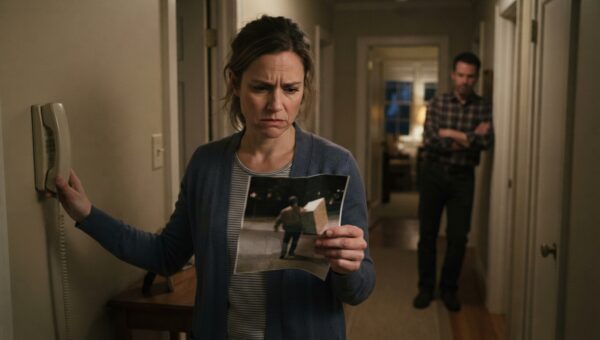
The receipt was crumpled in the right pocket of my husband’s gray wool overcoat. I found it while reaching for the coat hangers on a rainy Wednesday night, checking the pockets before dropping our winter things off at the cleaner. It was printed on thin pink thermal paper from The Reading Tree, an independent children’s bookstore on the west side of Grand Rapids, forty minutes in the opposite direction from his office.
The purchase was dated the previous Thursday at 5:48 PM: $34.18 for two hardcover picture books, one called The Little Blue Truck and another about baby animals on a farm.
We do not have young children. Our oldest, Brian, is thirty-one and works as an accountant in Chicago. Our youngest, Chloe, is twenty-seven and lives in an apartment downtown with two rescue cats. We have no grandchildren. Every Sunday dinner for two years, my husband, Jim, had joked about how peaceful our house was now that the tuition bills and school schedules were long behind us.
Yet for six months, Jim had been working late every single Thursday.
He told me his civil engineering firm had taken on a municipal drainage contract for Kent County that required weekly evening site evaluations. He always came home around eight-thirty smelling of cold air, took off his muddy work boots on the porch, ate whatever plate of chicken or pot roast I had kept warm in the oven, and rubbed his temples like a tired man who had spent three hours looking at sewer culverts.
I didn’t accuse him of anything. After thirty-four years of marriage, you learn that waving a scrap of paper in a man’s face only gives him time to build a tidy explanation.
Instead, I folded the receipt, slid it into the back of my checkbook, and put his coat back on the brass hanger.
The next Thursday, I left my desk at the county records office twenty minutes early. I parked my blue Subaru behind an empty delivery van across from Jim’s office park on Cascade Road. At 5:12 PM, Jim’s silver Ford sedan pulled out of the visitor lot. He didn’t turn toward the highway or head north toward the county drain project. He headed west, crossing the river into a modest older neighborhood near Lincoln Park.
I kept four car lengths between us in the heavy commuter traffic. He turned down Elmwood Street, a quiet block lined with cracked sidewalks and small postwar bungalows. He pulled into a narrow crushed-gravel driveway behind a small brick house with dark green shutters and a sagging chain-link fence.
I pulled over to the curb three doors down, right beneath the bare branches of a silver maple, and turned off my headlights.
Jim got out of his car. In his left hand, he carried a glossy white paper gift bag with two picture books sticking out of the top. In his right hand, tied to a white ribbon, was a bright pink birthday balloon that bobbed in the November breeze. He didn’t look around. He walked up the three wooden steps of the side porch with the easy familiarity of someone who had climbed them dozens of times.
Before he could knock, the front door swung open.
A little girl with dark curly hair, wearing purple leggings and a yellow sweatshirt, ran out onto the porch rugs. She threw her arms around his knees and yelled, high and clear through the quiet street: “Grandpa!”
Jim set the bag down, knelt on the porch, and lifted her into his arms, laughing as she buried her face in his neck.
My hands tightened on the steering wheel until the leather groaned. My breath caught in my throat. We had no grandchildren. I had never seen this child in my life. The thought that Jim had kept a secret family, that he had lived some double life right under my nose while I ironed his work shirts, made my stomach turn completely over.
I reached for the gear shift. I put my Subaru in drive, ready to step on the gas and get away before my chest caved in.
Then the storm door pushed open again.
A woman stepped out onto the porch. She was in her late twenties, wearing a thick gray cardigan with holes at the cuffs. She didn’t look at Jim or the child. She looked past the driveway, down the sidewalk, and straight through my windshield at where I was sitting in the dusk.
She didn’t run inside. She didn’t look surprised.
She walked down the porch steps, pushed open the metal latch of the chain-link gate, and started walking down the gravel directly toward my car.
PART 2
I didn’t step on the gas. My foot stayed pressed against the brake pedal while the gravel crunched under her boots.
As she came closer under the street lamp, her face became clear. She was thin, with tired shadows under her dark eyes and her hair pulled back into an untidy knot with a plastic clip. She looked like she hadn’t slept a full night in months. When she reached my driver’s window, she didn’t knock aggressively. She tapped twice with the flat of her knuckle against the cold glass.
I lowered the window three inches. The smell of cold air and woodsmoke drifted inside.
“Mrs. Miller,” she said. Her voice was flat and raspy, shaking slightly from the wind. “Please don’t drive away. Turn off the car and come inside. Jim doesn’t know you followed him, but you need to hear this in the room where it belongs.”
“Who are you?” I asked. My voice came out like gravel. “Whose child is that?”
The woman took a slow breath, wrapping her cardigan tight across her chest. “My name is Sarah. That’s my daughter, Lily. She just turned four today. Jim isn’t my father, and he isn’t her father. But you need to see what’s on the kitchen table before you leave this street.”
She turned and began walking back toward the small brick house without waiting to see if I would follow.
I sat there for twenty seconds while the heater fan blew lukewarm air against my ankles. My mind was racing between every ugly possibility I had read about in advice columns over thirty years. But there was something in her posture, an exhaustion that had nothing to do with romance or secrecy, that made me turn the key and take the Subaru out of gear.
I got out, pulled my wool coat around my shoulders, and walked through the metal gate.
The front room smelled of vegetable soup, cheap floor cleaner, and damp plaster. There was an old brown sofa with a worn floral blanket draped over the back cushions, and a plastic toddler table covered in colored construction paper. The pink balloon was tied to the back of a kitchen chair.
The little girl, Lily, was sitting on the rug with the two picture books spread across her lap, pointing at a picture of a blue truck. Jim was standing at the counter with his back to the door, pouring milk into a small plastic sippy cup.
When the front door clicked shut behind me, Jim turned around.
The plastic cup slipped out of his fingers. It hit the linoleum floor with a hollow bounce, splashing milk across the toes of his work boots.
His face drained of whatever color had been there. He took a half-step backward until his hip hit the edge of the laminate counter. His mouth moved, but no sound came out for several seconds.
“Hannah,” he whispered. “What are you doing here?”
“I found the receipt from The Reading Tree, Jim,” I said. I kept my voice low so the child on the floor wouldn’t get scared. “You told me you were inspecting county drainage ditches every Thursday night for six months. You told me you were working late so we could save for a trip to Maine.”
Jim looked down at the puddle of milk by his feet, then looked over at Sarah, who was standing quietly by the kitchen doorframe with her arms crossed.
“She has to know, Jim,” Sarah said softly. “You can’t keep carrying this alone. The sheriff’s deputy was here yesterday with the final notice.”
“What notice?” I asked, looking between them. “Jim, what is this family to you?”
Jim didn’t answer right away. He took a dish towel from the sink, bent down, and wiped the milk off the floor with slow, mechanical motions, just like he did when our kids spilled their juice thirty years ago. His hands were shaking so hard the cotton towel bunched up into an uneven ball.
“Lily isn’t mine, Hannah,” Jim said, his voice cracking on my name. “She’s Brian’s.”
PART 3
The room felt entirely without air.
“Brian?” I said. “Our son Brian? Brian lives in an apartment in Lincoln Park in Chicago. He’s had the same job at the accounting firm for four years.”
“Brian lived with me here for three years before he left for Illinois,” Sarah said, stepping fully into the kitchen. Her voice was steady, but there was a deep bitterness beneath it that she wasn’t trying to hide. “We met when he was working his first contract job out of Michigan State. We rented this house together in 2021. When I got pregnant with Lily, he told his father. He told Jim that if you found out, it would ruin his chances of moving to Chicago, because you had taken out twenty-five thousand dollars in home equity loans to pay for his master’s degree and expected him to settle down with a professional.”
I looked at Jim. “Is that what you thought I would do?”
Jim stood up with the wet towel in his hand. He looked older than sixty-one, his shoulders curved forward and his eyes rimmed with red.
“Brian came to me in tears four years ago, Hannah,” Jim said, leaning against the counter. “He was terrified. He said he wasn’t ready to be a father. He said he had an offer at the firm in Chicago, but if he took on a child support order and child care here, he’d be trapped in town working entry-level bookkeeping. He begged me to help him keep it quiet until he got established. He promised he would send money every month to Sarah once he made junior partner.”
“And did he?” I asked.
Sarah gave a short, hard laugh that had no humor in it. She walked over to the small kitchen table and picked up a legal-sized yellow manila envelope. She pulled out three folded sheets of paper and handed them to me.
The top sheet was an eviction summons from the 61st District Court in Grand Rapids, addressed to Sarah Miller and all occupants, dated eight days ago. The overdue rent was $3,200.
The second sheet was a printout of bank transfer receipts from our personal savings account. Every single Thursday for six months, an electronic withdrawal of $250 had been made from the joint credit union account Jim and I had maintained for thirty years. That was $6,500 altogether, money I thought was sitting in our money market fund for our retirement.
The third document was a court order for administrative wage withholding from the State of Michigan Friend of the Court, dated four months earlier. It listed Brian Miller as the non-custodial parent, ordered to pay $612 a month. The arrearage balance was $9,450. Across the bottom of the order was a red rubber stamp from the state enforcement unit: UNABLE TO LOCATE ASSETS / JURISDICTIONAL TRANSFER PENDING.
“Brian hasn’t sent twenty dollars in two years,” Sarah said, looking down at the little girl on the rug. “He changed his phone number. When the state tried to serve him at his Chicago apartment, the management company said he had moved to an unlisted condominium in Evanston. The only person who ever answered my calls was your husband.”
I looked at Jim. “You’ve been taking money from our retirement account every week.”
“I was paying her landlord two hundred and fifty dollars every Thursday so they wouldn’t throw a four-year-old onto the street, Hannah,” Jim said. Tears were running down his face now, catching in the gray stubble around his jaw. “Brian blocked my number four months ago when I told him he needed to step up and sign the custody agreement. He told me that if I pushed him, he’d cut all ties with the family and move to the West Coast. I was trying to protect our son’s future, and I was trying to protect this baby.”
“You weren’t protecting Brian,” I said, my voice dropping so cold and clear it cut through Jim’s crying. “You were hiding his cowardice. And you made me an accomplice to abandoning my own granddaughter.”
Jim flinched like I had struck him.
The little girl looked up from her book, sensing the tension in the room. She held up The Little Blue Truck toward me, her wide hazel eyes matching Brian’s baby pictures almost line for line.
“Look, lady,” Lily whispered, pointing a small finger at the painted yellow barn on the cover. “A cow.”
I looked down at the child. She had Brian’s high forehead, but she had her mother’s quiet, cautious mouth. For four years, while I had been bragging at the library about my son the CPA in Chicago, this little girl had been growing up five miles from my kitchen table, eating generic cereal while her father bought luxury furniture for an apartment two hundred miles away.
I set the papers back on the laminate counter. I took my phone out of my wool coat pocket, pulled up my contacts, and scrolled down to Brian’s name.
“What are you doing?” Jim asked, his voice shaking.
“I’m calling our son,” I said.
“Hannah, don’t,” Jim pleaded, stepping toward me with his hands out. “If you push him right now, he’ll disappear. He won’t talk to either of us.”
“Then he won’t talk to us,” I said. “Put your coat on, Jim. We’re not leaving this kitchen until this table is cleared.”
ENDING
I dialed Brian’s direct office extension at the accounting firm. It was 6:15 PM, and he was always at his desk during tax season prep.
He answered on the third ring with his brisk, professional greeting: “Brian Miller, senior tax associate.”
“Brian,” I said. “This is your mother.”
There was an immediate pause on the line. “Mom? Is something wrong? Did Dad have another episode with his back?”
“I am sitting at the kitchen table on Elmwood Street,” I said, keeping my words measured and slow. “I am looking at your daughter, Lily. She is four years old today. She likes picture books about trucks. And your father has spent sixty-five hundred dollars from our joint savings keeping her landlord from putting her clothes on the curb because you haven’t paid child support in two years.”
The silence on the other end was absolute. I could hear the faint sound of an office copier running in the background.
“Mom,” Brian whispered. His voice lost all its professional polish, dropping into the thin, panicked tone he used when he broke our garage window with a baseball at twelve. “Let me explain. Sarah was demanding things I couldn’t handle. It was complicated. Dad told me he would manage it until my promotion went through.”
“Listen to me very carefully, Brian,” I said. “Tomorrow morning at nine o’clock, you are going to wire thirty-two hundred dollars directly to Sarah’s landlord to clear the back rent. Then you are going to call the Kent County Friend of the Court, provide your verified Evanston address, and authorize voluntary payroll deduction for the full arrearage. If you do not send the confirmation to my email by noon tomorrow, I am taking this file directly to the managing partner of your firm, and I am filing an affidavit with the county prosecutor’s office for felony non-support.”
“Mom, you would destroy my career,” Brian cried, his voice breaking into a sob. “You can’t do that to your own son.”
“You did it to yourself, Brian,” I said. “And you did it to your daughter. Do not call your father. Do not call me until you have the wire receipt.”
I hung up the phone and laid it face down on the table.
Jim stood by the sink with his head bowed, weeping quietly into the wet towel. Sarah didn’t say anything. She walked to the small refrigerator, poured a fresh cup of milk, and handed it to Lily on the rug.
The wire transfer confirmation arrived in my email inbox the next day at ten-forty in the morning: $3,200 sent to the property management company, followed by a signed electronic authorization form submitted to the state child support agency.
Things did not go back to normal in our house on Cascade Road.
Jim and I sleep in separate bedrooms now. He transferred the sixty-five hundred dollars back into our savings from his personal hobby vehicle fund, and he spends his Thursday evenings sitting quietly in the basement workshop, working on birdhouses he never finishes. Thirty-four years of trust doesn’t mend because an old man was trying to protect a son who didn’t deserve it. We talk about groceries, we talk about the furnace filters, but the ease between us is gone, replaced by a quiet, watchful distance that will probably remain for whatever years we have left.
Brian hasn’t visited Grand Rapids since that night. He sends his court-ordered child support every month through the state portal, clean and on time, but his calls to our house are brief, awkward, and rare. He chose his pride over his family, and he has to live with the quiet rooms in Evanston that pride bought him.
Yesterday was Thursday.
I didn’t stay at my office late, and Jim didn’t drive across town. At four-thirty, I drove my blue Subaru over to Elmwood Street by myself.
Lily was waiting on the porch steps, wearing her yellow sweatshirt and holding a plastic container of sidewalk chalk. When she saw my car pull up to the gravel curb, she stood up and waved with both hands, shouting my name across the yard.
I took a box of sugar cookies off the passenger seat, pushed open the metal gate, and sat down on the bottom wooden step beside her to help draw blue trucks on the concrete.