PART 1
When my Aunt Clara died last fall, my cousins did not waste forty-eight hours before dividing up her life.
Her daughter Michele took the deed to the brick ranch house on Sycamore Street. Her brother Kevin took the 2011 Buick LeSabre with twenty-four thousand miles on the odometer. Together, they emptied Aunt Clara’s primary savings account at First State Bank, which sat at exactly $63,000.
I was at the kitchen table on the third afternoon after the funeral, helping pack Clara’s everyday dishes into cardboard boxes, when Michele tossed a padded blue binder across the linoleum. It hit my forearms and slid into a stack of saucers.
“Here,” Michele said, leaning against the counter and taking a long sip from her sweet tea. “You always liked church junk.”
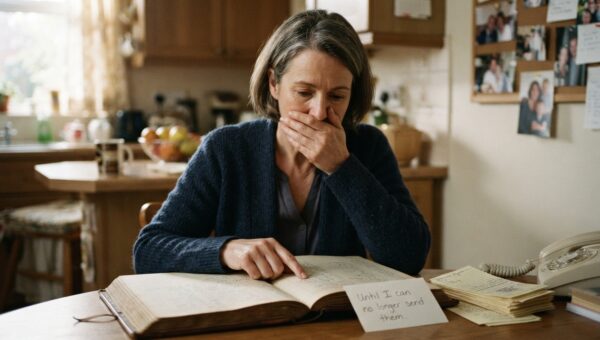
It was Clara’s funeral guest book. It had sixty-eight signatures inside, written in shaky cursive by elderly neighbors, ladies from the altar guild, and two retired mail carriers.
Kevin laughed from the doorway where he was holding Clara’s silverware chest under one arm. “Save her the trouble of buying stationery,” he said.
I did not scream. I did not throw the book back. I was fifty-four years old, working thirty-six hours a week as a floor nurse at Valley Memorial, and I had learned decades ago that arguing with Uncle Donald’s children only gave them an audience.
Their father, Clara’s brother Donald, had spent forty years convincing everyone in our county that his branch of the family did the heavy lifting while my late mother and I were just poor relations looking for handouts.
When my mother died of breast cancer in 1996, I was twenty-four, working the night shift as a certified nursing assistant, and scraping together dimes for junior college tuition. Donald told the family at my mother’s wake that girls from our side didn’t have the stamina for real medical degrees and that I would end up working a register. Aunt Clara had stood behind him that day, her hands folded over her purse, saying nothing.
So when Michele and Kevin took the house, the car, and the cash, I took the guest book.
For nine months, it sat on the right corner of my dresser between my jewelry tray and a framed snapshot of my mother.
Every morning when I put on my earrings, I saw the faded gold lettering on the padded cover: In Loving Memory.
Then came last Saturday morning.
I was dusting the bedroom with an old flannel rag, lifting the perfume bottles and wiping down the mahogany veneer. I picked up the guest book to dust underneath it. The bottom binding had dried out from years in Clara’s damp front closet before the service. When I turned it over, the heavy paper backing cracked. The inside cardboard lining separated from the faux leather spine.
A piece of stiff paper scraped inside the lining.
I set the rag down. I pulled at the split corner. Tucked completely flat between the cardboard stiffener and the padded fabric was a folded yellow church bulletin from August 16, 1998, from Grace Baptist Church.
Wrapped inside the bulletin was a cashier’s check receipt from First Federal Savings.
The receipt was dated August 18, 1998. The amount printed in black punch ink was $12,500.
It was not made out to Clara. It was made out to the bursar’s office at State Valley Nursing College. The remitter line did not have Clara’s name on it either.
The student name at the bottom was mine.
Across the front of the yellow bulletin, one printed announcement in the third column was heavily circled in faded blue ballpoint: “Scholarship fund established anonymously for continuing medical education.”
I stood there by the dresser with my hand pressed against the edge of the wood. In the fall of 1998, after two years of being rejected for private student loans because I had no co-signer, the financial aid office had called me into a basement office. A woman named Mrs. Gable told me an anonymous donor from a local church fund had cleared my outstanding tuition balance and prepaid my entire final two years of clinical rotations.
That money had saved my life. It was the only reason I walked across that stage in 2000, pinned my white cap, and became the first girl in our family to earn a registered nursing license.
For twenty-six years, Donald had taken credit for it. At Thanksgiving tables, Donald would lean back after his second slice of pie, look down the table at me, and say, “Good thing your family had men with business sense who could keep you on your feet.” We all thought Donald had talked the church council into helping me. Clara had never contradicted him.
I flipped the yellow bulletin over.
On the blank back page, written in Clara’s tiny, unmistakable left-handed slant, were four lines in pencil:
“Tell them I paid because their father took your mother’s share in seventy-nine. If you are reading this, Michele found the money and left you the book. Go see Frank Miller at County Title.”
PART 2
Frank Miller was seventy-eight years old and still kept an office on the second floor of the old courthouse annex on Elm Street. His desk smelled like stale pipe tobacco and damp paper towels. He had handled property abstracts in our county since the late nineteen-seventies, back when the farmland south of the bypass was still planted in sweet corn.
On Monday afternoon, I took my personal day from the hospital, put the yellow bulletin and the cashier’s receipt in a plastic sleeve, and walked up the annex stairs.
Frank put his reading glasses on, looked at the cashier’s receipt, and then looked at Clara’s handwritten pencil note on the back of the bulletin. He did not say anything for a long time. He took off his glasses, set them on an open county ledger, and rubbed his eyes.
“Clara told me five years ago she put that in the cover,” Frank said. His voice was raspy from age. “She told me, ‘Frank, if Michele has any decency, she’ll give that book to the library or keep it on her coffee table. If she’s her father’s daughter, she’ll dump it on Sarah.'”
“What did she mean about seventy-nine?” I asked. “My mother never owned land.”
“Your grandfather owned sixty acres on the creek,” Frank said. “When he died in November of 1978, he didn’t leave a will. The law back then divided the ground between the three kids: Donald, Clara, and your mother, Jean.”
Frank stood up, turned around to a wall of olive-drab metal filing cabinets, and pulled out a wide buckram folder tied with cotton string. He untied the knot and spread three copies of county deeds across the green blotter.
“In March of 1979,” Frank said, pointing a thick index finger at a signature line, “Donald brought your mother a set of papers. She was twenty-one, working third shift at the textile mill, trying to raise you in that rental on Third Street. Donald told her the creek land had a tax lien on it from their father’s back debts. He told her if she didn’t sign her third over to him for eight hundred dollars cash, the county would seize the property and garnish her paycheck.”
I looked at the deed. My mother’s signature was on the line, written in the hurried, light ink she always used when she was tired.
“Was there a lien?” I asked.
“Not a nickel,” Frank said. “Donald took her third, added it to his, and forced Clara into a corner. Clara wouldn’t sell hers, but she couldn’t afford to buy Donald out. Ten years later, in 1989, the county ran the state highway right through that creek bottom. The state paid Donald two hundred and ten thousand dollars for thirty acres of right-of-way. Your mother got nothing. She died thinking Donald had saved her from jail.”
The paper felt stiff and cold under my fingers. “And Clara knew?”
“Clara fought him in private for twenty years,” Frank said. “She couldn’t prove fraud in court because the statute of limitations had run out five years after the deed was filed. When your mother got sick, Clara wanted to pay for the hospital bills outright, but Donald controlled the family business accounts. So when you got into nursing school, Clara took the only clean cash she had from her own small egg money, walked into First Federal, and bought that cashier’s check. She told the pastor to swear on the pulpit Bible never to tell Donald.”
“Why didn’t she tell me while she was alive?” I asked.
Frank pulled a smaller, recent document from the bottom of the folder. It was an official transfer on death deed, stamped by the county recorder just twelve months before Clara died.
“Because Donald died in twenty-fifteen boasting to his kids that your branch was trash,” Frank said quietly. “And Clara knew if Michele and Kevin knew Clara had cash left, they would tear the house down with crowbars before you ever saw a dime. Look at the legal description on this paper, Sarah.”
I looked.
Michele had taken the house on Sycamore Street because the will Clara signed in 2004 left “all residential improvements on Lot 4” to her daughter. Kevin had taken the bank accounts because he was named secondary on the old signature card from 2010.
But Lot 4 was only the front half of the parcel.
Behind the house on Sycamore Street sat an unpaved, two-acre commercial strip that backed directly onto the new hospital access road. In 2024, the township had rezoned that strip for professional offices. Clara had severed that parcel from the house lot three years ago with Frank’s help.
The transfer on death deed was recorded in my name. The only reason it hadn’t surfaced during the informal estate division was that Michele and Kevin had never hired a lawyer to probate the estate; they had simply used the old 2004 papers and walked into the bank with Clara’s death certificate to split the cash without an estate administration.
“They thought they took everything,” Frank said. “They took the house and the sixty-three thousand. But this deed sat right here in my vault, waiting for you to walk in with Clara’s note.”
PART 3
I called Michele that evening from my kitchen table.
“What do you want, Sarah?” she answered on the second ring. In the background, I could hear her television blaring a game show. “If this is about Clara’s costume jewelry, Kevin already sold the box to an antique dealer in Marion.”
“I don’t want the jewelry,” I said. “I’m calling about the back two acres behind your mother’s house.”
The line went silent for three seconds.
“There’s no back acres,” Michele snapped. “The house sits on a normal town lot. Mom’s will gave me the real estate. It’s done. I’m having the locks changed tomorrow because Kevin’s buddy wants to rent the basement.”
“Your mother subdivided the parcel three years ago,” I said, keeping my voice as flat and level as I did when giving a patient report at the nursing station. “She kept the house on a half-acre lot. The two acres behind it, the part touching the hospital connector, was recorded on a transfer on death deed to me last year. Frank Miller has the original in the county vault.”
“You’re lying,” she said. Her voice rose an octave. “You’re trying to steal from us because you got mad about that church book.”
“Go down to the annex tomorrow morning,” I told her. “Ask Frank to pull parcel seventy-four dash B. And while you’re there, ask him to show you the deed from March of 1979 where your father cheated my mother out of her inheritance for eight hundred dollars.”
“Don’t you talk about my daddy,” she yelled into the phone. “My daddy built this family. He paid your college tuition. He paid twelve thousand dollars to keep you off welfare, and you never even said thank you to our side of the house.”
“Your father didn’t pay twelve cents, Michele,” I said.
I picked up the yellow bulletin from the table. “Your mother paid twelve thousand five hundred dollars from her own savings account on August 18, 1998. She hid the receipt inside the funeral book you threw at my chest last week. She wrote down what your father did on the back of the church bulletin. She knew you’d take the money and throw me the book. She counted on it.”
Michele stopped breathing hard. For the first time in my life, she had nothing to say.
“I’m not touching your house,” I said. “You and Kevin can have the sixty-three thousand and the Buick. But the access road ground is mine. If you set one foot past the old cedar fence line behind the garage, I will have the county sheriff trespass you.”
I hung up the phone before she could answer.
The next morning at eight-fifteen, my cell phone rang four times. It was Kevin. I let it go to voicemail. He didn’t leave a message.
At ten o’clock, Frank Miller called my landline from the annex.
“They were just here,” Frank said, a dry chuckle in his throat. “Michele came in with her hair pulled back in a clip, waving that 2004 will in my clerk’s face. I laid out the certified survey, the recorder’s stamp, and Clara’s 1998 receipt right on the counter.”
“What did she do?” I asked.
“She read Clara’s handwriting on that bulletin,” Frank said. “She turned around, walked out the glass doors, and left Kevin standing there by the water cooler. Kevin looked at the map, asked me how much the commercial frontage was worth, and when I told him the hospital network offered eighty thousand for an easement last spring, he went white as lard and walked out after her.”
ENDING
The hospital authority closed on the purchase of the two-acre strip in mid-November.
After county fees and closing costs, the title company wired ninety-one thousand four hundred dollars into my savings account. It was the first time in my life I had more than four thousand dollars in the bank at one time.
I used twelve thousand five hundred dollars of it to pay off the remaining balance on my modest Honda Civic. I put the rest into a long-term certificate of deposit at First State Bank, the very same branch where Michele and Kevin had stood in line to drain Clara’s checking account.
Michele still lives in the brick ranch on Sycamore Street. From her back kitchen window, she can see the new paved access lane the county built across the two acres. Every day, ambulances and supply trucks turn off the bypass and drive along that lane toward Valley Memorial. She put up a six-foot privacy fence along her back line, but the fence doesn’t block the sound of the traffic.
Kevin hasn’t spoken to her since Thanksgiving. A cousin on the other side told me they got into a shouting match in the church parking lot over how Donald had split the land in seventy-nine, and Kevin accused her of costing him half the commercial frontage by throwing away the guest book.
I don’t go to the family reunions at the fairgrounds anymore. I don’t need to.
The yellow bulletin and the cashier’s receipt are framed together now. I didn’t put them in a fancy shadowbox; I bought an eight-dollar wooden frame at the pharmacy and hung it on the wall of my small hallway right outside my bedroom door.
Every night when I come home from my twelve-hour shift at the hospital, I take off my nursing badge and hang my lanyard on the peg right next to that yellow paper.
Aunt Clara knew exactly who her daughter was. She knew that greed makes people blind to the things they think have no price tag. And for thirty years, every time I helped a sick person through the night, I was doing it on Clara’s dime, not Donald’s pride.