PART 1
My husband, Wallace, kept a storage unit out on County Road 9 that I always assumed held his old fishing gear.
He had paid $75 a month on it for twenty-two years. It was an automatic draft from his personal checking account, the one he used for his hunting licenses, gas money, and pocket cash. Whenever I asked about clearing it out to save the nine hundred dollars a year, Wallace would wave his hand, give me that slow, tired grin, and say he had two vintage fiberglass bass boats and forty tackle boxes from his late father that he wasn’t ready to sell off.
I never questioned it. In thirty-one years of marriage in Bucyrus, Ohio, Wallace was as steady as an anvil. He worked thirty-four years as a tool-and-die machinist for the transmission plant, paid our mortgage off five years early, and attended church every Sunday morning without fail. We had two sons who were grown with families of their own in Toledo. We lived a decent, quiet life.
Then his memory started slipping last fall.
At first it was little things. He would misplace his truck keys or forget what day the recycling bin went out. But by October, he couldn’t remember his doctor’s name, and he began getting confused when driving home after dusk. I took over the household mail and the checkbook.
The notice from Oak Ridge Self-Storage arrived on a Tuesday afternoon in early November. It was addressed to me by mistake, marked Annual Lease Renewal and Gate Verification.
Tucked behind the yellow invoice was a three-page printout of gate access logs.
I sat down on our piano bench, reading the dates with my reading glasses balanced on my nose.
The electronic gate record stretched back twelve months. Every single Friday afternoon at exactly 4:00 PM, Wallace’s four-digit PIN had been punched into the keypad. Fifty-two Fridays in a row. He stayed an average of forty-five minutes each time.
Wallace had told me for twenty years that he spent his Friday afternoons sitting at the diner having pie and black coffee with his retired foreman, Dale.
The room tilted as I read the dates. The air went thin in my chest. Dale had died in 2021, and Wallace had kept right on leaving the house at three-thirty every Friday, telling me he was meeting the boys.
I waited until Wallace fell asleep in his recliner in the den, his chest rising and falling beneath his wool cardigan.
I walked out to the garage, unlocked his gray metal tackle box on the workbench, and found the small brass padlock key tucked into the bottom lure tray, right under an old Daredevle spoon.
I drove out to the storage facility on the edge of town.
The gravel crunching under my tires sounded like breaking glass. I found Unit 48 along the rear concrete breezeway, slid the brass key into the lock, and turned it. The tumbler gave a stiff click. I rolled the metal garage door upward.
There were no fishing rods. There were no tackle boxes. There was not a single speck of motor oil.
The concrete floor was swept clean and covered with a soft pink braided rug. In the center of the ten-by-ten space sat a wooden crib, carefully painted pale yellow. Against the far cinder-block wall stood a small white dresser.
I walked over to the dresser, my boots making no sound on the rug. I pulled open the top drawer.
It was packed with little girl clothes, all folded in neat rows. Tiny pink onesies, knit booties, and pastel winter rompers, every single one of them with the store tags still attached.
I opened the second drawer. Toddler dresses with lace collars, size 2T to 4T.
I opened the third drawer. Grade-school cardigans, floral blouses, and denim overalls up to size ten. A full decade of birthdays bought, folded, and never given.
Taped to the cinder-block wall above the crib was a yellowed birthday card written in Wallace’s unmistakable block handwriting. It began:
“For the daughter your mother never let me…”
PART 2
I stood inside that concrete locker with my fingers resting on the top edge of the yellow crib.
The paint was smooth and dry. Wallace had put three coats on it; I recognized the exact shade of pale buttercup enamel because he had used the leftovers to paint our kitchen pantry shelves back in the summer of 2004.
I reached up and pulled the tape loose from the cinder-block wall.
The birthday card showed a picture of a kitten playing with a ball of pink yarn. On the inside, beneath the printed greeting, Wallace had written three paragraphs in blue ballpoint ink:
“For the daughter your mother never let me hold. I brought your first pair of shoes today. Little white buckskin boots with yellow laces. If you ever come looking for your dad, I kept everything right here. I am so sorry I was not strong enough to make her stay.”
The card was dated June 14, 2003.
June of 2003 was the year our youngest son, Mark, left for the Navy. Wallace had spent that entire summer working seventy-hour weeks at the plant, or so he told me. He would come home with grease under his fingernails, eat his supper in silence, and sit out in the garage until midnight listening to the baseball game on the radio. Whenever I asked him if he was grieving the empty house, he told me he was just tired from the heat.
I pulled open the bottom drawer of the white dresser.
Beneath a stack of yellow flannel blankets lay a metal lockbox with a combination dial. I didn’t need to guess the numbers. I turned the wheels to 0-6-1-4, the date from the birthday card. The latch popped open.
Inside was a certified copy of a birth certificate from Marion General Hospital, dated June 14, 2002.
The child’s name was Hannah Grace Vance.
The mother’s name was Evelyn Vance, aged twenty-six.
The father’s name on the legal certificate was blank. But clipped to the back of the hospital record was an official paternity test summary from a private clinic in Columbus, dated August 2002. The probability of paternity for Wallace Miller was listed at 99.98 percent.
Beside the lab report was a thick stack of cancelled cashier’s checks.
Every single check was made out to Evelyn Vance for $500, dated the first of every month from September 2002 through June 2020. Eighteen years of support. One hundred and eight thousand dollars paid out from a private credit union account I never knew existed, tucked away behind the $75 monthly storage fee.
I sat down on the edge of the yellow crib. The mattress gave a tiny groan under my weight.
For thirty-one years, I believed I knew every corner of my husband’s heart. I had nursed him through his gall bladder surgery. I had folded his flannel shirts. I had stood beside him at his parents’ graves. We had never had an argument about another woman. We had never had a moment where I felt him pull away from our marriage bed.
Yet for twenty-two years, Wallace had spent forty-five minutes every Friday afternoon sitting alone in an unheated storage locker on County Road 9, looking at baby clothes and writing letters to a child he had never brought home.
I put the birth certificate and the card into my coat pocket, closed the dresser drawers, and pulled the metal roll-up door down into the latch. The lock clicked shut with a sharp, heavy finality.
When I drove back into our driveway, dusk was settling over the bare oak trees in our front yard.
Through the living room window, I could see the lamp glowing on the side table. Wallace was awake, standing near the window with a coffee cup in his hand, looking down the street for my sedan. When he saw my headlights, he raised his free hand in a small, gentle wave.
My hands gripped the steering wheel until my rings pinched into my fingers.
I did not want to hate him. He was seventy-one years old, his mind was fading by the week, and he had given me three decades of kindness. But the betrayal was not an affair that happened twenty-four years ago; the betrayal was the twenty-two years of silence that followed it.
I took the brass key off my keyring, took a breath, and walked through our back door.
PART 3
Wallace was at the counter, rinsing his ceramic mug under the tap.
“Where did you run off to, Martha?” he asked. His voice was soft, slightly wandering, the way it had been for the last six months. “The sun went down early. I didn’t hear your car leave.”
I didn’t answer right away. I took off my coat, hung it on the hook by the door, and walked over to the kitchen table.
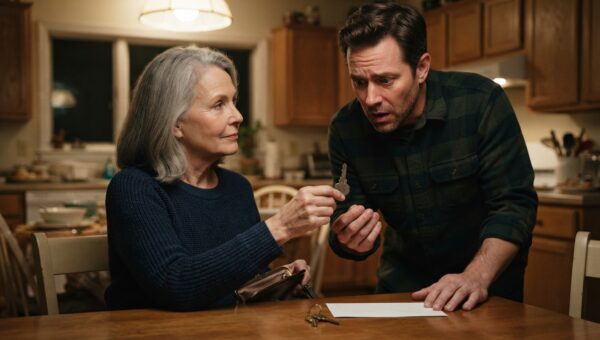
I laid the yellow birthday card flat on the floral tablecloth, right next to the napkin holder. Beside it, I placed the Marion General Hospital birth record.
Wallace turned from the sink, drying his hands on a dishtowel. When his eyes dropped to the paper with the pink yarn kitten, his hands stopped moving entirely.
He didn’t speak. He slowly walked over to the table, pulled out his regular chair, and sat down. He put both palms flat on the wood on either side of the card, his thick, calloused machinists’ fingers trembling.
“The storage facility sent the renewal to me, Wallace,” I said. My voice was completely steady. “I went to Unit 48.”
Wallace looked at the card for a long time. When he finally looked up at me, his eyes were wet, but there was no panic in his face. Only a terrible, bone-deep exhaustion.
“I wondered when the Lord was going to make me tell you,” he whispered.
“Who was Evelyn Vance, Wallace?”
Wallace pressed his thumbs against the edge of the table. “She was a receptionist at the machine supply house in Marion. In the winter of 2001, when the plant laid off the third shift and I was driving down there three days a week picking up wholesale tooling. I was forty-eight years old, Martha. You were working doubles at the nursing home, the boys were gone, and I felt like an old machine that nobody needed anymore.”
He closed his eyes, two tears cutting slow paths down his weathered cheeks.
“It lasted three weeks,” he said. “That was all. In February of 2002. I stopped seeing her the second I realized what a fool I was. I came home, I got on my knees in the garage, and I begged God to take my life before I broke your heart. But in May, Evelyn called my personal cell from the clinic. She told me she was pregnant.”
“And you never told me,” I said.
“I wanted to,” Wallace whispered, his voice cracking. “I came home that night intending to pack my bags and tell you everything. But when I walked in, you had just received the call that your sister had terminal leukemia in Michigan. You were crying on this very kitchen floor. You had four years of taking care of your sister ahead of you, and I couldn’t do it. I was a coward, Martha. I was terrified of losing you, and I was terrified of what our boys would think of their father.”
“What about the clothes, Wallace? What about the yellow crib?”
Wallace reached out with one shaking finger and touched the card.
“Evelyn didn’t want me in Hannah’s life,” he said. “Her father was a preacher in Hardin County. When Hannah was born, her father told Evelyn that if she ever brought a married machinist into their home, he would cast her out. Evelyn made me sign an informal agreement. I had to pay five hundred dollars a month through an attorney in Marion, and I was forbidden from visiting the house or contacting the child until she was eighteen.”
“So you built a nursery in a storage locker?”
“I had nowhere else to put her,” Wallace wept, putting his face in his hands. “Every year on her birthday, I bought her a dress from the catalog. I went out there every Friday at four o’clock after my shift, and I swept that concrete floor. I sat in that folding chair by the crib, and I prayed that someday she would want to know who her dad was. When she turned eighteen in twenty-twenty, I went to Marion. Her mother had married a farmer and moved out to Iowa ten years earlier. The lawyer told me Hannah didn’t know anything about me.”
Wallace looked up at me, his chin shaking violently.
“I was going to clear it out last summer,” he said. “Before my head started getting bad. But every time I put the key in that padlock, my feet wouldn’t move. I felt like if I threw those clothes away, I was throwing away the only proof that she existed.”
ENDING
We did not shout that night.
We sat at that oak table until midnight, two old people looking at the wreckage of an old sin that had been hidden under thirty years of clean laundry and steady paychecks.
I did not file for divorce. When you are seventy years old and the man who hurt you cannot remember what he ate for breakfast forty minutes ago, walking away does not bring justice. It only leaves you bitter in an empty house.
The next morning, I took my Buick back out to Oak Ridge Self-Storage.
I did not ask Wallace to come with me. I backed my car right up to the roll-up door of Unit 48.
I spent four hours carrying the boxes out into the daylight. I took the small white dresser, the yellow crib, and every single dress with the store tags still attached. I drove them across town to the county women’s shelter on Walnut Street.
The director, an older woman named Sister Agnes, met me at the loading dock. When she saw the yellow flannel blankets and the neat rows of little girl coats, she took my hands in hers and thanked me for blessing families who had nothing.
I did not tell her where the clothes came from. I told her they were a gift from an old family account that was finally closed.
I kept only two things from that locker.
I kept the birth certificate for Hannah Grace Vance, and I kept the yellow card with the kitten. I put them in an envelope in my own cedar chest at the foot of our bed, filed under my own name.
Three weeks ago, I hired a private investigator in Marion for three hundred dollars to find an address in Iowa.
Her name is Hannah. She is twenty-four years old now, working as an ultrasound technician in Des Moines, and she has her father’s straight, heavy jawline.
I wrote her a four-page letter. I did not ask her to come to Ohio, and I did not ask her to forgive Wallace. I simply told her that her father was an old man who had loved her from sixty miles away, that he had never missed a single month of support, and that if she ever wanted to see the letter he wrote on her first birthday, the door to our kitchen was unlocked.
She hasn’t written back yet, and that is her right.
Wallace’s memory is fading faster now. Some days he calls me by his mother’s name, and he needs help buttoning his flannel shirts in the morning.
Last Friday at three-thirty, he stood near the garage door with his car keys in his hand, looking confused by the light.
“Martha,” he said, rubbing his temple. “Don’t I have somewhere I need to be at four o’clock?”
I walked over, took his keys gently from his fingers, and hung them on the wooden peg by the door.
“No, Wallace,” I told him, taking his arm and leading him back toward the warmth of the kitchen. “You’re done with that now. You’re already home.”