PART 1
My mom spent every single Christmas with my younger sister, Laurie, for the last nine years.
I never made a fuss about it. Laurie has three kids, ages seven, ten, and twelve, and I never had children. In our family, the unspoken rule was simple: holidays belonged where the toys were unwrapped on the living room rug. Every December twenty-fourth, I drove over to Laurie’s house in time for dinner, sat on the folding chair near the radiator, helped clean up the wrapping paper on Christmas morning, and then drove back to my quiet house by noon so Laurie’s in-laws could have their turn.
It stung sometimes, but I told myself it made practical sense. My mother, Evelyn, was seventy-one, and traveling between two houses in winter was getting hard on her knees.
Then, on the second Tuesday of December, my phone rang at work.
“Joyce,” Mom said, not bothering with hello. “I’m coming to your place for Christmas this year. Just you and me.”
I held the desk phone against my shoulder while I stamped an invoice. “Did Laurie change her travel plans?”
“No,” Mom said. Her voice sounded thin, like she was talking with her hand partially over the receiver. “I told her this morning I wasn’t coming. I’ll take the regional bus into town on the twenty-third. You don’t have to cook a turkey. Just buy some of that peppermint tea we used to drink.”
I didn’t press her. When Mom made up her mind, asking questions only made her dig in deeper.
But after I hung up, a cold knot formed right behind my ribs. Laurie had called me three days earlier complaining that Mom was being stubborn about her checking account, but that was normal weekly bickering between them. They lived six miles apart in Mansfield; Laurie managed Mom’s doctor appointments, grocery runs, and utility bills. For Mom to walk away from Laurie’s house at Christmas meant something had broken.
I spent the next week getting the house ready. I aired out the spare bedroom, washed the floral sheets, and stopped at three grocery stores until I found the exact tin of loose peppermint tea Mom liked. In the bottom of my hallway closet, behind two bins of winter coats, I even dug out the old five-hundred-piece wooden puzzle of a snow-covered covered bridge that my dad and I used to assemble on the dining table when I was in grade school.
Dad had passed away twelve years ago from heart failure, and we hadn’t touched that puzzle since his memorial service.
Mom arrived on the afternoon of the twenty-third carrying one small burgundy suitcase and a worn black shoulder bag. She looked smaller than she had in August. Her shoulders were pulled up toward her ears, and she didn’t take off her wool coat until she had checked the lock on my front door twice.
That evening, after we finished bowls of chicken and rice soup at my kitchen counter, I boiled water for tea. I set the mugs down and brought out the wooden puzzle box, setting it gently between us.
“Look what I found in the hall closet,” I said, trying to lift the heavy air in the room.
Mom looked at the picture on the box. Her chin trembled for a second, but she didn’t smile. Instead of opening the puzzle, she reached into her shoulder bag and pulled out a long, heavy manila envelope.
It was sealed with two strips of clear packing tape across the clasp.
“Your sister thinks I’m here because we had a fight about her husband’s truck,” Mom said quietly. “That’s not why.”
She pushed the envelope across the formica tabletop.
My name was written across the front in my mother’s neat, upright handwriting. But right underneath it, written in faint, pencil block letters that had faded over years, was my father’s name: Robert E. Miller.
“Open it,” Mom said. “I should have given it to you in 2014, but I was scared of what it would do to your sister.”
PART 2
The tape on the envelope was yellowed along the edges. I used a butter knife from the drying rack to slit the paper open.
Inside was a legal-sized document folded into thirds, backed by blue cardstock, and a stack of fifteen bank receipts clipped together with a rusted paperclip.
The top document was a title deed for the four-acre parcel of land out on Route 9, where my father had run his small tractor repair shop until he got too sick to lift the wrenches. When Dad died in 2012, Laurie had handled the probate paperwork with an attorney from her church. She had told me at the time that Dad died with nearly forty thousand dollars in unpaid medical debt from his hospital stays, and that the repair shop land had to be surrendered to the county credit union to clear the lien.
I remembered that conversation clearly. Laurie had sat in my living room with a red folder, crying into a paper napkin, telling me we were lucky the bank didn’t come after Mom’s house. I had signed the probate waiver without reading the attachments because Laurie was the organized sister with the business degree, and I was just an inventory clerk who trusted her.
I looked down at the paper in my hands.
It was not a foreclosure surrender. It was a deed of transfer dated May 14, 2014. The grantee line did not say the credit union. It said Miller Ridge LLC, an entity registered to Laurie and her husband, Greg. The purchase price listed on the county transfer stamp was exactly one dollar.
“Dad didn’t have a lien on that shop,” I said, my voice barely carrying across the table.
“He owed six thousand dollars on an old equipment loan,” Mom said. She kept her hands wrapped around her hot mug, looking down at the dark tea. “That was all. Laurie told me the shop was an eyesore and that the taxes would ruin me after Dad was gone. She said she and Greg would take the title into their company name just to hold it, so the county wouldn’t assess it while Dad’s estate was open. She told me she was protecting your share, too.”
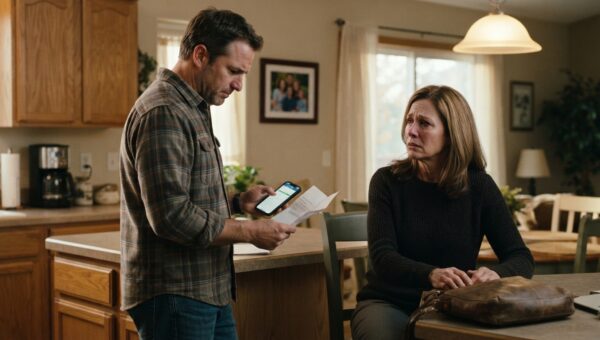
“What are these receipts?” I asked, touching the clipped stack of paper.
“Every month for eight years,” Mom said, “a company called Buckeye Tower Solutions deposited fifteen hundred dollars into an account Laurie set up for the LLC. Dad leased the back corner of that four-acre lot for a regional cell tower back in 2009. The lease had a twenty-year term. Laurie told me the tower company went bankrupt after Dad died.”
I pulled off the rusty clip. The receipts were quarterly distribution summaries from Buckeye Tower Solutions, addressed to Miller Ridge LLC.
Fifteen hundred dollars a month. Eighteen thousand dollars a year. Over eight years, that was one hundred and forty-four thousand dollars in pure ground rent.
“How did you get these, Mom?”
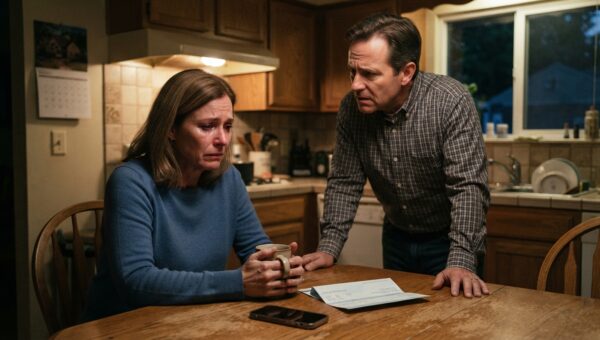
“Two weeks ago, Greg left his work briefcase on my kitchen counter when he came to fix my storm window,” Mom said. “He asked me to find his tape measure in the front pocket. The envelope was in the bottom divider. Laurie had printed the tax schedule for the LLC. Beside each quarterly payment, she had written in pencil: ‘Joyce loan repayment.’ She told Greg that the money was reimbursing them for debts you ran up after college.”
My throat felt dry. “I worked thirty hours a week to pay my own community college tuition. I never borrowed a dime from Laurie or Greg. Not one nickel.”
“I know that,” Mom said. “Your father knew that, too. That’s why Dad wrote the note on that envelope before he died. He knew Laurie had a way of convincing people that whatever she wanted was only fair.”
PART 3
At seven o’clock on Christmas Eve morning, my front doorbell rang three times in rapid, angry bursts.
I looked through the peephole. Laurie was standing on the porch in her heavy navy parka, her car keys hooked around her thumb. Her minivan was idling at the curb, exhaust pluming white in the freezing morning air.
I opened the door, but I didn’t step back to invite her inside.
“Where is she, Joyce?” Laurie said, pushing past me into the small entryway before I could stop her. “She isn’t answering her flip phone. The kids have been crying since yesterday because she isn’t there to help bake the gingerbread houses. Do you have any idea how selfish this is?”
Mom walked out of the guest room. She was fully dressed in her brown slacks and wool cardigan, her hair brushed straight back.
“I turned the phone off, Laurie,” Mom said from the hallway.
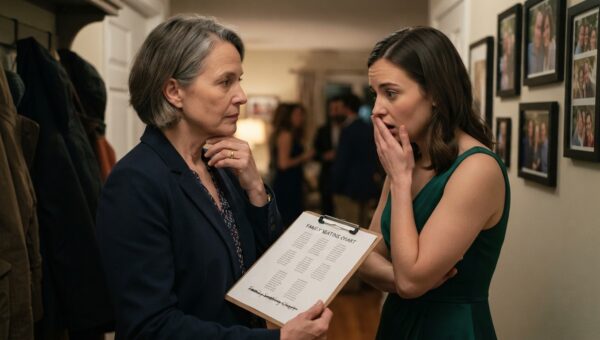
Laurie took a deep breath, her face softening into that familiar, practiced look of weary patience she always used with our mother. “Mom, you’re seventy-one years old. You can’t just take an intercity bus in the middle of winter without telling Greg or me. We had an arrangement. You’re supposed to be at our house. Come on, put your coat on. Greg is waiting down at the pharmacy.”
“I saw the tax return for Miller Ridge, Laurie,” Mom said.
The entryway went completely quiet. The only sound was the hum of the refrigerator in the kitchen behind us.
Laurie didn’t blink. She looked at Mom, then slowly turned her eyes toward me. “Did you put her up to this, Joyce? Is this what you do the one year you get her to yourself? You rifle through our private tax papers?”
“Greg left the papers on my counter,” Mom said, her voice rising with a firm, sharp tone I hadn’t heard from her since Dad was healthy. “You told me the credit union took your father’s shop. You told Joyce there was forty thousand dollars in hospital bills. Dad’s medical bills were covered under his union supplement, Laurie. You took that land for one dollar, and you’ve been taking fifteen hundred dollars every month from that cell tower company while I had to ask you for sixty dollars every time I needed my heart prescription refilled.”
“We paid the property taxes!” Laurie shouted, her face turning red above her coat collar. “We maintained that dirt! We cleared the brush! We took care of you for nine years, Mom! Joyce lived three hours away, working her little retail job, while I drove you to every single cardiologist appointment in Mansfield! We earned that land!”
“You didn’t earn it,” I said, stepping between Laurie and our mother. “You lied on a county probate filing. You told the probate court the estate had zero real property value because you transferred the deed to your own LLC before the final estate inventory was submitted. That is fraud, Laurie. You didn’t just take Mom’s income. You stole Dad’s name.”
Laurie laughed, a harsh, dismissive sound that bounced off the hallway walls. “Good luck proving anything from twelve years ago, Joyce. Dad signed that transfer intent before he went on the ventilator. The lawyer notarized it.”
“Dad didn’t sign it for you to keep,” Mom said.
She walked forward and handed Laurie the yellowed manila envelope.
Laurie looked down at the envelope. When she saw Dad’s faint pencil block letters across the lower half, her mouth snapped shut.
Inside the envelope, behind the deed and the receipts, was a one-page handwritten memo on yellow legal paper, signed by my father on October 12, 2012, two weeks before his final hospitalization. It had been witnessed by his shop mechanic, Roy Patterson.
In plain, blunt language, Dad had stated that the shop parcel on Route 9 was to be held by Laurie only as an administrator, with the cell tower lease income divided equally: fifty percent to Evelyn for her living expenses, twenty-five percent to Laurie, and twenty-five percent to Joyce. At the bottom, Dad had written: “If this division is not honored by Laurie, the land must be sold immediately and proceeds divided by three.”
Laurie’s fingers tightened on the paper. “Roy Patterson died six years ago, Mom. This isn’t a recorded trust.”
“No,” I said. “It’s not. But the county prosecutor’s office on Park Avenue opens on Friday morning. I called an estate attorney in Mansfield yesterday afternoon while Mom was resting. He told me that when a family executor conceals a commercial lease during estate administration and transfers title to a personal LLC for nominal consideration, the statute of limitations for probate fraud doesn’t start until the fraud is discovered.”
Laurie looked at me. For the first time since she had walked through the front door, the irritation drained right out of her face. She looked down at the paper, then back at our mother.
“You’re going to ruin my family at Christmas?” Laurie whispered. “Over an old tractor lot?”
“You ruined this family twelve years ago,” Mom said. “Now take your car keys and go home to your children. I am staying with Joyce.”
ENDING
Laurie left my house at seven-forty that morning without another word. She didn’t slam the front door; she closed it with a soft, careful click, like someone trying not to wake a sleeping baby.
We didn’t go to the county prosecutor on Friday.
My attorney met with Laurie and Greg’s lawyer in Mansfield on the second week of January. Greg was terrified of what a public fraud filing would do to his commercial contracting business, so they didn’t fight the restructuring. Under the settlement agreement we signed in February, Miller Ridge LLC was formally dissolved. The four-acre parcel on Route 9 was deeded directly into Mom’s name, with the cell tower lease payments redirected into an independent living trust.
Laurie and Greg were required to repay thirty-six thousand dollars into Mom’s trust account over the next three years to cover the money they had withheld from her living expenses.
Mom never moved back to Mansfield.
In April, we sold her small house on Third Street and used her share of the proceeds, along with her monthly cell tower income, to buy a small two-bedroom garden apartment four blocks away from my house. She walks over to my place every Tuesday and Thursday afternoon.
Laurie sends Mom a card on Mother’s Day and her birthday, but they do not speak on the phone. The grandkids come to visit Mom for one weekend every summer; they take the bus down together, and Mom takes them to the diner on Main Street for pancakes, but Laurie stays in the car when she drops them at the station. It is a quiet, distant peace, but it is an honest one.
Last night, Mom and I finally finished that five-hundred-piece wooden puzzle of the snow-covered covered bridge.
It took us three weeks of working an hour after dinner, fitting the weathered red planks and the dark pine trees together piece by piece on my dining table. When we put the last corner piece in place, Mom sat back in her chair and wiped her hands on her apron.
She reached across the table, touched my wrist with her dry, warm fingers, and smiled.
“Your father always said the truth is like an old wrench,” she said softly. “It takes a little muscle to turn, but once it catches, everything else comes loose.”