PART 1
My wife, Brenda, started keeping her phone face down on the kitchen counter after twenty-two years of leaving it anywhere.
For more than two decades, our life in Lima, Ohio, had zero locks on it. We shared a tablet on the coffee table. Her cell phone usually sat screen-up next to the butter dish or on the arm of the recliner while she folded towels.
Then, around the middle of September, the routine changed. If she set the phone down to stir soup, the glass was against the granite. If the screen buzzed while we watched the evening news, she covered it with her palm before sliding it into her cardigan pocket.
I noticed, but I did not snoop. When you have been married twenty-two years, you give the woman you love room to breathe. I figured it was something about her sister Carol, or maybe early plans for my fiftieth birthday in December. I told myself that good marriages do not turn into police interrogations over a turned-over telephone.
Then, on a Tuesday morning in early October, our bank called.
I was at my workbench behind the house, putting fresh oil on the garden tiller, when my cell phone rang. It was an assistant manager named Karen at Buckeye Community Bank, where Brenda and I had kept our joint savings since 2004.
“David,” Karen said, her voice dropping into that careful tone bankers use when they suspect elder fraud or an online scam. “I am looking at a pending electronic wire transfer for $9,800 from your secondary money market account. It is going to an individual account at a credit union in Fort Wayne, Indiana. We just needed verbal confirmation from you before we release the hold.”
The grease rag in my hand went still. “Who is the recipient, Karen?”
“The name on the receiving account is Wayne Vance,” she said.
The name meant nothing to me. Not a relative. Not a contractor. Not a medical billing service.
“Put a temporary freeze on it for two hours,” I told her. “Let me speak to Brenda.”
When I walked through the mudroom door, Brenda was at the kitchen sink, washing celery stalks. She was fifty-one, still wore her hair pinned up with the tortoiseshell clip I bought her in Gatlinburg for our fifteenth anniversary, and still looked like the quiet, sensible woman I had fallen for at a church softball picnic.
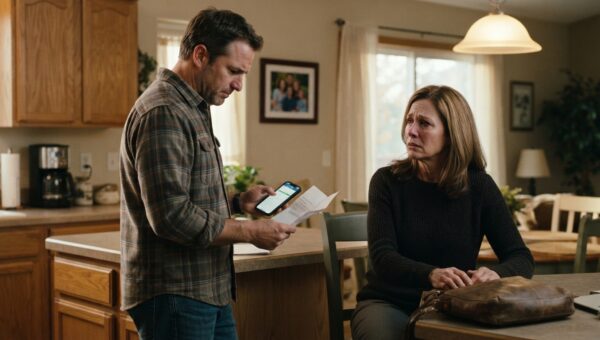
“Brenda,” I said, leaning both hands on the island. “Buckeye Community called. Did you authorize a $9,800 wire to somebody named Wayne Vance?”
The celery stalk snapped between her fingers. She did not turn around immediately. When she finally faced me, her face was completely drained of color, her apron strings pulled tight against her waist.
“It is for a family emergency, David,” she whispered.
“What family?” I asked. “Your mother has been gone four years. Carol is in Phoenix with her husband. Who is Wayne Vance, Brenda? That is almost every dollar in our rainy-day fund.”
“Please don’t ask me to explain right now,” she said. Her hands shook so hard she had to grip the edge of the stainless steel sink to keep them steady. “It is an emergency. It is not what you think. I need you to trust me. Just this once, David, please do not block that transfer. If I don’t send it, something terrible is going to happen.”
I wanted to trust her. Every instinct built over twenty-two years of shared morning coffee, shared car notes, and shared quiet evenings told me my wife was an honest woman. So I called Karen back and authorized the release of the $9,800.
For seven days, the house felt like an empty church. Brenda barely ate. She kept her phone in her apron pocket from sunrise until bedtime.
Then came the following Tuesday evening.
Brenda told me she had to run to the grocery store on Cable Road for laundry detergent and milk. Twenty minutes after she drove off, I walked into the hallway bathroom and saw the yellow grocery list still lying beside the soap dispenser, along with her store discount tag.
A bad feeling settled in the middle of my chest. I took my work truck, drove toward town, and checked the grocery parking lot. Her silver sedan was not there. It was not at the pharmacy either.
I took the old bypass toward the edge of town where Route 30 meets the county line. Tucked behind a closed diner sat the Pines Motel, a low, concrete-block strip with chipped green doors and weeds pushing through the cracked asphalt.
Her car was parked in the far corner, tucked underneath a dead willow tree.
I pulled my truck along the side gravel, cut my headlights, and walked over.
Brenda was sitting in the driver’s seat of our sedan. The engine was off. Both hands were over her face, and she was crying so hard her whole upper body jerked against the seatbelt.
I tapped twice on the driver’s side glass.
She gasped and dropped her hands. She looked terrified, not guilty. She scrambled with the door lock, pushing the door open just enough to speak.
“David, what are you doing here?” she choked out. “You shouldn’t have followed me.”
Before I could ask her about the motel, the $9,800, or why she was crying in the dark, the green door of Room 14 opened.
A teenage boy walked out into the chilly evening air. He was tall, thin, wearing a faded black hoodie, and carrying an army-green duffel bag over one shoulder. He had a faint dark bruise along his left cheekbone.
He did not look at me. He walked straight up to my wife’s open car door.
“Mom,” the boy said, his voice cracking with pure exhaustion. “He found me again.”
Brenda closed her eyes. Two fresh tears cut down through the dust on her cheeks. She turned her head toward me, her voice barely a whisper in the cold.
“I should have told you before we got married,” she said.
PART 2
The night air felt like ice water in my lungs.
Twenty-two years. In all our talks about children during our twenties and thirties, Brenda had always said she wanted to focus on us. When my brother had his three boys, Brenda bought them birthday presents and attended their ball games, but she never lingered in the nursery. She had always told me she was content with the two of us.
Now a boy with her exact dark, deep-set eyes and straight nose was standing on the gravel of a seven-dollar-a-night motel calling her Mom.
“Get in the car, Sean,” Brenda told him quietly.
She turned the ignition, unlocked the passenger side, and looked at me through the open window. “David, follow us back to our house. Please. Do not make a scene here.”
The drive back along Route 30 was forty minutes of dead silence behind the wheel of my truck. My headlights stayed locked on the rear bumper of our sedan. My mind ran through every year of our marriage, picking through old memories like broken glass. Had she been leaving town? Had she been taking trips I didn’t know about? Nothing fit. Brenda worked thirty hours a week at the county clerk’s office. She came home at four-thirty every afternoon. She helped me weed the tomatoes. She cooked pot roast on Sundays.
When we pulled into our driveway, Brenda led the boy directly into the kitchen.
The boy set his canvas duffel bag by the refrigerator. Under the bright overhead kitchen light, I could see how thin he was. His wrists stuck out of his hoodie sleeves, raw and red from the cold. He looked around seventeen or eighteen, his face marked by the shadow of a new beard and that yellowing bruise on his cheek.
Brenda took off her wool cardigan with stiff, clumsy motions and filled the electric kettle.
“Sit down, Sean,” she said.
The boy sat on the wooden stool where my brother usually sat during football games. He looked down at the linoleum, keeping his hands jammed deep into his front pockets.
I stood against the counter, right next to the wall calendar where Brenda had written dentist appointments and oil changes in neat pencil.
“Start talking, Brenda,” I said. My voice was level, but it was hard. “Who is this boy, and where did that $9,800 go?”
Brenda poured boiling water over a single tea bag, pushed the mug toward the boy, and then leaned both elbows on the countertop. She looked directly at me.
“His name is Sean Vance,” she said. “He turned seventeen in August. I gave birth to him at St. Rita’s Hospital on November 14, 2008.”
The numbers hit me in the chest like an anvil.
“Brenda, we were married in 2004,” I said. “You were living in this house in 2008. We remodeled the kitchen in 2008.”
“I know,” Brenda whispered. She did not look away. “In the spring of 2008, while you were working that four-month turn-around job at the refinery in Toledo, I went to Dayton for what you thought was Carol’s gall-bladder recovery. It wasn’t Carol. An old boyfriend from before I met you, Wayne Vance, had tracked me down at work. Wayne was fifty years old, running illegal sports betting out of a pool hall in Fort Wayne, and he had records from my early twenties that he threatened to bring to you.”
She swallowed hard, her throat clicking in the quiet room.
“I made a terrible, cowardly choice, David. I met him in Dayton to pay him off with my personal savings to keep him quiet about my past. While I was there, he trapped me in a motel room. When I realized I was pregnant that summer, I wanted to jump off the bridge over the Ottawa River. I knew the child was Wayne’s because you and I had not been together during those months. When Sean was born at the county hospital under an assumed name, Wayne came with an attorney. He made me sign an informal custody agreement and surrender every maternal right, or he was going to walk into your family’s church on a Sunday morning and hand you the photographs.”
I looked at the boy on the stool. Sean did not look up from his mug of tea.
“You gave a baby to that man?” I asked.
“I was twenty-six years old and terrified out of my mind,” Brenda cried, her voice finally breaking. “I thought if you knew, you would throw me out on the street. Wayne told me he had an aunt in Indiana who would raise Sean with proper money. He swore to me on his mother’s grave that the boy would have a decent home and that I would never hear from either of them again. I gave him twelve thousand dollars of my own pre-marriage savings that day, and I came back to this kitchen and pretended my life had not ended.”
PART 3
“And the $9,800 last week?” I asked. “Wayne came back after sixteen years?”
The boy, Sean, spoke up before Brenda could answer. His voice was deeper than I expected, raspy and worn.
“Wayne didn’t raise me,” Sean said. He pulled his hands out of his hoodie pockets and laid them flat on the kitchen table. His knuckles were raw and split. “He kept me in a rental house outside Fort Wayne with three different girlfriends over the years. When I was eleven, he figured out Brenda was married to a man who owned land. Every couple of years, Wayne would tell me my real mother was a rich lady in Ohio who dumped me in a trash bin.”
Sean looked at Brenda, his jaw tight. “Two weeks ago, Wayne took a six-thousand-dollar beating in a garage behind a racetrack. He came home with two cracked ribs, tore my mattress apart looking for my summer paycheck, and said if I didn’t get him ten thousand dollars by Friday, he was going to take a crowbar to my knees and then drive to Lima to burn your barn down.”
“Wayne sent Sean to my office on Monday,” Brenda said. She pulled a folded piece of paper from her apron pocket and pushed it across the counter to me.
It was a bank deposit receipt from the Fort Wayne credit union, dated October 8. On the back, written in thick black marker with heavy, uneven strokes, was a note:
“9,800 clears the interest. The principal is 25,000. Send Sean back with the rest by the 20th or David gets the 2008 hospital log and the photographs in his mailbox.”
I looked from the note to the boy.
“Why did you leave the motel room tonight?” I asked Sean.
Sean pulled the collar of his hoodie aside. On the side of his neck was a fresh, purple thumbprint bruise.
“Wayne tracked my burner phone to the Pines Motel an hour ago,” Sean said. “He called the front desk clerk and told him he was coming down Route 30 with two guys in a pickup to drag me back to Indiana. I grabbed my bag and ran out to Brenda’s car just as you tapped on the glass. He thinks Brenda has the rest of the twenty-five thousand.”
The kitchen went dead quiet again. The electric kettle clicked off with a sharp snap.
Brenda looked at me with her hands open, empty and defeated. “I was going to ask you to take another loan against the truck tomorrow, David. I was going to give him the twenty-five thousand to keep him away from you. I didn’t know what else to do.”
“You don’t pay blackmailers, Brenda,” I said. The anger that had been simmering in my chest since Karen called from the bank suddenly burned cold and clear. “You pay a blackmailer once, they own your house. You pay them twice, they own your grave.”
I walked over to the landline phone mounted on the wall beside the pantry.
“David, please,” Brenda cried, reaching for my forearm. “If you call the police, Wayne will tell everyone in Allen County what happened in 2008. Your brother, your pastor, the guys at the lumber yard. They will all know.”
“Let them know,” I said.
I picked up the receiver and dialed the personal cell number of Tom Hendricks. Tom had been my high school defensive tackle in 1991, and he had spent the last nine years as a senior detective with the Allen County Sheriff’s Department.
Tom picked up on the fourth ring.
“Tom,” I said, keeping my eyes fixed on the green duffel bag by the refrigerator. “I have a seventeen-year-old runaway sitting in my kitchen with interstate extortion threats and battery marks on his neck. His father is on his way down Route 30 right now in a pickup truck to collect twenty-five thousand dollars from my wife.”
Tom didn’t ask twenty questions. He told me to keep the deadbolts locked, turn off the front porch light, and wait inside.
Twenty minutes later, two unmarked cruisers and a county squad car pulled into the gravel drive of the abandoned diner across from the Pines Motel, right at the bypass ramp.
Wayne Vance never made it to my kitchen door.
A state trooper pulled his beat-up Chevy pickup over two miles north of our road for an expired Indiana commercial tag and a broken tail lamp. When the deputies searched the cab, they found an unlicensed .38 revolver under the driver’s bench, four bundles of cash from the Fort Wayne credit union wire, and three printed copies of Brenda’s 2008 hospital records sitting on the passenger seat in a manila folder.
ENDING
Wayne Vance was indicted three weeks later by a federal grand jury in Toledo for interstate extortion and felon in possession of a firearm. With his prior convictions in Indiana for aggravated assault and illegal gambling, the prosecutor told us Wayne would be looking at eight to ten years in a federal penitentiary before he ever saw a parole board.
The $9,800 wire transfer was frozen by court order as evidence of an ongoing extortion scheme. It took four months of paperwork and three signed affidavits from our bank manager, Karen, but in February, the funds were fully restored to our money market account.
Sean did not go back to Indiana.
Because he was within nine months of his eighteenth birthday and had documented physical abuse from Wayne, the county juvenile court placed him under a temporary kinship protective order. Brenda and I set up the spare bedroom upstairs, the one we had used for twenty years to store winter blankets and old canning jars.
I bought him two pairs of heavy work boots, three flannel shirts, and a used toolkit from the hardware store. Every afternoon after he finished his adult diploma classes at the technical center, he came out to my workshop. He didn’t talk much at first. He just stood by the wood lathe, watching how I planed cedar boards and sharpened chisels. But by December, he was measuring fence posts without being asked.
Brenda and I did not have an easy winter.
For two months, we slept on opposite sides of our queen bed, separated by twenty-two years of silence and the truth she had carried alone in the dark. We sat in a small counseling room at the family services office every Thursday evening, working through the shame that had made her hide her past and the betrayal that had cut through my trust.
Forgiveness in a long marriage does not come in a single afternoon. It comes in inches, like snow melting off a barn roof.
Yesterday afternoon, Sean turned eighteen.
We didn’t have a big party. Brenda baked a chocolate sheet cake with yellow frosting, and we ate it around the kitchen table after supper. When we finished, Sean handed me an official blue envelope from the county probate court.
He had filed a petition on his own eighteenth birthday to legally drop the name Vance. Underneath the state seal, his new driver’s license application was printed with the name Sean David Miller.
Brenda wiped her eyes with the corner of her kitchen towel and walked over to the sink to clear the plates. For the first time in six months, her phone was lying on the counter right beside the fruit bowl, face up, screen dark, with nothing left to hide.