PART 1
My daughter asked me not to wear my wedding ring to her engagement party because her fiancé’s family might think I was showing off.
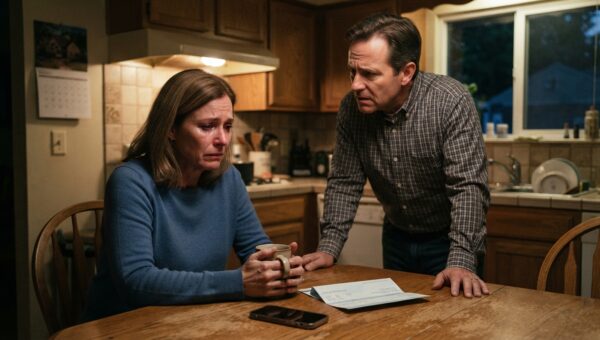
We were standing in my kitchen on a Wednesday evening while I packed leftover roast beef into plastic containers for her. Brooke was twenty-six, working as a junior stylist at a boutique salon in Columbus, and getting ready to marry a young commercial real estate broker named Spencer.
“Mom, please,” Brooke said, leaning against the counter with both hands wrapped around her paper cup of coffee. “Spencer’s mother has very particular tastes. You know how modest they like to keep things. Your ring is just… loud. It doesn’t match the rest of your outfit. If you wear it, people are going to think you’re trying to make a statement about having old money. Just help me keep things comfortable.”
I looked down at the ring on my left hand.
It was small, delicate, and thirty-nine years old. My late husband, Thomas, had worked double shifts at the rail yard in 1987 to buy the thin platinum band with three small round diamonds set between tiny scrollwork leaves. The stones were clean, but they were barely a quarter-carat each. Nobody in their right mind would call that ring extravagant.
I had spent forty years being the person who kept the peace in our family, so my first instinct was to swallow the hurt again.
When Thomas died six years ago, I didn’t push Brooke about her college loans or her apartment deposits; I covered them quietly from my widow’s pension and kept my head down. I didn’t want one awkward moment over jewelry to turn into a family war right before her wedding.
Looking back, there had been smaller signs over the summer, but this was the first one I couldn’t explain away.
In August, when Brooke went dress shopping, she invited Spencer’s mother and two of Spencer’s cousins, but texted me afterward saying the boutique only allowed four chairs in the viewing suite. Last month, when Spencer’s parents hosted an informal barbecue at their country club, Brooke told me the gate code was only for immediate wedding party members. Every time, she had that same smooth excuse ready: “Just help me keep things comfortable.”
Then I found the one thing that made me stop making excuses.
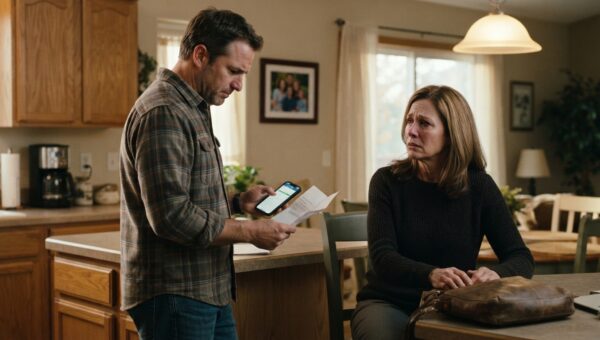
On Friday afternoon, Brooke came by my house to drop off the favor bags for Saturday’s party and left her planner binder open on my dining table while she ran to the pharmacy.
Tucked inside the plastic divider was the formal seating and photography chart for the country club ballroom.
There was a diagram of the head table. Spencer’s parents were seated directly beside the couple.
Underneath the diagram was a handwritten list titled “Family Formal Photos.”
My name, Martha Evans, had been scratched out with blue ballpoint ink from the front row next to the bride. Beside the scratch mark, Brooke had written in pencil: Move Mom to group shot 4, back row corner.
I stared at that pencil line until my eyes burned.
I told myself I only wanted one clear answer. I almost called Brooke to say I had a migraine and was staying home. But on Saturday morning, my late husband’s sister, Clara, drove over to drop off an ironed blouse and saw me sitting at the kitchen table in my bathrobe.
Clara took one look at the seating chart, set her car keys on the counter, and crossed her arms. “You get dressed, Martha.
You put on that ring your husband bought you, you walk into that clubhouse, and you sit where you belong. If Brooke is embarrassed by her own mother, she can look you in the face and say it in front of God and the caterer.”
I didn’t decide what to say during the forty-minute drive to the club. My stomach was in knots the whole way down Route 23.
When Clara and I walked into the private dining room, the room was filled with white hydrangeas and silver tablecloths. Brooke was across the room by the champagne bar, wearing an ivory lace dress. Spencer’s mother, Eleanor, was standing next to her, holding court in a navy silk suit.
As soon as Brooke spotted me, her smile tightened. She excused herself, hurried over through the round tables, and looked straight down at my left hand.
“Mom,” Brooke hissed under her breath. “I told you to leave that at home.”
Before I could answer, Eleanor walked up behind Brooke, holding two flutes of ginger ale.
“Brooke, darling, is this your mother?” Eleanor asked.
Eleanor reached out to take my hand in greeting. But the second her palm touched mine, her fingers clamped tight around my fingers. Her eyes dropped to the platinum band.
She pulled my hand up into the light of the chandelier, her knuckles turning white.
“Where did you get this ring?” Eleanor asked.
PART 2
Eleanor’s grip was tight enough to press the platinum band into my bone.
Brooke’s face flushed bright red. “Eleanor, I am so sorry. My mother doesn’t always pay attention to dress codes. I told her not to wear anything flashy tonight—”
“Quiet, Brooke,” Eleanor said. The high, polite tone she used with the guests vanished instantly.
She turned my hand over, tilting the side of the setting toward the chandelier bulbs. Her manicured thumb rubbed along the outer curve of the metal where the leaves tapered into the shank.
“Look at the engraving on the inner shoulder, Martha,” Eleanor said. She wasn’t asking; her voice was unsteady, almost breathless. “Is there a capital letter J stamped next to an acorn mark?”
I didn’t pull my hand back. “There is. My husband bought it in October of 1987 from a watchmaker named Joseph on High Street.”
Eleanor let go of my fingers. She took a step backward, nearly bumping into a waiter carrying a tray of crab tartlets. She looked at Brooke, then looked back at me, her eyes wide.
“Eleanor, what is it?” Spencer asked, walking over with his father. Spencer had a silk pocket square tucked into his jacket and a relaxed, easy smile that faded the moment he saw his mother’s expression. “Mom, is something wrong with the table arrangements?”
“Brooke,” Eleanor said, ignoring her son completely. “You told me your mother was a retired county dispatcher who lived in an old duplex and sold off all your family heirlooms years ago.”
Brooke took a hurried half-step toward Spencer, her fingers twisting around the strap of her small purse. “She is retired, Eleanor. I was just explaining that Mom’s side of the family doesn’t usually attend these kinds of private events.”
“You told me your family had nothing left from the estate,” Eleanor repeated. Her voice wasn’t loud, but it had a cutting, icy clarity that made two nearby couples stop talking. “You told me that when your grandmother died, your mother gave the estate jewelry to a liquidator to pay off personal credit card debts.”
I looked at my daughter.
“Brooke,” I said. “What did you tell them about your grandmother?”
My mother, Sarah Vance, had been a schoolteacher in Marion for thirty-eight years. When she died eleven years ago, she didn’t have an estate or a safe full of diamonds. She had an eight-hundred-square-foot cottage with a small garden, which Brooke and I cleaned out together over three long weekends in July.
Brooke didn’t look at me. She stared down at the cream carpet, her shoulders pulled tight toward her neck.
“Let’s step into the coat alcove,” Spencer’s father, Richard, said quietly. He put a firm hand on his wife’s elbow and nodded toward the small hallway behind the registration easel. “We don’t need forty club members listening to this.”
We walked into the alcove. Clara followed right behind me, keeping her purse tucked firmly under her arm like a shield.
The small room smelled of winter coats and dry wool. Spencer shut the interior door, cutting off the low murmur of the party.
“Mother, what does a thirty-year-old ring have to do with anything?” Spencer asked, running a hand through his hair. “If Brooke’s mom wants to wear her wedding ring, let her wear it. We need to cut the cake in ten minutes.”
“Spencer, shut your mouth,” Eleanor said.
She turned to face me. “In September of 1987, my mother, Evelyn Vance, was robbed at a gas station outside Marion. A man took her purse and her engagement ring off her finger. The ring was custom-made by Joseph Miller on High Street for my father in 1952. It had three round-cut stones and an acorn maker’s mark on the inner band. My mother filed three police reports with the county sheriff, but the ring was never recovered. My mother talked about that ring until the day she died in 2004.”
PART 3
The air in the coat alcove felt suddenly thin.
Spencer looked at his mother in shock. “You’re saying Brooke’s family stole Grandma’s ring?”
“No,” Clara said, stepping forward before Eleanor could speak again. Clara’s voice was loud and clear. “Thomas Evans never stole a nickel in his fifty-eight years on this earth, and don’t you dare fix your mouth to say his name in the same sentence as a thief.”
“Then how does she have it?” Eleanor demanded, pointing a trembling finger at my hand. “That ring was one of a kind. Joseph Miller only made one casting of that leaf pattern. He made it specifically for my father’s wedding.”
I reached up with my right hand, twisted the platinum band around my knuckle, and pulled it off my finger.
The metal felt warm from my skin.
“Look at the receipt inside my purse, Eleanor,” I said.
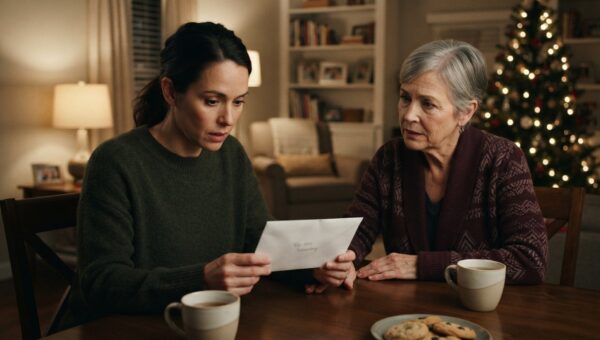
I reached into my shoulder bag and pulled out the small, clear plastic sleeve I had kept in the bottom zipper pocket for twenty years. Inside was the yellowed, carbon-copy sales slip from Miller Jewelry on High Street, dated October 14, 1987.
Thomas had kept every receipt for every major purchase in an old metal lockbox on the top shelf of our closet. When he died, I transferred the ring’s appraisal slip and the original store receipt to my wallet so I would never lose the paper trail.
I handed the slip to Eleanor.
Eleanor put on her reading glasses. The slip was made out to Thomas Evans. The description line read: Pre-owned platinum band, estate consignment, three round brilliant stones, maker mark J-acorn. The purchase price in punch-ink was $640.00.
Across the bottom line was the name of the consignor who had brought the ring into the shop to be sold for cash on October 2, 1987: Arthur Vance.
Eleanor stared at the paper. Her mouth dropped open.
“Arthur?” she whispered.
“Your brother,” Richard said, looking over his wife’s shoulder at the faded carbon ink.
“Arthur told us a man took it at gunpoint,” Eleanor said. Her hands began to shake so badly the plastic sleeve rattled against her ring. “He came home with his shirt torn. He said he tried to fight the man off by the air pump. My father gave Arthur ten thousand dollars that same month to help him replace his car and cover his medical bills from the shock.”
“Arthur sold it for six hundred and forty dollars forty-eight hours after it went missing,” Clara said flatly. “Joseph Miller was an honest jeweler. He kept consignment logs for forty years. My brother Thomas saw it in the display case, took two extra shifts at the yard to pay for it, and put it on Martha’s finger on their anniversary. There wasn’t any crime on our side of the fence.”
Eleanor slowly handed the slip back to me. The anger had completely vanished from her eyes, replaced by a hollow, sickening realization. For thirty-nine years, her family had blamed an imaginary street criminal for a loss that her own brother had manufactured to pay off his gambling debts in Marion.
Then Eleanor looked at Brooke.
“Brooke,” Eleanor said, her voice dropping to a harsh whisper. “Why did you tell me your mother’s ring was an embarrassment?”
Brooke didn’t speak. She was crying now, tears running down through her foundation makeup.
“She told you that because she found the receipt three weeks ago,” I said.
The alcove went dead silent.
“Two weeks ago, Brooke came to my house while I was at church to borrow an iron,” I told the room. “She went into my closet. She found my lockbox open on the bed. When I came home, my papers were ruffled, but I didn’t think anything of it. Brooke saw the name Arthur Vance on that slip. She knew who Arthur was because Spencer had told her the story about his uncle and the famous family robbery. She knew that if Eleanor saw this ring on my finger, Eleanor would recognize the setting.”
Brooke looked up, her chin trembling violently. “Mom, you don’t understand. Spencer’s family has been looking down on me since the day we got engaged. Eleanor checks every fork, every dress, every invitation. If she thought your family was connected to Arthur’s disgrace, she would have called the wedding off. Spencer’s trust pays for our apartment. I was trying to protect our future.”
“You weren’t protecting anyone, Brooke,” I said. “You were ashamed of me. You moved my name to the back row of your wedding photos so nobody would ask who I was.”
Spencer turned to Brooke, stepping away from her. “You went through your mother’s closet to hide an old family theft? You lied to my parents about where her money went?”
“Spencer, I did it for us!” Brooke cried, reaching for his sleeve.
Spencer pulled his arm back. He looked at his father, then at his mother, who was leaning against the coat rack looking gray and completely exhausted.
“The party is over,” Spencer said.
ENDING
Spencer walked out of the alcove, took the microphone near the bar, and told the guests that his mother had fallen ill and that the celebration was being rescheduled.
Within twenty minutes, the private dining room was empty. The waitstaff began clearing the untouched champagne flutes and boxing up the white hydrangeas.
Brooke left in an Uber by herself. She didn’t come back to my house that night, and she didn’t call on Sunday.
On Tuesday morning, Spencer’s father, Richard, came to my front door in Marion.
He didn’t bring Spencer or Eleanor. He brought a small leather box and an envelope. Inside the envelope was a formal, written apology signed by Eleanor, acknowledging that her brother Arthur had taken advantage of her parents and that she had misjudged my family based on decades of lies.
“Eleanor was too mortified to face you today, Martha,” Richard said, standing on my small front porch with his hat in his hands. “She wanted to offer you five thousand dollars for the ring to put it back in her mother’s memorial case.”
I looked down at the envelope, then handed it straight back to him.
“The ring isn’t for sale, Richard,” I told him. “My husband worked sixty hours in the rail yard through cold rain to buy that band for me. It represents his sweat, not your family’s feud. Tell Eleanor I accept her apology, but the ring stays where it belongs.”
Richard nodded, tipped his hat, and walked back to his car without arguing.
Spencer broke off the engagement two weeks later.
A cousin told me that Spencer couldn’t get past the fact that Brooke had calculated the lie, searched my private papers, and treated her own mother like an embarrassment just to secure a spot in a country club circle. Brooke moved into a smaller one-bedroom apartment near the university and picked up extra weekend shifts at the salon to cover her rent.
She called me on Thanksgiving morning.
Her voice was thin, small, and stripped of the sharp impatience she had carried all summer. She asked if she could come over for dinner, just the two of us.
I told her yes. I didn’t lecture her when she walked through the back door with a store-bought pumpkin pie, and I didn’t bring up the seating chart. But the dynamic between us had changed forever. She saw that I would not be tucked into the corner of someone else’s life just to keep the peace.
After dinner, while Brooke was washing the roasting pan at the sink, I sat at the kitchen table with a cup of black coffee.
The evening sun was coming through the window, catching the three small stones on my left hand.
The platinum was scratched along the edge from thirty-nine years of doing dishes, scrubbing floors, and holding Thomas’s hand while he was sick. It was not loud. It was not fancy.
It was just an honest piece of metal that had outlasted every lie told to bury it.