PART 1
My sister and I promised Mom we would split her care evenly after her stroke.
I took Monday through Thursday. My sister, Brenda, took Friday through Sunday. At least that was the plan we agreed on around the dining table at Lima Memorial Hospital back in March of last year.
Mom was seventy-six. The stroke had left her right side weak and her speech slow, but her mind was completely sharp.
She wanted to stay in her small yellow ranch house on Elm Street, where she had lived since 1974. I lived four miles away, worked thirty-two hours a week as a medical records clerk, and had two grown sons. Brenda lived twenty miles out in a new subdivision, worked for an insurance brokerage, and always drove an immaculate leased SUV.
For eight months, Brenda found excuses.
First it was work seminars in Columbus. Then it was weekend migraines that kept her in a dark bedroom. Then her Buick needed brake pads, or her youngest daughter had travel soccer tournaments two states away. On Friday afternoons around two o’clock, my phone would buzz with a hurried text: “Can you cover tonight? I will make it up to you next weekend, I swear.”
She never made it up. In the beginning, I called her and argued. I told her I had grocery shopping to do, that my own knees hurt from lifting Mom off the commode, and that a promise was a promise.
Brenda would cry, say I was making her feel like a terrible daughter, and hang up.
After four months of that, I stopped arguing. Arguing only upset Mom, and every time Mom got agitated, her blood pressure spiked into the red zone on the monitor. So I just did it all.
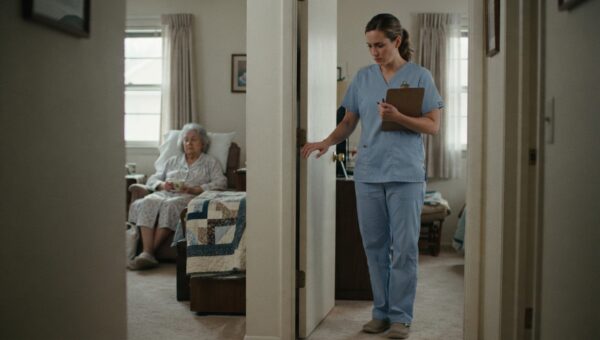
I gave Mom her sponge baths. I crushed her morning pills into applesauce. I pureed her squash, changed the bed pads at two in the morning, and sat in the vinyl recliner beside her bed when the pneumonia moved into her lungs in November.
Brenda came by for twenty minutes on Thanksgiving afternoon. She brought an expensive bakery pie, kissed Mom on the temple, took four photos on her phone, and said the smell of sickness made her nauseous before heading back out to her car.
Mom passed away on a cold Tuesday night three weeks before Christmas. I was the one holding her hand when the monitor flatlined.
Two weeks after the burial, we had an appointment at the probate attorney’s office downtown.
I arrived at nine-fifteen in my gray winter coat, my hair pulled back with a clip. Ten minutes later, Brenda walked through the glass double doors. She was wearing a tailored black wool coat, high leather boots, and carrying a new designer handbag.
When she took off her leather driving gloves, something caught the fluorescent light on her left hand.
It was Mom’s three-stone diamond ring.
Our father had bought that ring for their twenty-fifth anniversary back in 1993, working six weeks of graveyard shifts at the refinery to pay for the platinum band. Mom had kept it in a velvet box in her top dresser drawer, behind her winter scarves. I had bathed Mom every morning for eight months. Mom had never worn that ring on her swollen fingers, and I had never seen Mom give it away.
Brenda caught me looking. She didn’t drop her hands. She gave me a smooth, practiced smile and touched the center diamond with her thumb.
“She wanted me to have something special, Sarah,” Brenda said, her voice silky and soft. “She gave it to me right before she went into the hospital. You know how sentimental Mom was about family heirlooms.”
Before I could answer, the inner door opened.
The attorney, Mr. Harrison, walked into the waiting room holding a thick manila folder. He was seventy, wore wire-rimmed glasses, and had handled our father’s estate twelve years ago. He was a plain-speaking man who didn’t waste words on small talk.
He invited us into his conference room, pulled out two leather chairs, and sat behind his heavy oak desk.
As he opened the folder, his eyes dropped to Brenda’s left hand resting on the polished wood.
Mr. Harrison stopped turning the page. He adjusted his glasses, looked directly at the three diamonds, and then looked up at Brenda’s face.
“Did either of you open the envelope your mother taped inside the blue medicine cabinet?” Mr. Harrison asked.
Brenda stopped smiling.
PART 2
The room went completely silent. The only sound was the low rush of the heater kicking on behind the vertical blinds.
Brenda pulled her hand off the desk and let it drop into her lap, out of sight.
“What blue medicine cabinet?” Brenda asked. Her tone had tightened up, the easy, polished confidence slipping away. “Mom’s upstairs bathroom has a wooden cabinet with a mirror. There is no blue cabinet.”
“The old metal first-aid box in the laundry room,” I said quietly.
Mr. Harrison nodded slowly. “That is the one. Your mother purchased it at a farm sale in nineteen eighty-one. She kept her burn ointments and extra gauze rolls in there, mounted right above the utility sink behind the dryer.”
I had looked inside that metal box three times a week for eight months. Every time Mom tore her fragile skin on the walker or needed a fresh non-stick pad for her heels, I reached inside for the sterile tape.
Two weeks before Mom passed, while I was washing her flannel nightgowns, I noticed a thick white legal envelope taped flat to the inside of the door with yellow masking tape. It had my name written across the front in Mom’s shaky, left-handed slant, the awkward writing she had been forced to use after the stroke ruined her right hand.
I had not opened it. Mom was failing fast that week, struggling to swallow water, and my only thought had been keeping her warm and clean. After she died, the days blurred into funeral arrangements, casseroles from neighbors, and cleaning out the refrigerator. I had completely forgotten about the tape.
Brenda cleared her throat. “Mr. Harrison, my sister and I came here to review the will. Mom told me repeatedly that the house would be sold and the proceeds split fifty-fifty. I have the keys to the house, and I already spoke to an appraiser on Monday. We don’t need to waste billable hours talking about old first-aid boxes.”
“We are talking about it because your mother sat in that very chair six weeks ago, Brenda,” Mr. Harrison said.
Brenda’s jaw tightened. “Mom couldn’t drive six weeks ago. She was bedridden.”
“She didn’t drive,” Mr. Harrison said. “Her neighbor, Dale Evans, brought her down here in his van with her wheelchair. She paid my office a two-hundred-dollar consultation fee in cash. She spent forty-five minutes with me, signed an addendum to her estate plan, and had my notary public witness two specific documents.”
Mr. Harrison opened the left side of the folder and laid two photocopies on the desk.
The first page was an updated personal property schedule, dated November 4.
Across the first line, written in Mr. Harrison’s clean office typing, was a description of the platinum three-stone diamond ring.
Underneath, in Mom’s shaky handwriting, was a single sentence: “To be delivered directly to the estate administrator to cover outstanding home health expenses.”
“Mom didn’t have home health expenses,” Brenda said, her voice rising an octave. “The insurance paid for hospice during the final ten days. Everything else was handled by family.”
“No, Brenda,” Mr. Harrison said, looking over the top of his glasses. “The care was handled by Sarah. And your mother was well aware of that fact.”
PART 3
Mr. Harrison turned to the second document in the folder.
It was a sworn affidavit of personal property, signed by Mom and witnessed by Dale Evans and the notary.
“Your mother filed this affidavit after you visited her on the second Sunday of October, Brenda,” Mr. Harrison said.
I remembered that Sunday. Brenda had arrived unannounced at noon, stayed forty minutes, and left while Mom was supposed to be resting after her physical therapy exercises. When I came in with Mom’s broth that afternoon, Mom was sitting upright in bed with her glasses on, staring at her open dresser drawer with tears running down her cheeks. Mom had told me she was just having a bad day with her hip.
“On October twelfth,” Mr. Harrison continued, “your mother discovered that her anniversary ring was missing from the velvet box in her scarf drawer. She knew who took it because only one other person had been in that bedroom.”
Brenda’s face flushed bright red. “That is an outright lie! Mom gave me that ring! She put it in my hand and told me I deserved something nice for all the stress I was dealing with with my kids!”
“Your mother stated under oath that you took the ring from the drawer while she was in the bathroom with her walker,” Mr. Harrison said, his voice flat and unyielding. “She told me she was too weak to fight you for it. She said she did not want to cause a scene that would break her family apart while she was still breathing.”
“Then why didn’t she call the sheriff?” Brenda demanded, leaning forward in her chair, her fingers digging into the leather arms. “If she thought I stole it, why didn’t she call the police?”
“Because she was your mother,” Mr. Harrison said. “And because she chose to settle the account through her estate.”
Mr. Harrison pulled out the original will from 2018, along with the November codicil.
“The 2018 will left the house on Elm Street to both of you in equal shares,” he explained. “However, the codicil executed on November fourth contains an explicit offset clause. Your mother had the ring appraised in twenty-nineteen by a certified jeweler in Fort Wayne. The replacement value was established at fourteen thousand five hundred dollars.”
Mr. Harrison pushed a document across the desk toward Brenda.
“Under the terms of this codicil,” Mr. Harrison said, “any beneficiary who appropriates personal property without written consent prior to probate has the fair market value of that property deducted from their share of the real estate equity. Furthermore, your mother established a formal caregiver compensation agreement.”
I looked up at him. “A caregiver agreement?”
“Yes, Sarah,” Mr. Harrison said, his eyes softening. “Your mother kept a handwritten spiral notebook on the kitchen counter for eight months. Every single day, she wrote down who came to the house, what meals were prepared, what medications were administered, and how many hours were spent. She brought that notebook to my office.”
Mr. Harrison laid the spiral notebook on the table. It was the blue five-subject notebook Mom used to keep by her reading lamp.
“Your mother instructed me to bill her estate for two hundred and forty days of full-time home care at the state median rate of twenty-two dollars an hour, payable directly to you, Sarah, prior to any distribution of the house sale proceeds.”
Brenda stood up so violently her chair scraped hard against the baseboard.
“That is over forty thousand dollars!” Brenda shouted, her hands shaking. “The house is only worth one hundred and thirty thousand! If you deduct forty thousand for care and fourteen thousand for the ring, there won’t be anything left for me!”
“There will be approximately twenty-one thousand dollars remaining for your share, Brenda,” Mr. Harrison replied calmly. “Assuming the house sells at appraised value. That is the exact distribution your mother ordered.”
Brenda turned on me, her eyes wild with fury. “You put her up to this! You spent eight months whispering in her ear while she was sick, turning her against me because I had a job and a life!”
“I didn’t whisper anything, Brenda,” I said. My voice was steady, but my throat was tight. “I was too busy changing her bed sheets while you were at soccer tournaments.”
“You open that envelope in the medicine cabinet,” Brenda hissed, pointing a trembling finger at the door. “You open it right now! There has to be a letter in there! Mom would never do this to me!”
ENDING
We drove straight to Mom’s house in separate cars.
Mr. Harrison had given me the official executor certificate, and Brenda followed two car lengths behind my bumper the entire way down Route 30.
When we walked through the back door into the kitchen, the house smelled of cedar, lavender soap, and old wallpaper. It was cold; the thermostat had been set to sixty since the funeral.
Brenda marched straight past the kitchen into the laundry room. She pulled open the door of the blue metal cabinet above the utility sink.
The white legal envelope was still there, taped securely to the painted metal with yellow masking tape.
Brenda reached out, ripped the tape off, and tore the flap open with her fingernails.
Inside was a single sheet of yellow legal paper, folded twice.
Brenda unfolded it. As she read, the anger drained right out of her posture. Her shoulders slumped forward, and her hands began to drop toward the counter.
“What does it say, Brenda?” I asked from the doorway.
Brenda didn’t read it out loud. She let the paper drop into the stainless steel sink and walked past me without looking at my face. She grabbed her purse off the kitchen table, walked out the back door, and drove away.
I walked over to the sink and picked up the paper.
It was written in Mom’s awkward, left-handed slant, every letter deliberately shaped:
“Brenda, I saw you take the ring from my scarves. You thought I was asleep because my eyes were closed, but sickness does not make a mother blind. I gave you eight months of chances to show up for me. You chose your excuses every single weekend. Sarah gave me her life, her sleep, and her dignity. Wear the ring if your conscience lets you, but do not ask Sarah to give you what you never earned.”
I folded the paper, put it in my coat pocket, and turned off the laundry room light.
The house on Elm Street was sold four months later to a young couple from town for one hundred and thirty-two thousand dollars.
After the caregiver claim was settled and the closing costs cleared, the title company wired forty-two thousand two hundred dollars into my personal savings account. Brenda received her adjusted check for twenty thousand eight hundred dollars, minus the value of the platinum ring she kept.
Brenda has not spoken to me since that morning in Mr. Harrison’s office. A cousin told me she stopped wearing the diamond ring in public after people at church started asking about Mom’s estate, and that she keeps it locked in a safe deposit box.
I took eight thousand dollars of my caregiver funds and used it to pay off the remaining balance on my modest sedan. The rest sits in an emergency certificate of deposit at my credit union.
On Saturday mornings, I walk over to the cemetery on the north edge of town.
I bring a small spray of yellow carnations, the cheap flowers Mom always loved because they lasted two weeks in a jar on the windowsill. I wipe the dust off her headstone, sit on the stone bench beside the oak tree, and watch the morning sun come up over the fields.
Mom didn’t leave me a fortune, and she didn’t leave me diamonds.
She left me the peace of knowing that when someone you love needed a hand in the dark, I was the one who stayed until the morning came.