Dwayne wouldn’t even look up from the kitchen table when I dropped my car keys into the pottery bowl by the back door and told him I was heading over to the county park. He just kept scraping the burnt crust off his piece of toast with the back of a butter knife, the dry scratching sound filling the quiet house like tiny claws.
“They’re just going to ask the same old questions,” he muttered, his voice flat and heavy the way it always got whenever his people came up. “They’ve been telling the same stories since Reagan was in office, and I am not in the mood to listen to them pretend.”
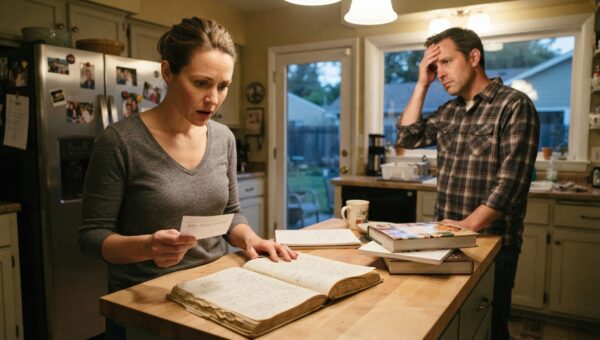
I didn’t argue with him because we’d had that exact same fight every summer for the twelve years we’d been married. He kept a faded, torn photograph folded up tight behind his driver’s license in his wallet, a little piece of paper he acted like was a state secret whenever I caught a glimpse of its corner. He always told me it was just some kid he grew up with down by the tracks, someone who didn’t matter anymore, but I knew better than to push when his jaw got that tight.
“I’m only staying an hour,” I told him, smoothing down the front of my blue linen skirt. “Aunt Martha turned ninety today, Dwayne.
If I don’t show my face, your cousins are going to call for three days straight asking if you’re dead in a ditch.”
“Tell them I’m fine,” he said, and that was the end of the conversation.
The park was packed with folding tables covered in red-and-white checkered plastic and weighed down by bowls of potato salad and metal jugs of sweet tea. Aunt Martha was sitting in a canvas folding chair right under the big oak tree, wearing a yellow cardigan that looked entirely too warm for July, watching the grandchildren chase each other through the clover. People drifted over to me right away, offering paper plates and asking why Dwayne hadn’t bothered to make the drive from town. I gave them the usual polite excuses about him having a pile of paperwork to finish up for the grain elevator, and everyone nodded like they understood, though a couple of the older cousins shared a look that had twenty years of baggage behind it.
I was standing near the edge of the shade, watching the ice melt in my cup, when a dry, papery hand caught my elbow.
“He didn’t come, did he?” Aunt Martha asked. Her eyes were milky around the edges with age, but she looked right through me just as sharp as she ever had.
“No, Martha,” I said, feeling a little guilty despite myself. “He had some things to wrap up at home.”
She gave a short, dry huff of a laugh that sounded like dry leaves scraping across concrete. “He never did have the stomach for these old ghosts. None of them do.”
Before I could answer, she reached into the deep pocket of her yellow cardigan and pulled out something small and cold, pressing it hard into the center of my palm until my fingers had to curl around it. It was a little iron key with a square head, the kind used for old padlocks or heavy metal lockboxes from back in the fifties.
“You go home and look beneath the tray in his old red toolbox,” she whispered, her fingers gripping my wrist with surprising strength. “Do it before he gets back from the feed store. The boy has carried enough of his father’s dirt around in his pockets for thirty years, and I am too old to keep lying to my grave about what really happened.”
She didn’t wait for me to say anything back. She just patted my hand, let go, and turned her chin back toward the kids in the grass.
I didn’t stay for cake. The little iron key burned right through the fabric of my pocket the whole drive back, pressing against my thigh like a live coal. When I pulled my car into the gravel driveway, Dwayne’s truck wasn’t there yet, which meant I had maybe twenty minutes before he finished his rounds at the grain bins.
I walked straight through the back screen door, letting it slam a little harder than I meant to, and headed down the narrow basement stairs where we kept the old camping gear and the heavy plastic storage bins. Right at the back of the bottom shelf, tucked behind a rusted oil can and a box of old winter boots, sat the red metal toolbox Dwayne had hauled with him from every apartment he’d ever rented before we bought the house. It was covered in gray dust, the paint chipped around the latch where something heavy had scraped it years ago.
My hands were shaking just a little bit as I dragged it out into the narrow strip of light coming down the cellar stairwell. The small iron key slid into the brass-colored padlock with a dry click that made me jump, even though the basement was completely empty. I popped the latch, lifted the lid, and the smell hit me first. It smelled like old paper, dried cedar chips, and something faintly chemical, like developer fluid from an old photo lab.
I pulled out the top tray, which held a handful of bent iron nails, a couple of rusty washers, and a pocketknife with a broken blade. Beneath the tray wasn’t tools at all. It was a thick stack of manila envelopes tied together with yellowed cotton twine, and right on top lay a second photograph, larger and clearer than the tiny folded one he kept behind his driver’s license.
I carried the stack over to the small workbench under the basement window where the light was better, my heart hammering against my ribs like a trapped bird. I untied the string and pulled out the top letter. It was written on cheap, lined notebook paper in bold, sprawling ink that had faded to a purple-gray over the decades.
“Dear Dwayne,” the top line read, dated October 14th, 1994. “They told me I couldn’t come within fifty yards of the property, but I want you to know I didn’t leave because I wanted to. They took the truck keys out of my coat while I was down at the creek.”
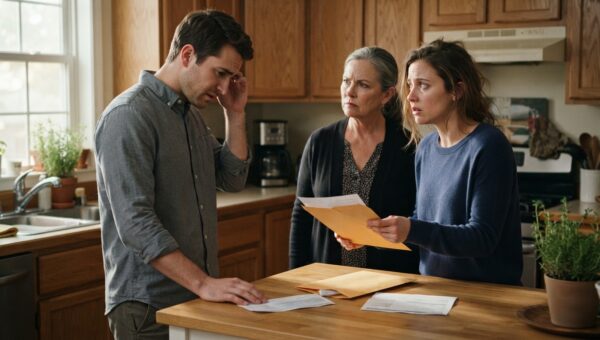
I sat down hard on the old wooden stool, the paper rattling in my hand. I read the second letter, and then the third, and then the journal entries tucked into the back of the folder. They were all written by Dwayne’s father, Thomas, a man Dwayne had always described to me as a cold drunk who walked out on his family without a word when Dwayne was twelve years old. The letters told a completely different story. They detailed how the older uncles and Aunt Martha’s husband had wanted the family farm sold off to pay down debts, how Thomas had refused to sign the papers, and how they had staged a vicious family intervention, accusing him of stealing from the farm accounts and driving him off the land under threat of the sheriff’s jail. They had intercepted every letter Thomas tried to mail to his son for six years, telling the boy his father was a coward who didn’t want him, while they carved up the land among themselves.
I picked up the larger photograph from the bottom of the box. It showed a younger Thomas standing by the fender of an old green pickup truck, one hand resting on the shoulder of a twelve-year-old boy who looked so much like Dwayne it made my breath catch. The boy was smiling up at his dad, holding a fishing rod, and the light in both of their eyes was bright and clear. That was the picture Dwayne kept in his wallet, torn down to just his own face so nobody would ever ask who the man standing next to him was.
“What are you doing down here?”
The voice came from the bottom of the stairs, deep and sharp in the dim basement air.
I dropped the photograph back onto the workbench, my hands going cold. Dwayne was standing at the foot of the stairs, his cap still on his head, his face gone completely gray beneath the tan he’d worked all summer to get. He was looking at the open red toolbox on the floor, then at the scattered letters on the wood bench, and finally at me.
“Aunt Martha gave me the key,” I said, my voice barely louder than a whisper because I didn’t know what else to say. “She told me to look beneath the tray.”
Dwayne didn’t yell. He didn’t slam the basement door or tell me to get out. He just stood there for a long, terrible moment with his shoulders dropping six inches, like someone had finally cut the heavy canvas straps of a pack he’d been carrying up a mountain for thirty years.
“She always was too stubborn to keep her mouth shut,” he said, his voice cracking right in the middle of the sentence. He took two slow steps toward the workbench, his hand reaching out to touch the corner of the topmost letter the way a blind man checks to see if a wall is real. “Did you read them?”
“I read them, Dwayne,” I said softly, standing up from the stool and stepping close enough to touch the sleeve of his flannel shirt. “They lied to you. Every single one of them.”
He let out a long, ragged breath that sounded like a sob trying to find a way out of a very narrow space. He reached into his back pocket, pulled out his worn leather wallet, and slid out the tiny, folded fragment of the photograph he’d carried around like armor for half his life. He laid it flat on the workbench right next to the larger picture from the box. The torn edge of his photo fit perfectly against the shoulder of the man standing by the green truck.
“I thought he just got tired of us,” Dwayne whispered, his chin trembling just a little bit before he bit down hard on his lower lip. “Every time I asked about him, Uncle Ray looked at me like I was something he stepped in on the porch. They told me he packed his bags while I was at school.”
“He didn’t pack anything,” I told him, reaching out to take his rough, grease-stained hand in both of mine. “The toolbox was the only thing he left behind that they couldn’t burn.”
We stayed down there in the cool basement light for a long time, neither of us moving toward the stairs or talking about what time it was. Dwayne didn’t put the letters back in the box, and he didn’t lock the padlock. He just sat down on the old wooden stool where I had been sitting, pulled the open metal box between his knees, and started reading the words his father had written him thirty years ago, reading them out loud to an empty cellar until his voice stopped shaking.
The next morning, neither of us mentioned the family reunion or what the cousins were doing down at the park. Dwayne didn’t go to work at the grain elevator right away either. He stayed in the house until mid-morning, working quietly in the living room with a small wooden frame he found in the hall closet.
When he was done, he didn’t put the photograph back behind his driver’s license. He walked over to the mantelpiece above the cold brick fireplace, pushed aside a heavy brass clock, and set the full, untorn picture of his father and his twelve-year-old self right in the center, side by side with the picture of the two of us on our wedding day. He stood back for a second, wiping a speck of dust off the glass with the hem of his thumb, and then he left the red toolbox sitting wide open on the bottom shelf of the bookcase by the front door, right where anyone coming into our house could finally see it.