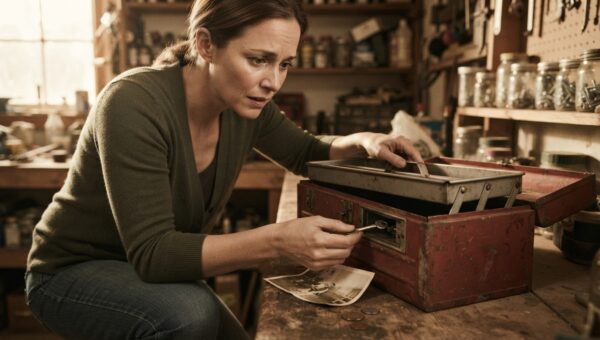
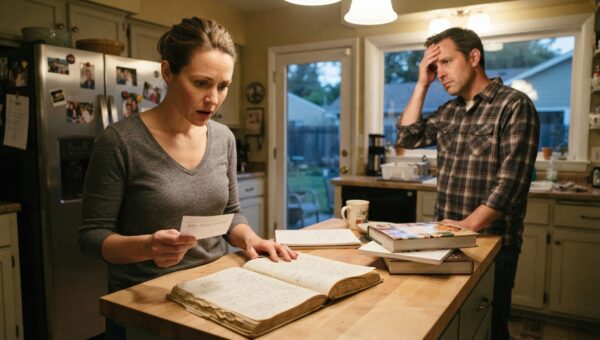
The manila envelope sat right on the front desk of the plant office, held together with a brass clasp that had already been bent and straightened too many times.
Brenda at the personnel desk didn’t even look up from her stack of insurance forms when I walked in. She just slid the package across the counter toward me with one pink-nailed finger.
“Your husband left this behind after his shift yesterday,” Brenda said, her voice dry as corn husks. “They said it was urgent paperwork from the main office in Omaha, but since he was already out the door, we figured you might as well grab it.”
I thanked her and tucked the thick, heavy thing under my arm, thinking it was just some sort of updated health insurance policy or a quarterly benefit statement.
It was three o’clock on a Tuesday afternoon, and the air in the hallway smelled of floor wax and stale cigarette smoke from the break room.
I didn’t open it until I climbed back into the driver’s seat of my sedan, resting the envelope against the steering wheel while the engine ticked and cooled down.
The brass clasp gave way with a small metal click.
Inside was a pink company check made out to Dale in an amount that made my chest tighten, followed by a blue-tinted wire transfer authorization form bearing my own signature at the bottom.
My penmanship is distinct, full of looping, hurried slants I picked up working years as a pharmacy clerk, but this signature was tight, small, and completely wrong.
I knew for a fact I had never signed that piece of paper.
I sat there in the parking lot for twenty minutes with the motor idling, watching the wipers sweep away a few dry maple leaves, trying to force my brain to connect the dots between Dale’s paycheck and a transfer I never authorized.
The memory of what his mother, Arlene, had said to me just three weeks before at the Piggly Wiggly came rushing back like cold water.
“You are bleeding my boy dry,” Arlene had snapped right there by the canned peaches, her fingers digging into the handle of her canvas tote bag as if she wanted to hit me with it.
I had blinked at her, dumbfounded, because my full-time salary from the clinic covered our grocery bill, the electric, and half the mortgage every single month without fail.
“Arlene, I pay my share and then some,” I had told her, trying to keep my voice even in front of the cashier.
“Don’t you lie to me,” she had hissed back, her chin trembling with that old-woman stubbornness she used like a crowbar. “Dale works fifty hours a week down at the rail yards, and he brings home a fraction of what he’s worth because you spend it all on foolishness.”
That night, I had sat Dale down at our kitchen table and laid out three months of bank statements to prove every single nickel went where it was supposed to go.
Dale hadn’t looked at the columns of numbers at all.
Instead, he had just stared at the salt shaker, his shoulders hunched inside his work shirt, looking more worried about what his mother might say if she found out we argued than about the accusation itself.
“She’s just stressed, Clara,” Dale had muttered, rubbing the back of his neck. “You know how she gets when the property taxes go up.”
After that night, he had started acting squirrelly about the mail, rushing out to the box before I got home from my shift and hiding his pay stubs underneath the spare woolen blankets in the hall closet.
I had told myself I was being paranoid, that men just get weird about money when their mothers get old and loud.
Driving home from the plant with that forged transfer slip in my lap, I finally understood why he had been hiding the mail.
I walked through the back door of our house just as the kitchen clock read 4:15.
Dale was sitting at the table in his undershirt, drinking a can of cheap beer and watching the local news on the small black-and-white television set we kept on the counter.
I didn’t say a word.
I just pulled the check and the blue wire transfer form out of the manila envelope and dropped them both right on top of the laminate table, right beside his beer can.
The paper slid across the plastic surface and stopped against his forearm.
Dale looked down at the signature line, and the color drained right out of his face, leaving him looking gray and pinched in the fading afternoon light.
“What is this, Dale?” I asked. My voice didn’t shake. I was surprised at how quiet it sounded.
He swallowed hard, his Adam’s apple bobbing up and down inside his thin throat.
“Where did you get that?” he whispered.
“Brenda gave it to me at the plant,” I said, leaning my hands flat against the edge of the table. “Someone forged my name to move four hundred dollars out of our joint account into an account I don’t recognize. Who signed this?”
He didn’t look at the paper again. He didn’t look at me, either.
He just closed his eyes for a second, let out a long breath, and asked the one question that broke what little was left of our marriage.
“Did my mother speak to you?”
The silence in the kitchen suddenly felt heavy, thick as wool.
“What?” I said.
“Did she talk to you about it?” Dale repeated, his voice dropping down to a miserable mumble as he stared straight ahead at the television screen.
“Nobody forged my name because of the grocery bill, Dale,” I said, my chest tightening until I could barely draw a breath. “You and your mother did this behind my back.”
“She needed the money for her hip treatments,” he blurted out, finally looking up with those watery, pleading eyes he always used when he wanted me to let something go. “You know how tight things are for her on that pension. She said it was just a temporary thing until her supplement kicked in.”
“She called me a thief in the middle of a grocery store while you two were stealing out of our own kitchen account,” I said.
“Clara, don’t make a big deal out of it,” he said, reaching out a hand as if he could touch my arm and smooth the whole thing over the way he always did. “It’s family. What was I supposed to tell her when she cried on the phone?”
“You were supposed to say no,” I said, stepping back so his fingers only brushed the air. “You were supposed to be married to me.”
The next few days were quiet. Too quiet.
I didn’t yell, and I didn’t pack a bag, but I spent every spare hour sitting at the kitchen table with our old checkbooks, matching up dates and deposit slips from the last eighteen months.
It wasn’t just four hundred dollars.
It was hundreds of dollars every single month, siphoned off into an account at the credit union down on Fourth Street that only Arlene’s name was attached to, all while Dale let me pay the heating bill out of my own pharmacy wages so his mother could keep up appearances at church.
On Friday morning, I went down to the First National Bank before my shift started.
The loan officer, a kind-hearted man named Mr. Henderson who had known my father for thirty years, listened quietly while I laid out the photocopies of the forged transfer and the bank statements.
“You have every right to protect your income, Mrs. Evans,” he said softly, sliding a new set of account forms across the mahogany desk toward me.
By noon, I had opened a brand-new checking account in my name only, with my direct deposit routed away from the joint ledger forever.
When Dale came home that evening, he walked into the kitchen and found me emptying the plastic fruit bowl we used for loose change.
“What are you doing?” he asked, stopping by the door with his lunch box still swinging from his hand.
“I went to the bank today, Dale,” I said, not even looking up as I dropped a handful of nickels into my apron pocket.
“Why would you do that without talking to me first?” he asked, his voice rising with that familiar defensive edge. “We’re a married couple. We share everything.”
“No,” I told him, looking straight into his eyes for the first time all week. “You and your mother share everything. I’m just the person who pays the bills so you can afford to keep her happy.”
He stood there by the refrigerator, looking smaller than he ever had, a middle-aged man caught between a domineering mother and a wife who was finally done carrying his water.
“She’s my mother,” he said one last time, as if that explained away every lie and every forged signature on the kitchen table.
“I know she is,” I said, turning away from him to finish packing my things. “And now you can figure out how to pay her bills all by yourself.”
The new, single-name bank statement rested squarely on the kitchen table beside the returned employer envelope, marking the precise boundary where my money and my future belonged to me alone.