The linoleum in Clara’s kitchen always had that faint smell of lemon dish soap, even when the counters were bare and the sink was empty. I brought a foil-covered casserole dish through the back door on a Thursday evening, expecting the usual clutter of mail and half-empty pill bottles. Instead, the room was quiet. Too quiet. The floor was completely clear, save for a single green canvas suitcase sitting right by the refrigerator. Clara was sitting on the linoleum next to it, her knees pulled up toward her chest, holding a black ink pen in her right hand.
“I’ve been keeping track,” Clara said without looking up. Her voice was steady, which somehow felt worse than if she had been crying.
Three weeks earlier, we had all crowded into her living room after her hysterectomy. My brother, Russell, brought a box of doughnuts and a laminated calendar. We made a big show of dividing the responsibilities among ourselves, writing names in blue dry-erase marker across the grid. Monday was supposed to be cousin Brenda for grocery runs. Wednesday was Russell for trash and errands. Friday was my shift for dinner and laundry. We hugged Clara, told her to be a good patient, and patted ourselves on the back for being such a tight-knit family.
By the second week, Brenda stopped answering her phone on Mondays because her kids had soccer tournaments. By day fourteen, Russell called to ask if Clara could spot him eighty dollars for his truck inspection, completely forgetting she was recovering from major abdominal surgery. I was the only one still showing up by the third week, grumbling to myself about how nobody else was pulling their weight while I wiped down her counters and emptied her bins.
I set the casserole dish down on the counter with a soft clink. “What are you doing on the floor, Clara? Your stitches are still fresh. You shouldn’t be lifting anything, let alone a suitcase.”
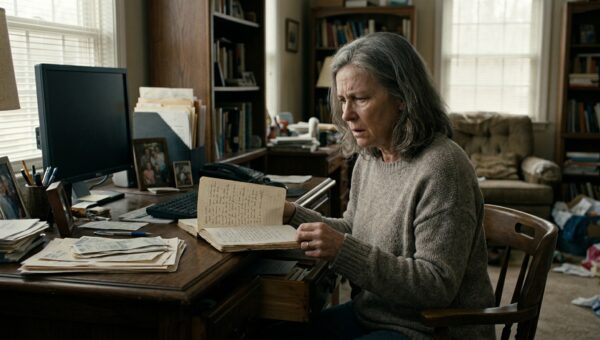
She turned the paper toward me. It was a sheet of legal pad paper torn straight across the top. Every single name from our laminated family care chart was written down in a neat column, and every single one had a thick, deliberate red line drawn straight through it. Russell. Brenda. Aunt Mae. Even my own name was sitting near the bottom, un-crossed, but boxed in by a heavy square of red ink that looked like a warning.
“I’m leaving in the morning,” she said.
I let out a nervous, breathless laugh that died almost instantly in the empty kitchen air. “Leaving where? You can’t drive yet. Dr. Keller said no driving for at least another month. Are you going to Russell’s? Because you know how his house is right now.”
“I’m not going to Russell’s,” Clara said, finally looking up at me. Her eyes weren’t angry. They were just tired, the kind of tired that comes from decades of keeping other people’s lives afloat while ignoring your own sinking ship. “I bought a place. Three hours down the coast. A little fixer-upper cottage with a screened porch. The keys have been in my drawer since before the surgery.”
The words sat between us like something heavy dropped on the floor. I stood there by the counter, my fingers still resting on the crinkly aluminum foil of the casserole dish. My brain refused to line up the facts. Clara never did anything impulsive. She was the anchor. She was the one who remembered every birthday, who lent money without charging interest, who dropped everything to watch Brenda’s twins whenever a school meeting popped up. She had been the family safety net for twenty-five years, absorbing every emergency like a dry sponge.
“You bought a house?” I asked, my voice sounding small in the quiet room. “Without telling any of us?”
“If I told you, you would have talked me out of it,” she said softly, shifting her weight against the lower cabinet. “Or worse, you would have asked me to help pay for someone else’s car repair first. I’m done being the emergency fund, Evelyn. I spent thirty years fixing everyone else’s mistakes, and the second I actually needed someone to show up for me on a Tuesday, my phone stopped ringing.”
“I showed up,” I said, and even as the words came out of my mouth, I heard how defensive and small they sounded. “I’ve been here every Friday. I brought you soup. I did your laundry.”
“You did,” Clara agreed, and that was what hurt the most. She didn’t argue with me. She just stated it like a fact. “You showed up because you felt guilty that nobody else was. But you spent the whole time complaining about Russell and Brenda while you folded my clothes. You were keeping score, too, Evelyn. Just a different kind of score.”
The silence in the kitchen stretched out, broken only by the hum of the refrigerator. I looked down at the crossed-off names on the legal pad. Every red line represented a broken promise, a missed shift, a selfish excuse delivered over the phone while Clara lay in bed healing from an incision that went from hip to hip. I thought about all the times we called her strong, as if being strong meant you didn’t need anyone to hold the door for you. We used her strength as an excuse to be lazy.
“Does Russell know?” I asked quietly.
“Nobody knows,” Clara said. She reached down and capped her pen with a sharp click. “And you aren’t going to tell them until I’m halfway across the county line. That is the only favor I am ever going to ask of you again.”
I wanted to argue. I wanted to tell her that family is family, that we have to stick together, that running away to the coast wasn’t going to solve anything. But I looked at the bare walls of her living room, noticing for the first time that the framed family portraits were already gone from the mantelpiece. She hadn’t just packed a suitcase. She had been quietly dismantling her life here for months, piece by piece, while we were all too busy asking her for favors to notice she was disappearing.
“Is the bed still set up?” I asked, my voice cracking a little.
“I kept the air mattress blown up in the guest room,” she said, a faint, sad smile touching the corners of her mouth. “You can stay the night if you want. We have tea left.”
I didn’t go home that night. We sat at the bare kitchen table drinking chamomile tea out of paper cups because the real mugs were already packed in brown cardboard boxes taped shut by the pantry. We didn’t talk about Russell or Brenda or any of the emergencies that had defined our lives for decades. We just talked about small things, like the way the salt air smells down by the coast and how Clara wanted to plant hydrangeas along the front fence where nobody could bother her.
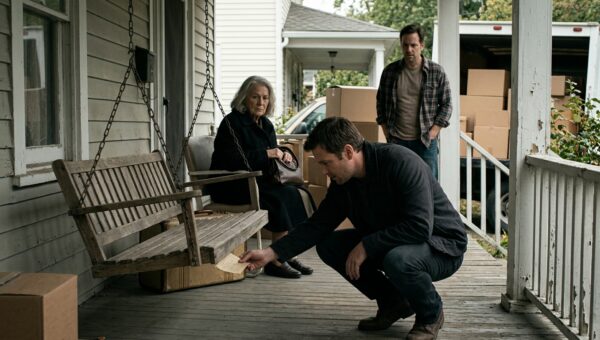
When morning came, the sky outside was the color of wet slate. The air had that damp, heavy chill that usually means rain is coming off the river. We loaded the green canvas suitcase into the trunk of my sedan along with two plastic crates of kitchen supplies she refused to leave behind. Clara walked slowly down the porch steps, her hand pressed lightly against her side where the stitches were still healing, and climbed into the passenger seat.
As I pulled out of the gravel driveway, my phone buzzed in the center console. It was a text message from Russell, asking if Clara was up yet because he needed to borrow her lawnmower for the weekend. I turned the phone face down without opening it and shifted the car into drive.
We drove for three hours through the gray morning fog, the tires humming softly against the wet asphalt. By the time we reached the small coastal town, the clouds had started to break, letting thin slivers of pale sunlight hit the rooftops of the old houses lining the harbor. I helped her carry her suitcase up the wooden steps of her new cottage and set it inside the front door. The rooms smelled like fresh paint and old cedar. There was no furniture yet, just a mattress on the floor and a single cardboard box serving as a nightstand.
“Are you going to be okay here?” I asked, looking around the empty, sunlit room.
“I think for the first time in my life, I’m going to be just fine,” Clara said, leaning against the doorframe.
We hugged on the porch, a short, tight embrace that felt more honest than anything we had shared in ten years. I got back into my car and drove the three hours home, my hands gripping the steering wheel a little tighter than usual.
By the time I pulled into my own driveway, my phone was ringing nonstop. Russell and Brenda were both leaving frantic voicemails about how Clara wasn’t answering her phone and nobody was there to watch the kids on Tuesday. I walked inside my house, set my keys on the counter, and let the phone ring until it finally went quiet.
The house was completely still. On the kitchen counter, I noticed the single empty coffee mug Clara had left behind before locking her front door for the last time, sitting right beside the spot where the morning sun cut a warm, unobstructed beam across the polished floor where her suitcase used to be.