Lorna’s Honolulu hotel booking was for one person, and the dates matched the call I’d just gotten from Owen’s mother’s care home.
I saw that little mismatch on the kitchen counter while I was clearing away the mail. I’d already taken Lorna off my airline travel pass. I’d done it the night before, after seeing her tell a room full of people that Owen paid for all those “free vacations.”
I know what that sounds like. It was petty. I knew it was petty while I was doing it.
There was a reason I got that mad. It wasn’t a good enough reason, but it was real, and it took me a long time to admit the difference.
Owen’s mother, Dottie, had moved to Honolulu with her second husband years before I met Owen. After her husband died, she stayed. She had friends there, a little condo, and enough money to get by until she didn’t. When her memory started going, she moved into a care home. Owen and I live in a paper-mill town in Maine. It’s a long way to go.
I work for an airline. My travel benefits let my family fly standby, which is cheap, not magic. There are fees, rules, and plenty of sitting around while other people get on the plane first. Still, for eight years, I let Owen’s relatives use my pass.
Lorna was the one who used it most. She’s Owen’s younger sister. She’d visit in the summer, sometimes with her daughter, and she’d come home with photos of beaches and Mai Tais. At family dinners, people would say, “Owen sure knows how to treat his family.”
He’d just smile.
I’d sit there thinking, I’m the one who filled out the forms. I’m the one who gets the calls when somebody misses a connection. It wasn’t a big sacrifice, honestly. But it was my benefit, and somehow I was the only person who knew that.
That night, at Owen’s cousin’s birthday supper, Lorna stood by the kitchen island with a paper plate in her hand. She’d just come back from a trip. Someone asked how she could afford to go to Hawaii again.
“Owen always takes care of us,” she said. “He got us the flights.”
The room laughed in that warm family way. Owen looked down at his plate.
I said, “Actually, those are my flights.”
Lorna looked at me. “What?”
“My employee benefits. The flights you keep calling free.”
She gave a little laugh, like I’d made a joke. “Well, Owen’s your husband.”
That set me off. Not because the words were awful. They weren’t. It was just the last little shove after years of hearing his name where my work belonged.
“I’m the one who put you on the pass,” I said.
Owen touched my arm under the counter. “Not here.”
That made it worse. I pulled my arm away.
“Why not here?” I said. “You can take the credit here.”
Lorna put her plate down. “I didn’t mean anything by it.”
“You never do.”
We drove home with the radio off. The tires made that steady road noise, and I could still smell the sweet pickle juice from the plate I’d carried out to the car.
That’s the kind of thing I remember. Not the exact date, but the smell.
Owen didn’t say much until we were in the driveway.
“She didn’t mean to hurt you,” he said.
“That’s convenient.”
“She just says it that way.”
“Why?”
He rubbed the side of his thumb. “I don’t know.”
He told me to sleep on it. I said I would. Then I sat at the kitchen counter with my laptop and removed Lorna’s travel privileges.
It took less than five minutes.
I didn’t tell Owen first. That was another thing I did wrong. I wanted to make the decision before he could talk me out of it, because I knew he probably would.
The next morning, I sent Lorna a short message saying she was no longer on my pass. She called right away.
“You took me off?” she said.
“Yes.”
“Because of what I said at supper?”
“Because you keep telling people Owen pays for it.”
“I wasn’t trying to steal anything from you.”
“You’ve had eight years to say my name.”
There was a pause. Then she said, “Fine.”
I expected a fight. I almost wanted one. Instead, she said she’d figure it out and hung up.
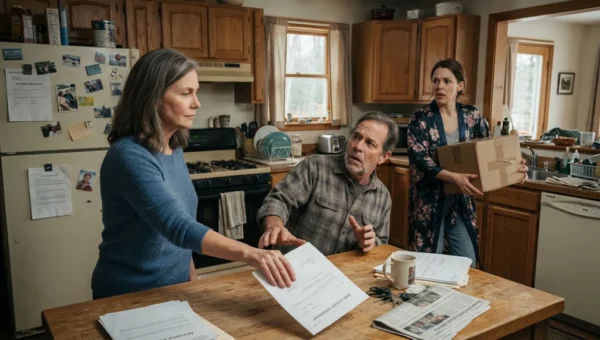
Owen found out when he got home from work. He’d been on the phone with her.
“Did you really cancel her?” he asked.
“I did.”
“She’s got a hotel booked.”
“She can cancel it.”
“It’s nonrefundable.”
“That’s not my problem.”
He looked tired, not angry. That bothered me more than if he’d yelled.
“You could’ve talked to me,” he said.
“I have talked to you. You never say anything when she takes credit.”
“I don’t care about the credit.”
“I do.”
I heard how childish that sounded. I still meant it.
He sat at the kitchen table and ran a finger around a water mark in the wood. “She’s going to see Mom.”
“Then she can tell me that.”
“She didn’t want to get into it.”
“She can get into it now.”
He looked at me like he knew I was making this about more than the pass. I didn’t ask what he thought the other thing was. I didn’t want to hear it.
The hotel booking showed up because Lorna had asked me to check whether her pass had been restored. She’d sent the confirmation with a note saying, “I have to leave Friday. Please don’t make this harder.”
The room was booked for one. The name on the confirmation was hers. I noticed that. I noticed the dates too. I couldn’t understand why Dottie’s care home had called me, but I filed the message away and told myself I’d call back later.
I called Lorna instead.
“What is this trip?” I asked.
“It’s to see Mom.”
“Your hotel says Waikiki.”
“It’s near the care home.”
“Why did you call it a vacation?”
“Because that’s what I call it when people ask.”
That answer made me mad again. “You tell everybody Owen pays for your flights.”
“He doesn’t.”
“I know.”
She took a breath. “I’m not asking you to like what I said. I’m asking you to put my pass back.”
“You could’ve told the family you were going to see Dottie.”
“I could’ve.”
“Why didn’t you?”
“I don’t want to talk about this on the phone.”
“Then don’t ask me to fix it on the phone.”
She hung up. I let it sit. I told myself she’d made her choice.
The next few days were quiet, except for Owen asking me twice if I’d reconsidered. I told him no both times. He didn’t argue. He also didn’t thank me for standing up for myself, which, if I’m honest, I was waiting for.
On Wednesday, Dottie’s care home called again. The woman who spoke to me said Dottie had been asking when Owen would arrive.
I said, “He isn’t coming.”
The woman was quiet for a second. Then she said, “I’m sorry. I thought Lorna had told you.”
“Told me what?”
“Lorna’s been visiting. She said Owen might not be able to come this time.”
I gripped the phone harder. “She’s there now?”
“No. She’s expected Friday.”
I sat down on the step by the mudroom. Owen was out back splitting a pile of kindling. I could hear the thud through the wall, steady and dull.
“Is Dottie okay?” I asked.
“She’s been declining. I’m afraid she may not have much time.”
I didn’t know what to say. I said thank you and hung up.
When Owen came in, he saw my face and put the kindling down.
“What happened?”
“Your mother’s asking when you’re coming.”
He leaned against the door frame. “I know.”
That was the first time I heard his voice crack on the subject. I’d known he felt bad about not visiting, but I thought it was the usual family guilt. You call when you can. You send a card. You say you’ll go next year.
“How long has Lorna been going?” I asked.
“A while.”
“How long?”
He rubbed his hands together, though there wasn’t any dirt on them. “Years.”
“Why didn’t you tell me?”
“She didn’t want it to turn into a whole thing.”
“A whole thing?”
“I don’t know, Jill.”
“Did she say you were paying for her trips?”
He looked down at the floor. “She said Mom asked about me.”
“That’s not what I asked.”
“No. I didn’t know she was saying that.”
I wanted to believe him. I also knew he’d let people think he was more involved than he was. He hadn’t corrected them. He’d smiled while they praised him.
“You let them think you were taking care of your mother,” I said.
He didn’t deny it.
“I thought she was going for fun,” I said.
“She does go to the beach.”
“That’s what she told everyone.”
“She stays with Mom most of the time.”
“Most of the time isn’t all the time.”
“No,” he said. “It isn’t.”
That night, I looked through old pass forms on my laptop. I could see every trip I’d approved for Lorna, going back years. I’d never counted them before. There were 23. I could remember a few: Christmas, a wedding, that time she got stuck in Chicago and called me from a gate. The other trips all looked the same in the record. Dates, destinations, names.
I didn’t know what I expected to find. Maybe a note. Maybe proof that she’d lied in some larger way.
Instead, there was just a list of flights I’d helped her take.
The next morning, Owen said Lorna had called. Dottie’s doctor thought her time might be short. Lorna still planned to go Friday, if she could get there.
“She can buy a ticket,” I said.
“She can’t afford a confirmed seat on short notice.”
“She booked a nonrefundable hotel.”
“She saved for that.”
I opened my mouth to say that wasn’t my problem. It came out as, “Why didn’t she tell me?”
Owen answered quietly. “Maybe she thought you’d say no.”
I hated him for saying it, mostly because I thought he might be right.
I called Lorna after lunch. She answered on the fourth ring.
“I spoke to the care home,” I said.
“Okay.”
“I didn’t know you’d been going to see Dottie.”
“I know.”
“Why didn’t you tell me?”
She let out a short breath. “Because it wasn’t about you.”
I went still, though I don’t use that word lightly. She said it so plainly. Like she’d been carrying that answer for years.
“What does that mean?”
“It means Mom wanted Owen there. He wasn’t there. I went instead.”
“Why tell people he paid for it?”
“Because Mom thought he was coming.”
I didn’t understand. “What?”
“She’d ask if her boy was coming. I’d tell her Owen had arranged the flight, that he was trying to get there. She’d settle down. She’d ask me to tell him thank you.”
“You lied to her.”
“Yes.”
I could hear a TV in the background, low and tinny. She was at home.
“You let her think Owen was coming?”
“I told her he was busy. I told her he loved her. I told her things she needed to hear.”
“Did Owen know?”
“He knew I was visiting. He didn’t know what I told her.”
“Why not?”
“Because he couldn’t handle it.”
The answer was so quick that I knew she’d said it to herself before.
I wanted to tell her that wasn’t her job. That she shouldn’t have had to carry it. But I was still angry about the family dinners, the credit, the way she’d made a joke out of my work. I couldn’t make all of it disappear just because the story had changed.
“So the ‘vacations’ were you taking care of her?”
“Sometimes. Some trips I did go to the beach. I’m not a saint.”
“I didn’t say you were.”
“You thought I was taking advantage of you.”
“I did.”
“Then at least we’re clear.”
I could hear her shifting around. A chair scraped. “I have to go Friday. She’s worse.”
“I’ll put you back on.”
“Don’t do it because you feel bad.”
“I’m not.”
That was a lie. Or part of one.
“I’m doing it because I shouldn’t have made a decision before I knew what I was deciding,” I said.
“Okay.”
“Can you still use the pass?”
“I don’t know. I’ll have to check.”
I asked if she’d tell Owen what she’d told me. She said no. She said he’d hear it from Dottie if he ever went. I told her that was unfair. She said, “Maybe.”
We ended the call without fixing anything between us.
I restored her pass that afternoon. It took a few clicks, the same as taking it away. I texted her the confirmation. She replied, “Got it.” Nothing more.
Owen asked whether she’d be able to travel. I said I didn’t know. He wanted to go with her. I asked why he hadn’t gone before. He said there wasn’t a good answer. I told him he should buy a ticket and go anyway.
“I can’t get there by Friday,” he said.
“Then go Saturday.”
“She might not know me.”
“That’s not a reason to stay here.”
He looked at me. “You’re right.”
I wish I’d felt better after he said it. I didn’t. I thought about all the times I’d called Lorna’s trips vacations and never asked why she went alone. I’d seen the pictures, the hotel, the beach. I’d decided the part that annoyed me was the whole story.
Lorna flew out Friday. I got a text when she landed. “Made it.” I sent back a thumbs-up. I know. Petty again.
Owen left the next morning. He bought a ticket and took a connection through Seattle. I stayed home because my shift started Sunday, and because I couldn’t think of a reason I belonged there.
For two days, there wasn’t much news. Lorna sent one message saying Dottie had been sleeping a lot. Owen sent a photo of a paper cup of coffee beside a hospital bracelet. I asked if he was okay. He said, “I’m here.”
Dottie died early Monday morning.
Owen called me from Honolulu. He didn’t cry on the phone. He told me Lorna had been holding Dottie’s hand. He said Dottie had opened her eyes once and asked if he’d come.
“What did you say?” I asked.
“I said yes.”
There was a pause.
“She smiled,” he said.
I put my hand over my mouth. I didn’t know whether I was trying to stop a sound or keep one in.
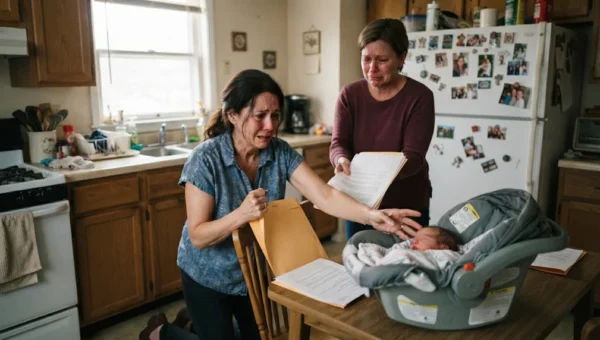
Owen came home three days later. Lorna came back the next week. Her hotel receipt was still on my counter, folded in half where I’d left it. I almost threw it away, but then she called and asked me to meet her at the house.
She brought a small envelope from Dottie’s room. The care-home staff had found it in a bedside drawer with Owen’s name on it. Lorna said Dottie had asked them to give it to him.
Owen opened it at the kitchen table. Inside was a note in Dottie’s shaky handwriting. It said, “Thank you for coming, my boy. I know you couldn’t. Lorna told me you were trying.”
Nobody spoke for a while.
Then Owen pressed the note flat against the table with both hands.
I’d thought Lorna was taking credit for something she hadn’t done. She’d been taking blame for something she hadn’t done, too. She’d let Dottie think Owen was trying. She’d let the family think he was paying. And I’d cut off the one person who kept making that trip.
I still think Lorna should’ve told me. I still think Owen should’ve gone years ago. I can hold both thoughts at once, which doesn’t make either one of us look better.
I kept the hotel receipt. I don’t know why. It’s tucked under the old pass forms in my desk drawer, the room for one and the dates printed in black.