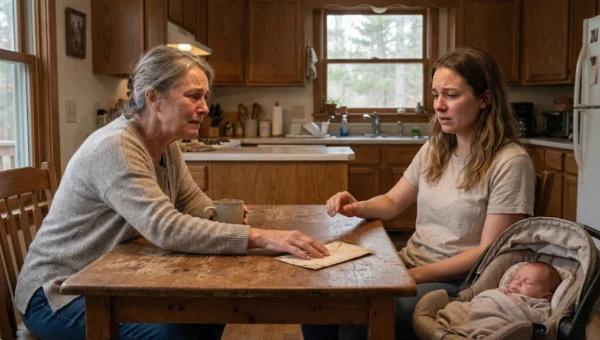
Why did I think my mother would tell me if she ever changed her mind about Janice? I still ask myself that when I drive past the old house. I had 26 letters in my hands before I understood how long she’d been keeping that answer from me.
I’m Cal. I drove trucks for a living, mostly freight between Maine and places I never wanted to stay.
My wife, Janice, worked in the office at a paper mill until it cut her hours. My mother, Bev, lived alone in the same small town where I grew up. She and Janice had never gotten along, or so I thought.
I married Janice in June. At the reception, Mom pulled me aside near the coat rack and said she didn’t think Janice was right for me. She was crying, which made it harder to tell her to stop. I told her she’d get used to Janice. Mom nodded, dabbed her eyes, and went back to the cake.
I didn’t make a big thing of it. I was 36 and old enough to know Mom could be stubborn. Janice didn’t ask me to choose between them, either. She said she wanted us to have a decent relationship with my mother, and I let that stand in for doing much about it myself.
That part’s on me. I was on the road a lot, and whenever the two of them had a tense call, I told myself it would blow over by the next Sunday. I did not ask what had actually been said.
The first year after the wedding, I stopped at Mom’s most Sundays when I was home. Janice came with me a few times. Mom was polite in the way people are polite when they’re waiting for the visit to end. She called Janice “your wife,” not by her name, and Janice noticed.
“She doesn’t have to like me,” Janice told me once in the car. “She just has to stop acting like I’m a stranger.”
I said I’d talk to Mom. I didn’t. I was tired, and I didn’t want one more fight with anybody. That was the easy answer. It also meant Janice had to keep walking into a house where she was treated like an unwanted guest.
Mom’s house had a little entry bench with a chipped corner. She’d kept it since I was a kid. Janice fixed the loose leg one afternoon with a bit of folded cardboard from a cereal box, then teased me that a truck driver should know how to keep furniture level. It was the kind of small thing she did without making a show of it.
A few months later, Mom told me Janice had stopped visiting. I said Janice was working odd hours. Mom said she understood, but her voice had that flat edge I knew. I asked Janice about it at home.
“I’ve called her,” she said. “She doesn’t pick up.”
I told her Mom was probably busy. Janice looked at me for a second, then changed the subject. I didn’t follow her back to it.
The next time I was home, Mom had made coffee and bought the cinnamon rolls I liked from the bakery by the mill.
She asked about the truck, my routes, the usual things. When I brought up Janice, Mom said they’d had a misunderstanding and she didn’t want to talk about it.
I figured that meant Janice had said something sharp. My mother could be difficult, but I’d seen Janice lose patience, too. I was not fair about which one I believed.
The part I remember clearly is Mom asking if Janice had been calling me while I was out. I said yes. Mom stared down at her coffee and said, “Good. At least somebody does.”
It sounded like a joke. It also sounded like a complaint. I laughed, because that was what I did when I didn’t want to ask what she meant.
I took longer routes that winter and stayed out nearly three months at a time. Janice didn’t complain, but we started talking more like coworkers than a married couple. I’d call from a truck stop, ask if the furnace was acting up, tell her when I’d be back. She’d remind me to check the oil. I didn’t ask if she was lonely.
Mom called more often while I was away. She said the furnace was making a noise. She said the snow was piling up by the back steps. Once she called because she’d dropped a jar of pickles and wanted to know whether I remembered where she kept the broom. It was in the same closet it had been for 20 years.
I told Janice Mom was having a hard time being on her own. Janice said she’d go check on her. I said it might be better if I called first. Mom didn’t like surprise visits, I told her. Janice said, “Fine, but I can still ask.”
That was how I kept things quiet. I thought I was preventing a fight. Mostly I was keeping myself out of the middle.
Mom died two years after the wedding. She was 68. It was a stroke. I was in New Hampshire, about four hours away, when my cousin called. I got to the hospital after they’d already taken Mom upstairs. She died that evening.
Janice drove us back the next day. She sat beside me with one hand on my knee, not saying much. I knew she had her own history with Mom, but I didn’t know what to ask. The funeral was small. Janice stood beside me the whole time and took my coat when I forgot where I’d put it.
After the service, my cousin helped with the bills and the paperwork. I was the one who had to clear out Mom’s house. I kept putting it off because every room looked like something I’d have to decide about, and I was bad at deciding.
A month later, I finally drove over after a morning delivery. I still had my work boots on, and I’d brought coffee in a paper cup that went cold before I finished it. I planned to pack the kitchen things first, then call a charity about the furniture.
I opened drawers and wrote down what was inside. Mom’s old checkbook. A stack of grocery flyers. Batteries that were too old to trust. It felt like work, which helped. I’ve always been better with a list than with grief.
I left her bedroom for last. There was a box of clothes by the closet and a pair of slippers beside the bed. I picked them up, then set them back down. I don’t know why I remember that. Maybe because I’d bought them for her after she said the floor was cold.
I pulled the box of clothes toward the door. It caught on something underneath the bed.
I got down on one knee and reached under. My fingers hit cardboard. The box was wedged against the wall, behind a pair of old shoes. It wasn’t big. It had a grocery store logo on the side and tape across the top.
I didn’t know what I was looking for. I cut the tape with my pocketknife.
The first thing I saw was Janice’s handwriting.
I sat back on my heels. There were envelopes, tied in two bundles with blue yarn. Every one had Mom’s name on it. Some had postage stamps. Some were folded notes with no envelope. The dates started four months after the wedding and kept going for more than a year.
I counted them twice. Twenty-six.
I called Janice from the bedroom. She answered on the fourth ring and asked if I’d found the tax folder. I said I’d found something else. Then I told her what was in the box.
She didn’t say anything for a few seconds. I could hear the kitchen clock at our house through the phone. It had a little click before every minute, which she’d once said sounded like a bad turn signal.
“Are they open?” she asked.
“Most of them.”
“Don’t read them without me.”
I said I wouldn’t. I was already holding one, but I put it back in the box. That was the first time in a while I’d listened to her without making a case for why I should do something else.
Janice drove over after work. She didn’t rush. I could tell she was trying to get herself ready before she came in. She stood in the bedroom doorway, looked at the box, then at me.
“I wrote those because I thought she wanted to hear from me,” she said.
I asked if Mom had ever answered.
“No.”
“Did she tell you to stop?”
Janice shook her head. “She didn’t answer the calls, either.”
We sat on the floor with the box between us. Janice picked up the oldest envelope and rubbed her thumb over the stamp. She didn’t open it. I started to apologize, but she held up one hand.
“Let’s see what she kept.”
The first letter was short. Janice had written that she was sorry their wedding day had been hard for Mom. She said she knew Mom had imagined a different life for me, but she loved me and wanted us to make room for each other.
The next note was about Thanksgiving. Janice had asked if Mom wanted help with the meal. The one after that said she’d found Mom’s old recipe for molasses cookies and would bring a batch by, if that was all right.
I knew those cookies. Mom used to make them every December. I’d assumed Janice got the recipe from her during one of their visits.
Janice looked up when I said that. “She gave it to me before we got married.”
I hadn’t known that.
The letters weren’t all graceful. One said Janice had waited outside Mom’s house for 20 minutes and left because she didn’t want to make her answer the door. Another said she’d called twice and felt foolish for trying again. That one had a coffee stain across the bottom. I thought of the kitchen at our old apartment, where Janice used to set the mug on top of the mail and forget it was there.
Then I found a letter from the winter I was away for 11 weeks. Janice had written that Mom’s pipes had frozen and she’d gone over to help. She’d left a note on the counter because nobody answered. Mom had called her later and said she shouldn’t come by uninvited.
Janice had put one line at the end: I’m not trying to take your place in his life. I’m trying to be someone you can call.
I read it again. Then I read it a third time.
I asked Janice why she hadn’t told me.
“I did,” she said. “You said your mom didn’t like surprise visits.”
That was true. I remembered saying it. I remembered saying it more than once.
I picked up another envelope. It was dated two weeks later. Janice had written that she’d left a bag of groceries on the porch after Mom said she was short on money. Mom had called her and sounded angry. The note said Janice didn’t know if she’d crossed a line, but she didn’t want Mom to go without food.
I had no idea about the groceries. Mom had told me she’d managed fine. I’d believed her because it was easier than asking what she needed.
Janice was quiet beside me. She didn’t seem pleased to have been proven right. She looked tired, and I could see a little ink mark on the side of her finger from work.
I asked if Mom had ever said anything kind about her.
“Once,” Janice said. “At the hospital, after she had that bad fall.”
Mom had fallen in her kitchen the year before she died. Janice had gone with me to the emergency room. I remembered Mom refusing help, then letting Janice fix the strap on her coat because her hands were shaking.
“She said I was good to you,” Janice told me. “Then she asked me not to tell you.”
I didn’t know what to say. I had been in the room. I’d been standing three feet away. Mom had told me to get her purse from the car, and I’d left.
Janice reached for the next bundle. Her hands stopped on the blue yarn.
“I don’t want to make her into a saint now,” she said. “She made me feel unwelcome.”
“I know.”
“No, Cal. You heard me say it. You just thought it would go away.”
I wanted to argue that I had loved them both, that I’d tried to keep the peace. I could hear how thin that sounded before I said it.
“You’re right,” I said.
The letters from the last six months were different. Janice had started writing less often. One was only a few lines, asking if Mom had gotten the birthday card she left by the door. Another said she’d called and would try again after the weekend.
The last one was dated three weeks before Mom died. Janice had written that she was sorry for not coming by lately. She said she didn’t know if Mom wanted her there, and she didn’t want to keep putting herself in the way.
At the bottom was a sentence that made Janice set the page down.
I hope you know I tried because I love your son, and because I thought I could love you too.
We didn’t talk for a while. I could hear a truck on the road outside, shifting gears as it climbed the hill. It sounded like work, which is what I needed it to sound like.
I asked Janice if she wanted to take the letters home.
She said no at first. Then she changed her mind. She asked if we could read the rest together. We sat there and went through every envelope, even the ones with only a few words. Some were hard to read because Mom’s name was written on them so many times.
There were no letters from Mom. Not one reply. But in the bottom of the box, under the last bundle, I found a folded sheet of yellow paper with my name on it.
It wasn’t addressed to Janice. It was in Mom’s handwriting, the careful print she used on the labels in her pantry. She’d written it sometime after the hospital fall. I could tell because she mentioned the blue coat Janice had helped her with.
I started reading, then stopped. Janice asked if she should leave the room. I said no.
The note wasn’t long. Mom said she knew I’d be angry if I learned how often Janice had called. She said she’d told Janice not to mention the visits because she didn’t want me driving home every time she got lonely or scared. I’d left jobs before to help Mom, and she knew it. She said she’d rather have me think Janice was giving up than have me feel I had to choose.
Then she wrote that Janice was kinder than she deserved, and she was too proud to tell her.
I read that part out loud. My voice caught on the word proud, which annoyed me. It was just a word. I read it again anyway.
Janice said, “She could’ve told me.”
I said, “I know.”
“She could’ve just said she was scared.”
“I know.”
I kept using those words because I didn’t have better ones. Mom had tried to protect me from being pulled back to town, but she’d made Janice carry the cost. She had also let me believe my wife had stopped trying. I’d helped that lie along without knowing it, mostly by not asking questions when the answers might have meant work.
I wasn’t proud of how relieved I’d felt when Mom and Janice stopped speaking. The house was quieter. I didn’t have to be the person between them. I told myself that was peace.
It wasn’t.
We took the letters home that evening. Janice put them in a file box, still tied in the blue yarn. She didn’t want to throw them away. She also didn’t want to keep them somewhere we’d have to see them every day. I understood that.
A week later, I called my cousin and told her I’d found papers in Mom’s room. I didn’t say what they were. She said Mom had been proud of me and asked whether I wanted the house key. I told her to keep it until I knew what I was doing with the place.
The house sat empty for another month. Janice and I went back once to take the bench from the entry. The cardboard was still folded under one leg. I slid it out and kept it in my pocket, which was a strange thing to do, but I did it.
Before we left, Janice asked if I wanted to lock the front door. I had the key in my hand. I could see Mom’s old slippers through the open bedroom door, where I’d left them beside the bed.
I turned the key in the lock, but I didn’t pull the door shut. I stood there holding it open while Janice waited beside me.
The last letter from Janice stayed tied in blue yarn, and Mom’s front door stayed open.