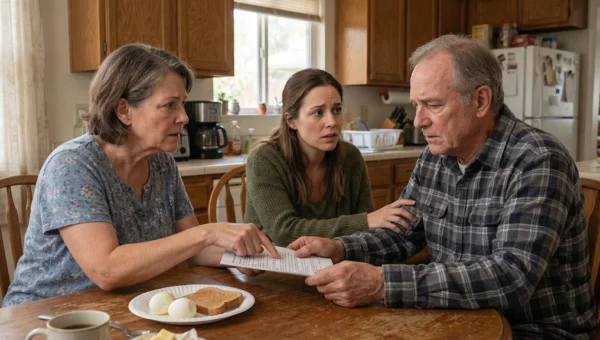
Did my mother know she was Aunt Ruth’s daughter before that little music box started playing? I’ve asked myself that for years. I don’t mean whether she suspected something. I mean whether some part of her had been waiting for an answer she couldn’t name.
I was standing beside her when the lawyer read the will. Mom had her black funeral shoes in a plastic grocery bag because the heel on one had come loose.
The lawyer said my cousins, Bruce and Paula, would get the house, Aunt Ruth’s jewelry, and the investment accounts, which were worth just under $3 million. Mom got a dusty music box with a broken ballerina.
Bruce made a little laugh. He said he’d buy it from her for five dollars. Mom didn’t answer. I laughed too, just once, because everybody else had, and because I wanted the room to stop feeling so mean. I hate that I did that. I can still see Mom folding the lawyer’s paper smaller and smaller while I pretended not to notice.
Aunt Ruth had been the rich one in our family for as long as I could remember. Her house sat on a quiet street outside Dayton, with a stone front step that was always cold, even in July. Mom was supposed to be her younger sister, though there had always been a strange distance between them.
Ruth was private. Mom was careful around her, like she was a guest who had stayed too long.
I grew up hearing that Mom had been difficult as a teenager. That was the family explanation for why Ruth had never been close to her. My grandmother, Norma, had raised Mom, and everybody said Ruth had been busy with work and her own life. I took that story as fact. I had no reason to question it, or so I told myself.
Mom did keep the music box. She carried it home in the same grocery bag as her shoes and put it on her kitchen table. The wood had a film of dust on it. When she lifted the lid, the ballerina leaned to one side, and the tune stopped after three notes.
“She could’ve given me something useful,” Mom said.
I said, “Maybe she didn’t know what you’d want.”
That wasn’t kind. It wasn’t even true. Ruth knew Mom well enough to know she wouldn’t ask for jewelry or money.
Mom had spent her whole life trying not to seem greedy around people who had more than she did. I knew that, but I let the sentence go anyway.
The note was tucked under the velvet inside the lid. It was in Ruth’s handwriting, with the R’s she made too large and the rest of the letters pressed close together. “Play it only when you’re ready to hear the truth.” Mom read it twice, then set it facedown on the table.
For weeks, she didn’t wind the box. I’d stop by after my shift at the pharmacy, and it would still be in the same spot, next to her jar of loose tea bags. The note would be under it or beside it, depending on whether she had cleaned the table. Mom didn’t talk about it much. I didn’t ask, either. I was afraid she’d say the thing I’d already suspected: that I had laughed with Bruce.
When I did ask, she only shrugged. “It’s probably some old family story.”
I said, “You don’t have to listen.”
She looked at me then, not mad, just tired. “I know.”
The funeral was the last time all of us were in Ruth’s house together. Bruce and Paula had already started talking about what they would do with it. They used words like roof and taxes and upkeep, as if the place had been waiting for them to make a sensible decision. Paula said Ruth had left the estate to the people who’d helped her most.
I knew Mom had driven Ruth to appointments. I knew she’d picked up groceries and sat with her after Ruth had surgery. I’d gone with her a few times. I remembered Mom keeping a small notebook of Ruth’s medicine times because Ruth would insist she was taking everything correctly, even when she wasn’t.
But I didn’t say any of that. I didn’t want to start a fight during the funeral lunch. That’s how I excused it. I was good at finding a reason to keep quiet when speaking up might make people uncomfortable.
A few months later, the ballerina’s loose arm fell off. Mom wrapped it in a tissue and brought the box to an antique repair shop near the old hardware store. She asked if the repairman could fix the music mechanism. I offered to go with her, then got called in to cover a shift. I told myself it wasn’t important. The shop was only a few minutes away.
Mom said later that the repairman, Mr. Cline, had been turning the box over when he noticed the bottom didn’t sit flat. He asked if she knew there was something tucked beneath the wooden floor. She said she didn’t.
He opened it carefully. Under the lining, he found a little recorder, smaller than a matchbox. It had a tiny switch and one old recording on it. Mr. Cline didn’t play it. He called Mom and asked if she wanted him to set it up for her.
She said yes.
When I arrived at her house, the music box was on the table, along with the recorder and a small speaker Mr. Cline had lent her. Mom hadn’t taken her coat off. I was still holding my pharmacy badge in one hand.
“You found something,” I said.
She nodded. “Ruth put it there.”
I should have sat beside her. I should have put my hand over hers. Instead, I asked if she wanted me to call Bruce. I thought a witness would help. Really, I wanted someone else in the room in case the recording was bad news.
Mom said, “No. Stay.”
The first few seconds were only a hiss. The speaker made a little pop, and Mom flinched. Then Aunt Ruth’s voice came through, older and thinner than I remembered it. I’d heard her talk about the weather and complain about the price of eggs. I had never heard her sound scared.
“Irene,” she said. “I am your mother.”
Mom’s hand went to the edge of the table. I reached for her, but she moved her arm away. Not hard. Just enough.
Ruth kept speaking. She said she had been seventeen when Mom was born. Her parents had told her she would ruin her life if she kept the baby. Her older sister, Norma, had no children then and wanted one badly. Ruth let Norma take Irene home and raise her as her own.
The recording had a pause in it. We could hear Ruth breathing. Mom didn’t move. I didn’t know what to do with my hands.
Ruth said she was sorry. She said she had wanted to tell Irene once she was grown, and then after she was married, and then after she had me. Every time, Ruth told herself that opening the truth would only hurt the people she loved. She said it became easier to act like she was only an aunt.
Then she said she had let the family believe Mom was ungrateful and hard to love because that was easier than explaining why she had kept her distance. She hadn’t wanted Mom to see how much she regretted giving her away.
I heard Mom whisper, “All those years.”
Ruth didn’t answer that. Of course she didn’t. It was a recording made before she died. There was no way to ask what she meant by easier, or why she had let Mom feel unwanted for so long.
The recording went on. Ruth said she left the money and house to Bruce and Paula because they had managed her bills and repairs in the last few years. She said she had not wanted to use the estate to force Irene to forgive her. I don’t know if that was true or if she was trying to make her choices sound better. I still don’t know.
The last thing she said was that she had put the box in the will because she could not say the truth to Mom’s face. She asked Mom to keep it, or throw it away, or do whatever she wanted. Then Ruth said, “Norma was your mother in every way that counted. I should have been brave enough to tell you both.”
The recording clicked off.
Nobody spoke for a long time. I could hear the refrigerator start. Mom was staring at the little speaker, but she wasn’t crying. She had both hands flat on the table, like she was keeping herself from getting up.
I was the one who started crying. I told her I was sorry I laughed at the lawyer’s office. I told her I should’ve stood up for her when Bruce made that offer. I said I had let the family story stand because it was easier than asking whether it was fair.
Mom shook her head. “You thought I was being sensitive.”
“I did.”
“I was.”
That was the part that hurt. She wasn’t letting me off the hook, but she wasn’t making me into the villain either. I had spent years thinking I was being reasonable by not picking sides. I had been picking the side that required the least from me.
Bruce called the next morning. He wanted to know if the music box had any value now that it had been repaired. Mom told him there was a recording inside. He asked what it said. She told him she wasn’t ready to talk about it.
He said, “Well, it can’t change the will.”
Mom told me later she almost hung up. Instead, she said, “I know. It changed me.”
Bruce went quiet. He said he hadn’t meant to hurt her at the funeral. Mom said she believed him. She also told him that joking about five dollars had been cruel, whether he meant it that way or not. He didn’t have a good answer.
I thought she might call Paula after that. She didn’t. For a while she kept the music box in the kitchen, where she could see it when she made tea. She didn’t wind it. She said the broken tune bothered her.
The truth didn’t make Mom’s childhood come out right. It didn’t give her back the years she spent believing Ruth had never cared enough to be close. It didn’t make Ruth’s choice about the money feel fair. But it gave Mom one thing she had never had before: a reason for the distance that wasn’t a flaw in her.
A few months after the recording, Mom asked me to come over for tea. She had taken the ballerina out of the box and placed it beside the sugar jar. The little figure was still broken. She said she wasn’t going to fix it.
Then she told me something I had never heard her say plainly. “Norma was my mother,” she said. “Ruth gave birth to me. Both things are true.”
I wanted to say something helpful. I started to, then stopped. Mom reached across the table and took my hand.
I said, “I’m glad you know.”
She squeezed my fingers. “I know now.”
The box is still at her house. The note is tucked under the lid, and the recorder stays in a drawer because Mom doesn’t need to hear it again. She never asked for Ruth’s house or the money. She didn’t ask Bruce and Paula to give anything back.
At family dinners, people still call Ruth her aunt. Mom doesn’t correct them every time. But once, when Bruce used that word, she looked right at him and said, “She was my mother, too.”
I was sitting beside her. This time I didn’t laugh, and I didn’t look away.