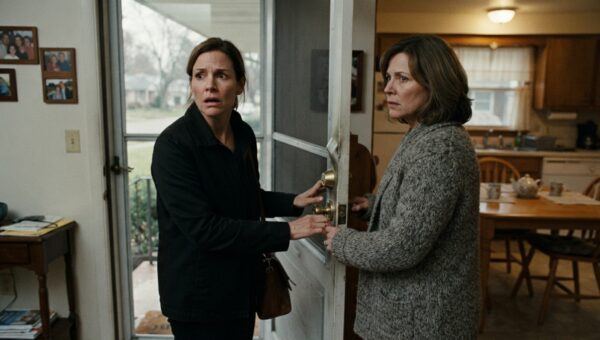
The cedar drawer in Mama’s pine dresser always stuck a little on the left side, catching on the tongue-and-groove joint the exact same way it had ever since Dad put the bedroom suite together back in the fall of seventy-four. Claire and I had spent four solid hours hauling black trash bags out to the rusted utility trailer parked by the hydrangea bushes, working with that grim, fast-paced silence that siblings fall into when they are dividing up a ghost.
Claire was standing by the closet with a stack of wire hangers rattling in her fist when I finally got the stubborn drawer to pop open. It didn’t smell like mothballs or lavender the way old closets usually do. It smelled like dry pine and the cheap peppermint lozenges Mama used to keep in her apron pocket for church.
Instead of sweaters or winter scarves, the entire top compartment was packed tight with neat little blocks of white paper napkins, stacked in precise, overlapping rows that looked like bricks in a miniature wall.
“Just pitch the whole drawer,” Claire said, not even turning around from the shoe rack. “It’s just napkins. She must have had a hundred packs from the diner or the grocery store. We don’t have time to sort through trash.”
I didn’t answer her right away. My hand had reached out on its own, brushing against the top corner of the nearest square.
It had been folded four times over into a hard little triangle, the edges pressed flat with a thumbnail.
“Hold on a second,” I said.
“Arthur, please. The donation truck gets here at three,” Claire sighed, dropping the hangers onto the bed with a loud clatter.
I ignored her, lifted the tiny square out of the stack, and slipped my fingernail under the crease. It unfolded with a faint, dry crackle. Across the center, written in Mama’s careful, sloping pencil hand, were a date and a single line.
*Tuesday. He didn’t call again.*
The air in the small bedroom seemed to thin out all at once. I sat back on my heels, the paper curling slightly against my thumb. Beneath that first one lay another, and beneath that one, hundreds more, filling the entire length of the maple frame.
“What is that?” Claire asked, her voice dropping its sharp edge as she finally walked over and looked down at my hands.
“I don’t know,” I whispered.
I reached down and picked up the second one in the row. *Thursday. Maybe he forgot. That’s alright.*
We spent the next two hours sitting right there on the braided rug in the middle of the floor, pulling those tiny squares out one by one. There were six hundred of them in all. We counted them later, after the sun had shifted off the rag rug and the room went gray with the late October chill. Twelve years of dates. Twelve years of quiet afternoons sitting by the white rotary phone on the kitchen wall, waiting for an only son who lived forty minutes down the highway to remember that his mother existed.
Every single napkin was a record of an absence. But none of them had an accusation on them. Not one. They were all small pardons she wrote to herself, little hand-drawn margins where she excused my meetings, my yard work, my tired evenings on the couch, my endless, heavy-headed busyness.
*Saturday. The road work probably kept him. He works too hard.*
*Tuesday. Rain makes the highway bad. I’ll call him tomorrow.*
Except tomorrow never had a note, because tomorrow was usually just another blank day until the silence stretched out for weeks at a time. I sat there with the papers spread all around my knees, my throat burning like I had swallowed a mouthful of hot gravel, realizing that my entire adult life had been neatly cataloged in cheap diner paper.
Then I found the last one. It wasn’t folded at all. It was lying flat at the very bottom of the stack, tucked beneath a wooden divider, and the pencil strokes were faint and shaky, as if the hand holding it had barely had the strength to press the lead against the grain.
The date was from three weeks prior, right around the time the hospice nurse started coming twice a day. The writing stopped halfway across the second line.
*If he ever reads these, tell him I was never…*
That was where it ended. The pencil mark trailed off into a thin, gray smudge that drifted down toward the bottom edge of the napkin like a dying breath.
“Arthur,” Claire whispered, her hand coming down to rest heavy and warm on my shoulder. “Arthur, look at me.”
“I was forty minutes away, Claire,” I said, and my voice sounded like it belonged to a stranger standing across the room. “I drove right past the county road every single Friday on my way to the hardware store. Every single week.”
“She didn’t want you to feel bad,” Claire said, though her own eyes were leaking now. “Mama knew how you got when things piled up at the shop. She didn’t want you carrying it.”
“She carried it for twelve years,” I said.
I couldn’t stay in that house while Claire finished packing the kitchen. I got into my truck and drove out past the grain elevators, taking the old two-lane highway toward Aunt Sarah’s place on the edge of town. Sarah was seventy-eight, with the same sharp blue eyes Mama had, and she was sitting on her enclosed back porch shelling butterbeans into an enamel colander when I pulled my truck up onto her gravel drive.
She didn’t look surprised to see me. She must have seen the truck coming from a half-mile off.
“You found them, didn’t you?” Sarah asked before I even cleared the screen door.
I walked in and dropped the unfolded final napkin onto her oilcloth kitchen table. It looked terribly small sitting there among the green hulls and the yellow bean skins.
“Sarah, what did she mean?” I asked, pulling out a wooden chair and sitting down hard. “What was she trying to finish? The nurse said she was lucid right up until the end. You were there in the room. What did she say?”
Sarah laid her thumb against the side of the colander and looked down at the scrap of paper. For a long time, the only sound in the kitchen was the rhythmic ticking of the wall clock above the icebox.
“Your mother was stubborn as a mule, Arthur, you know that,” Sarah said softly, her voice dry as corn husks. “When you stopped coming around as often after you bought that second truck and started taking on those commercial contracts, she didn’t get mad. Not like people thought. She just sat by that kitchen phone and felt her heart get heavy.”
“She had every right to be furious with me,” I said.
“She wasn’t furious,” Sarah snapped, her eyes flashing behind her wire-rimmed glasses. “That’s where you’re wrong. That woman loved you so hard it made her foolish. After about the second year of you missing Sunday dinner, she started getting those little pains in her chest. Not heart trouble, just the ache of it. One afternoon she called me over, and she had a stack of napkins from the kitchen dispenser.”
Sarah reached out and tapped the table with her knuckle.
“She told me, Sarah, if I keep these thoughts inside my head, I’m going to pick up the phone one day and say something I can’t take back. She said she needed a way to put the disappointment down somewhere so she could pick up the receiver with a clean heart. Every time you didn’t call, she wrote down why you couldn’t make it, folded it up tight, and put it in the drawer. And do you know what happened?”
I shook my head, not trusting my mouth to open.
“By the time you *did* call, every three or four months when you finally remembered your old mother, her drawer was full of your excuses, and her heart was empty of your absence,” Sarah said. “She didn’t hold a single grudge against you. Not one. When you talked to her on the phone, she was just so damn glad to hear your voice that she forgot all the days in between.”
“What about the last one?” I asked, my voice cracking right down the middle. “The one that didn’t get finished.”
Sarah reached across the table and covered my big, rough hand with her small, papery one.
“She was slipping fast that Tuesday, Arthur. Her breathing was shallow, and she kept reaching for the pad on her nightstand. I held the pencil for her, but her fingers wouldn’t close around it right. She got out *If he ever reads these, tell him I was never*, and then she looked right at me.”
Sarah paused, her own chin trembling for the first time.
“She told me to tell you the rest, in case you ever found them. She said, ‘Tell him I was never angry with him, only afraid he would blame himself.'”
The kitchen went very quiet then. The smell of damp earth and green beans drifted up from the colander, and I sat there in my heavy work jacket, letting twelve years of stubborn pride and self-pity finally crack open. All that time I had told myself Mama was probably downstairs watching her stories, or busy with her garden club, or simply didn’t care about an old son who was too busy making a living. I had built a wall out of my own convenience and called it independence.
“She protected you from yourself, Arthur,” Sarah whispered. “Don’t you go ruining it now by spending the rest of your days beating yourself up over a drawer full of napkins. That wasn’t a punishment. That was a mother keeping her own love safe from her own disappointment.”
I stayed with Sarah until the sun went down behind the ridge, drinking cold water out of a jelly jar and helping her carry the butterbeans inside to the freezer.
When I drove back to Mama’s house, Claire was gone, but she had left the front porch light burning for me. Inside, the rooms smelled like lemon oil and empty space. I went straight to the master bedroom, pulled open the stubborn left drawer of the pine dresser, and gathered up every single one of those folded white squares. I didn’t throw a single one away. I put them all inside an old cedar memory box that Dad had built back when they were first married.
Except for the last one.
I took that single unfolded napkin back to my own house that night. The kitchen was dark when I walked in, save for the green glow of the microwave clock glowing 9:14. I didn’t turn on the overhead light. I sat down at the oak table where my own phone sat plugged into the wall, quiet and steady.
I laid the final napkin flat under a small glass paperweight right beside Mama’s framed photograph from her seventy-fifth birthday, where she was smiling squinty-eyed into the backyard sun.
Then I picked up my phone, scrolled down through the contacts until I found my sister’s name, and pressed call.
Claire picked up on the second ring, her voice muffled by television noise in the background.
“Hello?” she said.
“Hey, Claire,” I said, leaning back in the kitchen chair and looking out the window at the dark highway running south toward town. “Just wanted to hear how your evening was going. Figured it’s about time we started calling on Tuesdays.”
There was a short, sharp breath on the other end of the line, and then my sister didn’t say anything for a second, and honestly that felt better than all the silence in the world.
“It’s going fine, Art,” she said softly. “It’s going just fine.”