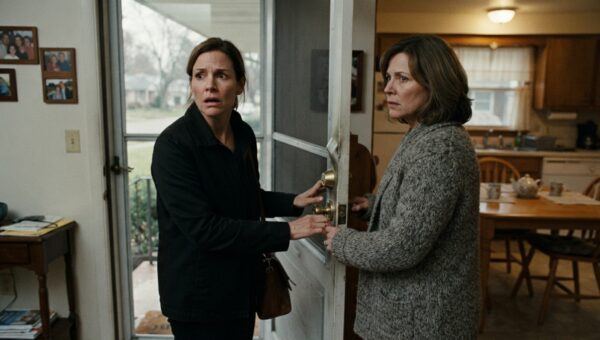
I got it wrong for seven solid years, thinking that silence was just a weapon my kid used to punish me for being human.
My name is Clara, and for a long time, I thought love meant keeping someone locked so tight inside your life that they never even looked out the window. We lived in that ranch house out past Bakersfield where the dust blows off the scrubland every afternoon and gets into the weather-stripping.
It was just Maya and me for most of her growing up. I adopted her when she was six months old, pulling her out of a state system that felt cold and indifferent, and I swore right then that she would never know what it was like to not belong. I built our whole world around her little socks in the laundry, the way she liked her grilled cheese cut into triangles, the piano lessons I paid for by taking extra shifts at the clinic. I was her mother, and I thought that title gave me ownership of her history.
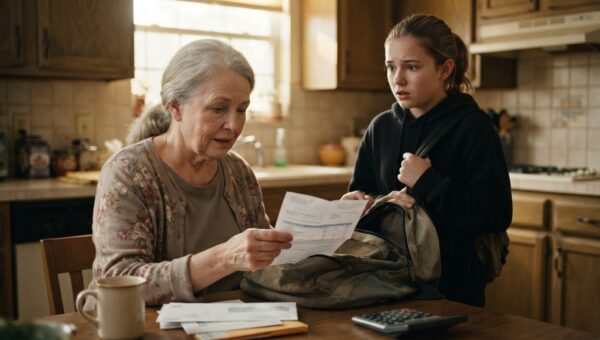
The trouble started on a Tuesday in October, right around her thirteenth birthday. Maya had found some old adoption agency papers tucked behind the winter coats in the hall closet, yellowed folders with blank spaces where her birth parents’ names should have been. She was sitting at the kitchen table with those papers spread out around her homework, her little jaw set hard in a way that scared me down to my bones.
She looked up at me with these wide, dark eyes and asked me why nobody else had wanted her, why her mother had just dropped her off like an unclaimed coat.
I was tired from a double shift, my feet throbbing inside my sensible nursing shoes, and the fear of losing her to strangers who hadn’t earned a single sleepless night caught in my throat like dry salt. Instead of sitting down and holding her hands, I let the panic turn into pure venom. I slammed the dish towel onto the counter so hard the sugar bowl rattled. I looked right at her and I let the worst thing I had ever thought spill out of my mouth without a filter.
“Nobody wanted you, that’s why you’re HERE!”
Maya didn’t cry. She didn’t yell back or throw a book at the wall. She just folded those papers very slowly, slipped them into her canvas backpack, and walked out of the kitchen.
She didn’t speak another word to me for five full years.
You do not understand what a silent house is until you live in one where every meal is eaten across from a stranger who refuses to look at your face. For five years, I cooked dinner and set two plates on the table, and for five years, Maya ate her food in absolute, deafening quiet. If I asked her to pass the salt, she would push the shaker six inches across the Formica top and stare straight ahead at the wall. If I tried to apologize, my voice would bounce off her closed bedroom door like I was talking to an empty room. I tried everything. I left notes in her locker, I begged her to scream at me, I even went to see Eleanor, the retired social worker who had handled her adoption papers back when Maya was an infant.
Eleanor just shook her head over her lukewarm coffee at the diner. “You broke the one rule of adoption, Clara. You made her feel like a debt she had to pay off with gratitude. You have to wait until she’s ready, because you slammed the door first.”
The waiting was a slow poison. Every morning I woke up smelling the stale coffee and watching the dust motes drift through the hallway, knowing I had built the walls myself. Then came her eighteenth birthday. She woke up at seven in the morning, packed two large duffel bags while I stood frozen in the doorway of her bedroom, and walked out to a battered sedan driven by a friend from school.
“Maya, please,” I whispered, reaching for her sleeve.
She pulled her arm away without a single ounce of anger, which was somehow worse. “I have a phone number if there’s an emergency,” she said, her voice completely flat. “Otherwise, don’t look for me.”
She was gone for two more years. Two years of empty holidays, of staring at her old empty bed where the indentation of her mattress slowly rose back up until it looked like nobody had ever slept there at all.
Then the heavy cardboard box arrived on a rainy Thursday afternoon.
The delivery truck crunched down the gravel drive, and the driver handed me a taped parcel that weighed a good ten pounds. My hands were shaking so hard I dropped my house key twice before I managed to unlock the front door. I carried it to the kitchen table, the exact same table where I had ruined everything seven years ago, and used a dull butter knife to cut through the thick layers of packing tape.
On the very top sat a handwritten letter addressed in Maya’s sharp, clear handwriting. Beneath it lay five thick, leather-bound journals, each one marked with a neat paper label on the spine: Year One, Year Two, Year Three, Year Four, Year Five. Next to the journals sat a newly published paperback book with a matte cover showing a sketch of an open door, and right there in bold black print was the author’s name: Maya Lin.
I sat down hard in the wooden chair, my breath catching in my chest.
I opened the first journal, the one marked *Year One: Age 13*, and started reading. Her handwriting on the first page was small and cramped. *She said the words today,* she had written on the night of her birthday. *They are written on the inside of my eyelids. Nobody wanted you. If nobody wanted her, then I am just a mistake taking up space in her kitchen. I will not give her the satisfaction of hearing me talk ever again. Silence is the only thing that belongs entirely to me.*
I had to put the book down for a minute and press the heels of my hands against my eyes because the kitchen was spinning. I turned to *Year Three*, flipping past pages of high school track schedules and notes on biology tests, finding passages where she tried to untangle the knot of her own identity. She wasn’t just mad at me; she was surviving me. She wrote about sitting in the school library until closing time just so she wouldn’t have to look at my face across our kitchen table. She wrote about volunteering at a community youth center downtown, finding kids who had been tossed around the system and learning how to help them find their voices while she kept hers locked away.
Then I picked up the published book. I turned to the dedication page on the flyleaf, and my heart stopped dead for a second. *To the girl I used to be, and to the woman who taught me how hard it is to raise a child who isn’t yours: thank you for showing me what I never wanted to become, and for giving me the push I needed to find my own way out.*
Inside the final journal was the letter. It wasn’t full of screaming or old grievances. It was calm, measured, and terrifyingly adult. *Dear Clara,* she wrote. *I don’t hate you anymore. Hatred takes too much energy, and I spent five years burning all my fuel just trying to breathe in your house. But I wrote these journals so you could see what those seven years looked like from my side of the table. I’m living in the city now, and I wrote this book because adoption trauma needs to be talked about honestly. If you want to talk, really talk, without the excuses about being tired or scared, I’ll be sitting on the bench by the duck pond at Hart Park this Saturday at two o’clock. You can come or you can stay home. It’s entirely up to you.*
I didn’t call Eleanor this time. I didn’t try to justify what I said or make up a story about how hard things were back then. I spent Friday night reading through all five journals from cover to cover, every single word a hammer breaking apart the proud, foolish image I had kept of myself as a martyr mother.
Saturday afternoon was cool and overcast, the kind of gray Bakersfield day where the sky looks like an old wool blanket. I parked my car by the park entrance and walked down the asphalt path toward the duck pond. My knees felt weak, and every step felt like walking through wet cement.
Maya was sitting on the green wooden bench, a thermos of coffee beside her, wearing a simple blue coat I had never seen before. She looked older, sharper, completely self-contained. She didn’t look like the little girl who had walked out of my kitchen with two duffel bags. She looked like a woman who had built herself from the ground up.
I stopped a few feet away from the bench, my hands jammed deep into my pockets to keep them from trembling.
“You came,” Maya said. Her voice was lower than I remembered, steady and clear.
“I read every page,” I said, my throat so tight the words barely came out. “Maya, I am so sorry. There is no excuse for what I said. Not my exhaustion, not my fear, not anything. I was selfish, and I tried to own you instead of loving you.”
She looked at me for a long, quiet moment, watching the wind ripple across the gray water of the pond. She didn’t offer a quick forgiveness or pretend that seven years could be wiped away with a hug.
“I know you were scared, Clara,” she said softly, using my first name for the very first time. “I know you fought for me when I was little. But I’m not your possession. I’m just Maya.”
“I know,” I told her, the tears finally spilling over my lashes. “I know that now.”
She reached down beside her and picked up a second copy of her book, holding it out toward me between us. “We can try once a month for coffee,” she said, setting her own terms with a quiet kind of grace that put every weapon I ever had to shame. “No living together, no demands about holidays, just two adults who happen to share some difficult history. That’s all I have to give right now.”
I took the book from her hands, feeling the weight of the paper and the years of silence resting right there in my palms.
“I’ll take whatever you’re willing to give,” I said.
We sat together on that green bench for forty minutes without saying another word, just watching the ducks move across the water while the wind pulled at the dry leaves around our feet. When it was time to go, I watched her walk back toward her car parked down the lane. She stopped halfway across the asphalt lot, turned back toward me, and gave a small, definitive nod before opening her door. It wasn’t a promise of a fairy-tale ending, and it wasn’t a restoration of the past. It was just a door left unlocked, waiting to see if I was finally wise enough to walk through it the right way.